

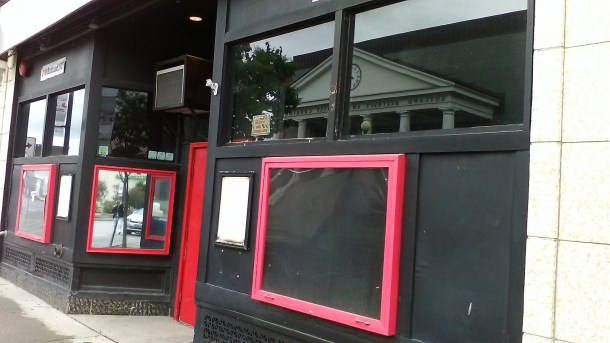
[R]utland — A recent mediation session did not lead to a resolution in the case of a former bar owner suing Rutland City over claims that discriminatory police tactics forced him to close his establishment.
The city, through its attorney, has denied the allegations and now is firing back at the owner of the bar, known as The Local, asking the judge in a motion submitted late last week to throw out the case, contending there is no proof any action by the city led to the bar’s demise.
“The allegation that enhanced police presence was the proximate cause of The Local closing in February 2017, is without merit,” Kaveh Shahi, a Rutland attorney representing the city wrote in the filing.
“An examination of plaintiff’s tax returns shows that the net income of The Local was actually improving as the police attention allegedly increased,” the attorney wrote. “The police interest was data driven and to promote public safety.”
Shahi submitted a motion asking the judge to grant the city summary judgment and toss out the lawsuit, and included along with it a statement of “undisputed” facts in case.
Matt Hart, a Rutland attorney representing the bar’s owner, Charles Greeno III, said Tuesday he was still reviewing Shahi’s filings and would be submitting a written response to the court.
“I will dispute the facts they say are undisputed,” Hart said, “and I will submitted my facts which will show that there was definitely a concerted plan to shut down Mr. Greeno and they would use whatever means is necessary.”
The case has been working its way through the federal court system since it was filed in March 2017, shortly after the nightclub’s owner, Charles Greeno III, closed its doors.
A four-hour mediation session took place late last month with no settlement.
Greeno, according to his lawsuit, is seeking more than $75,000 in damages, while the city wants the judge to dismiss the action and require the former nightclub owner to reimburse the municipality for costs in defending against the claims.
Greeno opened The Local in 2011 and said in the lawsuit filed in March 2017 that all was going well until 2012 when the police department began targeting African-Americans at the bar. Police claimed the patrons were dealing drugs; Greeno alleged in the filing that no drug dealing was taking place.
The city, in its initial response to the lawsuit last year, cited several defenses to the allegations, including the “exercise of policing function for public safety.”
In the latest filing last week, the city points to tax returns it says Greeno produced showing net income from 2011 to 2016.
According to the filing, the documents showed:
- 2011, a $3,112 net profit, with the business only open a couple of months.
- 2012, a $29,066 net loss.
- 2013, a $6,523 net loss.
- 2014, a $3,008 net profit.
- 2015, a $8,841 net profit.
- 2016, a $11,139 net profit.
“These figures show that The Local’s highest net income was in 2015 and 2016, the same years that Mr. Greeno alleges the police presence was escalation,” Shahi wrote in a filing.
Shahi added that Greeno stated in a deposition that he started the business with an estimated $10,000 and signed a five-year lease for $1,900 in a space that had been used by another downtown bar that had closed.
According to the filing, Greeno had no written business plan or prior experience owning a business.
“Mr. Greeno described his decision to open The Local as a ‘gamble,’ noting that ‘I took a big risk, I thought,’” Shahi wrote in a filing.
“Contrary to showing causation for his claim, Mr. Greeno’s evidence proves that police presence was good for The Local. Safer customers make happier customers. The true reason for Mr. Greeno’s decision to close The Local is unknown,” Shahi wrote in his motion to throw out the case.
“The likely reason based on the known information is that Mr. Greeno’s ‘gamble’ did not pay off with an undercapitalized new business in an economically challenged area with a limited pool of customers,” the attorney representing the city wrote. “The Local’ s fate was no different than many other bars in Rutland that have closed.”
The nightclub is described in the lawsuit as a place that plays dance music and “caters to the hip hop culture” featuring DJs from New York and Boston, often attracting African-American patrons from around the area.
However, according to the lawsuit, an ever-increasing police presence outside the establishment, often with cruisers parked with their blue lights flashing, was keeping people away.
In 2015, when Brian Kilcullen became the city’s police chief, Greeno said he expressed his concern to Kilcullen about the alleged tactics of the police department.
“Rutland City Police Chief Brian Kilcullen(’s) response was that it was data driven, he did not see any problems and that he personally has shut down many bars that he didn’t like,” the lawsuit stated.
“In February 2017 as a direct result of the unlawful and discriminatory policing policy being selectively enforced against Mr. Greeno,” Hart wrote in the lawsuit, “Mr. Greeno could no longer financially keep his bar open and he was forced to close The Local suffering significant economic damages.”
Shahi, in his recent filings on the city’s behalf, wrote that Greeno was provided with paperwork regarding thousands of incident reports from the city police connected to The Local.
“Mr. Greeno acknowledged having reviewed 3,700 plus pages of police incident reports produced in discovery to him for the years in question involving The Local but claimed most were unrelated,” Shahi wrote. “By way of example of the type of incident Mr. Greeno considered to be unrelated, an intoxicated female customer was taken from The Local by male customers and raped.”
Decisions from the state Liquor Control Board also had been issued regarding The Local leading up to its demise.
In one instance, which took place outside the bar, a man who had left the nightclub threatened others with a chainsaw. The board called for a 21-day suspension of its liquor license.
“Although we find serious violations here, and there is considerable enforcement history, there appears to be increased efforts with our regulations and cooperation with law enforcement,” that decision read.
Then, only days after the nightclub closed, the Liquor Control Board revoked the liquor licenses for The Local, effective March 1, 2017, and issued a $5,000 fine. According to the board, decision involved others incidents, including, according to the board, fighting inside the bar and the over-serving of an off-duty bartender on her birthday.
Neither Greeno, nor his attorney, took part in the hearing that led the revocation order.
Hart said a big reason why the Liquor Control Board came down so hard on The Local was at the “behest” of the city police as they sought to close down the establishment.
A different owner later attempted to open a new bar in the downtown spot vacated by The Local, but the city Board of Aldermen denied the request for a liquor license.
Hart, when he brought the lawsuit last year, told VTDigger that it appeared the Rutland Police Department “didn’t really learn from the Todd incident. The attorney was referring to a lawsuit brought against the city by former police officer Andrew Todd, who alleged racial discrimination in the department.
Todd eventually settled the case in late 2015 for $975,000.
Hart, who did not represent Todd, has brought other lawsuits against the city recently on behalf of other clients, including two currently pending alleging excessive force by officers. Those cases remain pending, with the city denying the allegations in those as well.
Hart did say Tuesday that the net income figures for The Local cited by the city don’t tell the entire story.
“What had happened is he spent less on advertising one year,” Hart said, adding that gross receipts for the business continued to drop over the years.
As for those 3,700-plus incident reports, Hart said that “not one of them dealt with drugs, not one had anything to do with drugs, not for drug arrests, not for an overdose, not for a sale, not for anything.”
Drug-related crime was the reason cited by the police for labeling The Local a “hot spot” when it came to its data-driven policing, Hart said.
The hottest of the hot spots for crimes, such as retail thefts, drugs and assaults, in the city during that time, he added, was the downtown Rutland Shopping Plaza. That’s where many of the city’s biggest retail stores are located, including Walmart and the Price Chopper supermarket.
“Nobody is trying to shut them down and keep them from selling beer or alcohol,” Hart said of Walmart and Price Chopper. “Cases and cases get sold out of there every day.”
