

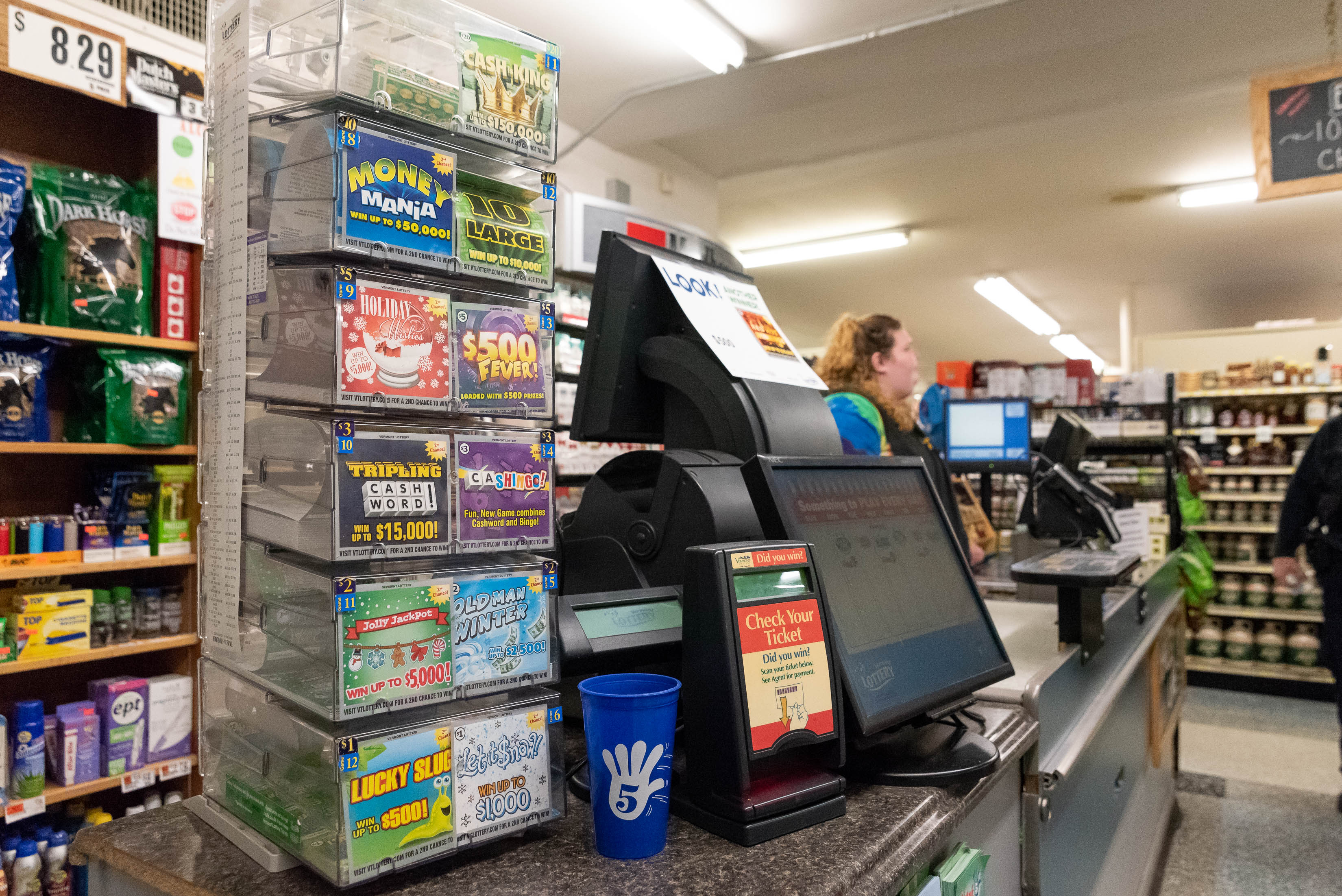
[T]he head of Vermont’s Lottery Commission has issued a report calling for administrative and policy changes following a VTDigger investigation that found that lottery agency owners, employees and their relatives were winning with eyebrow-raising frequency.
In “More than Luck? VTDigger investigates big wins on small games,” reporter Katy Savage found at least 117 retailers, or those close to them, had won a major lottery prize from scratch tickets — defined as $600 or more, the lowest level at which the state keeps track for tax purposes — between 2011 and 2016. Collectively, they won nearly $1.8 million. Employees at 29 convenience stores claimed more than $1.4 million in prizes from stores they worked at, or formerly worked at, or from neighboring outlets.
Two store clerks made more than $200,000 on scratch tickets over that same period, VTDigger reported. Typical individual wins on the Pick 3/Pick 4 games are a few hundred dollars.
In late April, Gov. Phil Scott asked Daniel Rachek, the lottery’s executive director, to “verify and confirm the integrity of our Lottery is intact,” setting a deadline for a report by the end of May.
Most of Rachek’s report, sent to VTDigger Monday afternoon, is a description of the processes and security protocols used by the lottery and its partners, and a person-by-person review of the big winners highlighted in the article.
This includes data analysis and follow-up interviews the director conducted with those individuals, as well as statistical experts who were quoted in the initial article. Rachek, a forensic accountant and the former head of the Vermont FBI, reports no wrongdoing, and concludes without exception that their winnings are plausible. A law enforcement investigation has not been undertaken.
“The assessment shows that the Vermont Lottery utilizes industry standard security measures for both instant and online tickets,” Rachek wrote in an email summarizing the report. “There was no evidence found indicating a lack of compliance with state statutes by agents or employees.”
When it comes to the crux of the story — that store owners, ticket sellers and their relatives seem to be winning at inexplicably high rates across the board — the report does not attempt a statistical analysis or response.
Rachek’s report offers a breakdown of total winnings by “lottery agents” from 2011 to 2017, the same period scrutinized by VTDigger. Agent wins are tracked through a self-reporting process (under penalties of perjury) for store owners or clerks who claim prizes of $500 or more.
According to Rachek’s report, lottery agents received 2.33 percent of total winning claims and 6.48 percent of all monetary winnings during that period, including a million-dollar Powerball winner. Agents also accounted for 6.25 percent of the 880 individuals who won at least $7,500 and had more than one win during this period.
“There are two unknowns to consider when deciding if 6.48 percent is too large of a percentage for agent wins: how many agents/employees and family members play and how much do they spend,” the report says.
The report, however, doesn’t answer that question. The Vermont Lottery Commission doesn’t track the number of employees, store owners and their relatives who buy tickets, nor does it keep tabs on total amounts spent.
The analysis is in line with the response of Rachek and other senior lottery officials when presented with VTDigger’s findings earlier this year: people who play often win often, and the individual winnings are not surprising when compared to total lottery payout.
Yet the last page of the 27-page report is dedicated to a series of recommended reforms.

The report says the commission will “explore and implement” closer review of lottery agents and employees who win multiple times or above a certain amount, and review “all top prizes won by everyone greater than $25,000.”
The report does not recommend preventing owners and employees from playing the lottery at their stores, as at least three states do, but instead calls for the endorsement of a “no play on duty” policy, which would involve lottery representatives training retailers on the pitfalls of agents playing the tickets they are selling.
At least one vendor in Vermont was prosecuted for fraudulently inflating bottle redemption slips while on duty and using the excess cash to purchase lottery tickets.
In other states, cashiers have been found to be stealing money from winners by checking their ticket and telling winners they lost and taking the winnings, or underrepresenting winnings and keeping the difference. Rachek’s report, and the initial VTDigger investigation, note that there is no evidence that this method has been deployed at lottery agencies in Vermont.
However, Rachek does suggest changes to prevent this type of scam from happening in the future. He writes that the lottery will look into contracting vendors to provide a smartphone app that will “permit players to privately check the winning/losing status of their own tickets.”
Scott said last week that he was impressed with Rachek’s initial review. “The commissioner did a great job with the review, and we’ll look forward to the findings,” Scott said.
Asked to comment on the full report, his spokeswoman, Rebecca Kelley, said the governor’s office “will be closely reviewing and considering next steps regarding Director Rachek’s recommendations for further strengthening security and other protocols so we can continue to ensure the integrity of the Vermont lottery.”
Vermont’s Legislature is nearing final passage of a bill combining the liquor and lottery commissions. It includes an amendment calling for the commissioner of the merged agency to conduct another investigation into the winnings of store owners, employees and relatives.
Scott has said he believes that a separate review is unnecessary. However Senate President Pro Tem Tim Ashe, D/P-Chittenden, who proposed the investigation amendment, said last month that it was important to have someone who hasn’t been working for the lottery look into it.
“It will be a fresh set of eyes and ears on the integrity of this system, rather than the incumbents,” Ashe said.
TJ Donovan, the Vermont Attorney General, has not said whether his office will investigate the Vermont Lottery.

