Editor’s note: This story is by Matt Hongoltz-Hetling first appeared in the Valley News.
WOODSTOCK — Hundreds of foresters and loggers from around the state descended on the Woodstock Union High School auditorium on Wednesday to learn more about the ongoing war between humans and harmful forest pests.
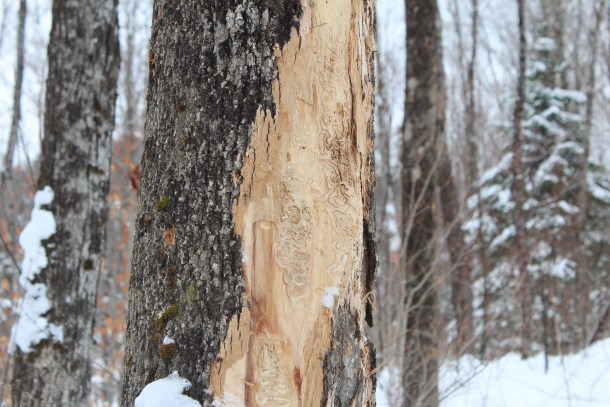
In some cases — like the emerald ash borer, an invasive insect that was documented in Vermont for the first time in February — scientists still are working to define the battlefront.
At the Vermont Forest Health Information conference, which featured a half-dozen presentations delivered from the auditorium podium, attendees learned that state and federal workers still are checking out possible reports to see whether more towns will be added to a list of emerald ash borer-infested areas that currently consists of Groton in Caledonia County; Barre and Plainfield, in Washington County; and Orange in Orange County.

Of all the invasive and native bugs that have the potential to ruin the economic and ecological value of Vermont’s forests, the emerald ash borer was foremost on the mind of consulting foresters such as Ryan Kilborn, of Washington.
“That’s the new kid on the block,” Kilborn said. “It’s setting up to be really bad. … Now that it’s here, it’s made people wake up and know something’s going to be occurring.”
“The writing’s on the wall,” said Ben Rubinfeld, 33, a logger from Bradford. He said local landowners are starting to worry about how to manage ash trees, given the borer’s sudden appearance.
“We’re from Orange County, and that’s where it’s been found,” Rubinfeld said. He said he came to the conference seeking answers that he could pass along to the public.
“There’s going to be legal issues in terms of moving the wood, and quarantines and stuff like that,” he said. “I’m hoping to get a feel for that and be able to give better information to landowners about their options.”
The battle against other forest pests have been raging for years, with state and federal officials pouring time and money into an infrastructure that supports monitoring, research and public education efforts.
Measuring the actual impact of all that activity fell to presenter Barbara Schultz, the forest health program manager for the Vermont Department of Forests, Parks and Recreation, who weighed in on a rogues’ gallery of established tree-eating pests.
There are some positive signs for forest health. For example, spruce budworm, a scourge of the mid-1980s and in the year 2000, still seems to be absent, based on the low number of budworm moths caught in traps. And Schultz said a series of aerial surveys of defoliation rates for various threatened tree species seemed to show that Vermont still is benefiting from extreme cold snaps that keep cold-sensitive insects like the balsam woolly adelgid at bay.
“Right at the moment, it looks like our winters are doing a good job,” Schultz said, noting that, for the balsam woolly adelgid, “the mortality rate was really high, which is promising.”

Because of that, a yearslong acceleration in the rate of decline in balsam trees seems to have leveled off this year, Schultz said.
Schultz said the department has deployed a biological weapon against the related hemlock woolly adelgid.
“We have introduced this beetle, laricobius nigrinus, into Vermont and we did what we call an enhancement of release this December as well,” Schultz said. “These are winter predators. … The beetles go right to work. You put them out and they go looking for hemlock woolly adelgid right away.”
An early warm spring last year put a lot of sugar maple pollen into the atmosphere, which was good news for pear thrips, a widespread invasive species that’s been eating the leaves of Vermont’s sugar maples for a century.
Overall, sugar maples — which also are susceptible to onslaughts from maple webworm, maple leafcutter, maple trumpet skeletonize and the newly observed orange humped mapleworm — seem to be having a tough year, Schultz said, displaying a slide showing that the percentage of trees with thin foliage has been climbing for the past few years, to a new high of about 15 percent in 2017.
“We monitor maple throughout the state,” Schultz said. “We’ve been doing it since 1988. We saw a dip in tree health and an increase in the amount of dieback, probably associated with those drought conditions.”
In the Upper Valley, Schultz said, sugar maples had a really unusual year, for reasons that stem back to drought conditions during the summer of 2016.
“(In) this area of the state … we’re in right now, the mid-Connecticut River Valley, there was an unusual condition where the trees had brand new dieback, (that) hadn’t been seen the year before,” she said. “The buds didn’t come out, probably because of the dry conditions. But … what buds did come out, came out beautifully because of all that moisture in May. … The buds that survived, the leaves grew very well, which is an odd combination to have.”
During a break between sessions, some of the loggers in attendance, such as Rubinfeld and fellow Bradford logger Will Lehning, 24, said the conference was just one more sign that stereotypes of animus between loggers and environmentalists are getting dated.
“Good loggers get to go back to the woodlots that they’ve tended,” Rubinfeld said. “That’s kind of a thing. You want to go back to a post that you’ve logged before and have something to work with. I think that’s a good feeling, and that’s what we’re headed for, I think.”
Rubinfeld and Lehning both graduated from the forestry program of Paul Smith’s College, but came to the conference to gain credits and maintain certification for the professional distinctions offered by groups such as Logger Education to Advance Professionalism.
“Vermont’s a little different,” Lehning said. “There’s a lot of hands-on property owners. If you go to cities and more suburban states, there’s more of a disconnect between a landowner and a logger. But here, we all want the same thing. At the end of the day, we want healthy forests.”