

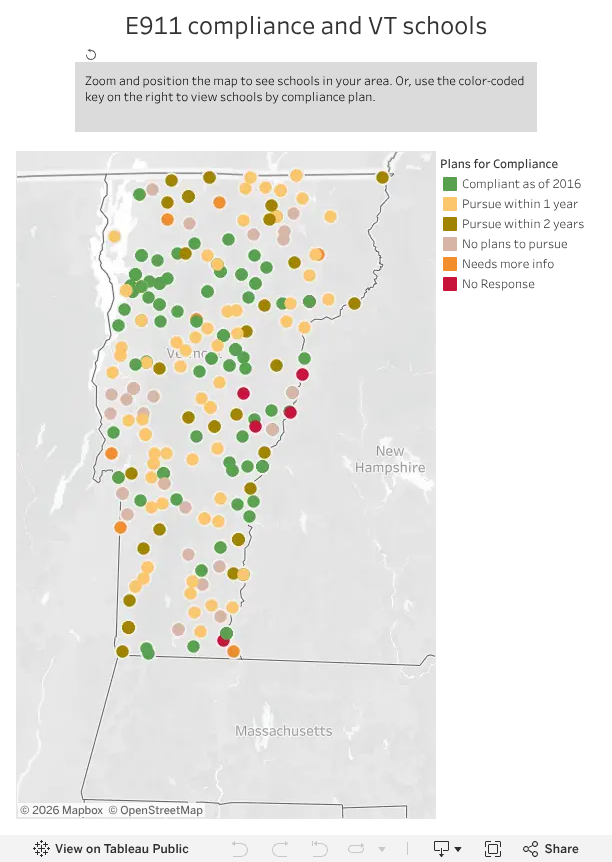
[O]nly about a third of Vermont schools have installed E911 systems that automatically gives first responders information about the location of a caller inside a building.
About 100 schools, out of a total of 300, now have the technology in place.
While all schools have 911 calling capability, which enables school personnel to reach emergency services by phone, most do not have E911 technology.
Barbara Neal, the director of the E911 board, says all schools have “demonstrated the ability to send the correct street address/town name for their facility” through 911.
“The issue of compliance with 911 location requirements is a separate issue from access to the statewide system,” Neal said.
Two-thirds of schools, however, don’t have the capability of providing first responders with “more granular requirements of unique phone number and specific location (floor, room number) within the school.”
Neal said more specific information is critical in situations when a caller is “unable to speak as it provides responders with a specific location of the emergency.”
The E911 board, a state organization that manages emergency call systems, has been authorized to provide matching grants to schools for the technology since 2016.
This year, $225,000 will be made available to schools. The average matching grant is $5,400, according to Neal.
Meanwhile, lawmakers and the Scott administration are bringing more scrutiny to bear on school safety measures in the wake of a shooting in Parkland, Florida, in February and a thwarted alleged plan to shoot up Fair Haven Union School.
In response to concerns about school safety, Gov. Phil Scott has authorized $5 million in grants for a variety of safety measures, including E911, security cameras and basic security improvements to school buildings.
Rebecca Kelley, the spokesperson for Scott, says the governor has been concerned about increasing the number of schools with E911 “since his time as lieutenant governor.”
Under the grant program, which includes $1 million in matching funds from the federal government, schools will be able to identify their individual safety needs and apply for this funding, which could include bringing the school into E911 compliance.
Schools have been slow to adopt E911, largely because of a lack of funding, according to the former Agency of Education secretary, Rebecca Holcombe. “It’s obvious we’d encourage every school to have E911,” she said, and she praised schools for making “great strides over the past few years.”
Since the incident at Fair Haven, “people are taking school safety very seriously and are being extra vigilant,” Holcombe said.
At the current rate of spending on E-911, it will be at least several years before all schools in Vermont are compliant. Grants range from $2,000 to $25,000 per school, depending on whether the school needs to upgrade existing systems or start from scratch.
Neal says she is “comfortable” with the amount of money that has been made available to schools this year.
“We will assess where we are once these funds are expended and work on an appropriate amount going forward,” Neal said. “Steady progress is what we want to see.”
Editor’s note: The data that appears with this story, in both the database and the map, was from most recent available from a survey conducted by the Agency of Education in June 2017. Readers should check with local school officials to understand the current status of local schools.
