

[W]ASHINGTON — Under tough questioning from Sen. Patrick Leahy, D-Vt., the CEO of Facebook confirmed that company officials have had contact with investigators led by special counsel Robert Mueller.
CEO Mark Zuckerberg said a company official has been interviewed as part of the probe into Russian interference in the 2016 election. He initially told Leahy that subpoenas had been issued; Zuckerberg quickly walked back that statement.
“I actually am not aware of a subpoena,” Zuckerberg said. “I believe that there may be, but I know that we’re working with them.”
“I want to be careful here because that — our work with the special counsel is confidential, and I want to make sure in an open session I’m not revealing something that’s confidential,” he said.
Earlier this year, Mueller secured an indictment of Russian operatives who used the social media platform to influence the 2016 presidential election. At the hearing, Zuckerberg confirmed news reports that the special counsel had interviewed an official at Facebook.
The admission came as Leahy, a member of the Judiciary Committee, grilled Zuckerberg during a five-hour hearing Tuesday afternoon at a joint meeting of the Senate Judiciary and Commerce, Science and Transportation committees.
Senators also interrogated Zuckerberg about the company’s handling of personal data and publication of Russian ads and fake news.
In an opening statement to the panel, Zuckerberg portrayed Facebook as an “idealistic and optimistic company,” focused on the positive aspects of connecting people.
“It’s clear now that we didn’t do enough to prevent these tools from being used for harm as well,” he said.
“We didn’t take a broad enough view of our responsibility and that was a big mistake, and it was my mistake, and I’m sorry,” he said.

It was Zuckerberg’s first appearance in Congress, after months of criticism of Facebook, which was used as a platform for propaganda and disinformation by the Internet Research Agency, a fake news factory in St. Petersburg, Russia, during the 2016 election cycle.
The hearing came just weeks after revelations that Cambridge Analytica used data collected through a Facebook quiz to influence voters. Facebook has said the data of 87 million users was compromised.
At the conclusion of the hearing, Leahy, a member of the Judiciary Committee, said he sees a need for Congress to take action to improve online protections.
Zuckerberg will appear before the House Energy and Commerce Committee on Wednesday, where Rep. Peter Welch, D-Vt., will get a chance to question him.
Zuckerberg’s presence generated buzz in the Capitol. People queued up in hallways outside for hours. The crowd stretched the length of the hallway and snaked down a staircase into an adjacent, connected office building.
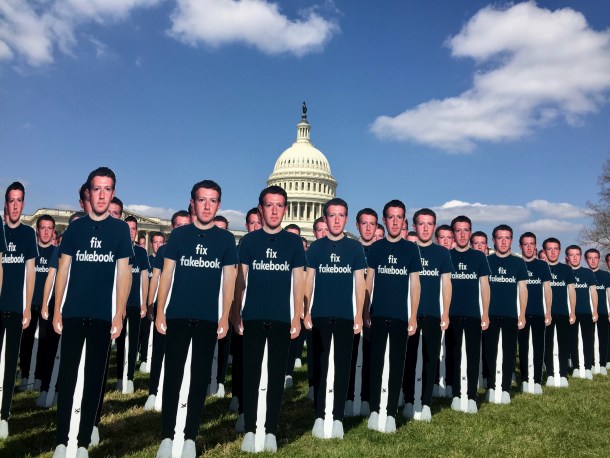
Demonstrators installed an army of 100 cardboard likenesses of Zuckerberg on the Capitol lawn and called on Facebook to stem the spread of fake news on social media.
During the hearing, Leahy grilled Zuckerberg on a statement Facebook’s general counsel made during an appearance before the committee last year about the suspension of Russian-linked accounts. An aide displayed a poster board of inflammatory images behind him, which Leahy said had been linked to Russian-backed pages. Those images were on Facebook today, he said.
Leahy also pressed Zuckerberg about the role Facebook has played in Myanmar. Material shared over Facebook is believed to have fueled the Rohingya crisis.
“Senator, what’s happening in Myanmar is a terrible tragedy and we need to do more,” Zuckerberg began.
“We all agree with that,” Leahy said, cutting him off. “But UN investigators have blamed you, blamed Facebook for playing a role in the genocide. We all agree it’s terrible. How can you dedicate and will you dedicate the resources to make sure such hate speech is taken down within 24 hours?”
Several senators asked Zuckerberg whether he would support implementing federal regulations on user data.
“Here’s the questions that all of us got to answer: What do we tell our constituents, given what’s happened here, why we should let you self-regulate?” Sen. Lindsey Graham, R-S.C., said.
When Graham asked whether Zuckerberg would embrace regulation, the Facebook chief responded: “I think the real question as the internet becomes more important in people’s lives, is what is the right regulation, not whether there should be.”
Some, including Sen. Richard Blumenthal, D-Conn., cast doubt on the steps Zuckerberg said the company would take.
“Unless there are specific rules and requirements enforced by an outside agency, I have no assurance that these kinds of vague commitments are going to produce action,” Blumenthal said.
However, Sen. Thom Tillis, R-N.C., cautioned against creating too much government regulation. Tillis suggested tech companies should develop their own industry standards.
In an interview Tuesday afternoon, Leahy downplayed Zuckerberg’s attempt to portray Facebook as a college novelty project that he started in 2004 from his Harvard University dorm room. Since then, the company has become a powerful international platform, Leahy said.
“It also has become a multi-, multi-billion dollar industry, and they have to show some responsibility for people’s privacy,” Leahy said.
Leahy said he hopes the attention on Facebook and Zuckerberg will increase support in Congress for a consumer protection bill he introduced last year, which would require companies to protect customer data and disclose security breaches.
He said he’d be interested in looking at crafting policies regulating social media companies. The European Union adopted new privacy laws earlier this year.
“Here they’ve let privacy and security take a back seat,” Leahy said.

