


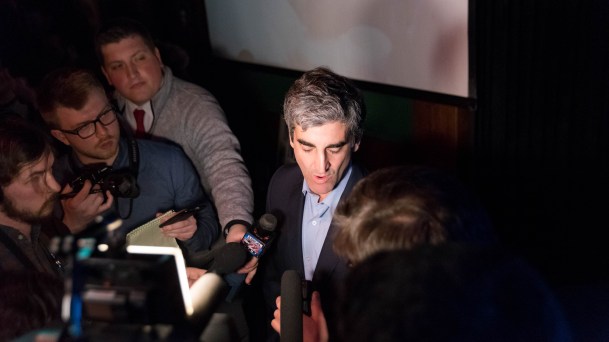
[B]URLINGTON — In his State of the City address, Mayor Miro Weinberger, who won re-election to his third term in office last month, outlined how he plans to lead Burlington through challenges the city faces over the next few years.
Chief among those challenges? The opioid crisis, which continues to steal the lives of residents here. Weinberger devoted a large portion of his speech to the issue, which he described as a national scourge that kills more Americans every year than the number of soldiers who died in the Vietnam War.
“Nowhere is our work more urgent and nowhere is there more at stake than in our efforts to turn the tide of the opioid crisis,” Weinberger said, citing the deaths of 13 Chittenden County residents from overdoses from powerful narcotics in the past eight months.
In his speech to well wishers and politicos at Contois Auditorium, Weinberger spoke at length about a South Burlington graduate whose drug addiction and mental health issues spiraled out of control, and ultimately claimed his life at the age of 27 last August.
Sean Blake was the son of a doctor at UVM Medical Center and a professor at St. Michael’s College. Weinberger described how Black suffered from bipolar disorder and addiction. He ended up in prison at Rikers Island where he received treatment and began to overcome his mental and substance abuse problems. Blake returned to Vermont where he eventually stopped taking medications and wound up in prison here. This time he received no treatment and a month after he was released, Blake overdosed and died.
Weinberger used Blake’s case as a prime example of how the city and the state are not doing enough to ensure that opiate addicts are getting the help they need — in prison and at clinics in the area.
Vermont prisons offer limited drug treatment and the mayor urged lawmakers to pass S.166, which would require the expansion of medication assisted care for inmates.
In Chittenden County, patients wait an average of 17 days for methadone and buprenorphine, the mayor said, and in the meantime, they use drugs to stave off withdrawal, running the risk of overdose.
“We should take advantage of every opportunity,” he said, “rather than telling them to wait until Monday, or to wait until next week, or the week after that, knowing that to stave off withdrawal, that patient will likely use illicit drugs multiple times.”
In Connecticut, doctors have found that overdose patients treated with buprenorphine “right in the emergency room” have twice the rate of success as patients who have to wait for the opioid treatment drug.
Burlington must dramatically increase access to treatment, he said, and create a system where a health professional prescribes methadone or buprenorphine to opioid addicted patients “at the time patients are ready to accept treatment.”
Weinberger said the city will partner with UVM Medical Center and the Howard Center to improve “rapid access to medication in order to start effective care at the right place and at the right moment to save lives.”
‘A more just future’
The mayor also delivered his overall vision for the future of the city, against the backdrop of his accomplishments over the past six years. Weinberger has worked with the Burlington City Council to put the state’s largest municipality and an economic engine for the state of Vermont on better financial footing.
Thanks to Weinberger’s fiscally conservative approach, the city has restored the city’s high credit rating and wiped out a $17 million debt owed for the expansion of Burlington Telecom under Progressive mayor Bob Kiss. The mayor’s administration has also invested in improvements to streets, sidewalks, parks and water lines, added three miles to the bike path and broke ground this year on City Place Burlington, a large residential, retail and office complex on Church Street, the city’s signature outdoor shopping mecca.
“Fiscal responsibility is the foundation on which all of our successes, ambitious projects, and vision for the future are built,” Weinberger said.
Over the next few years, Weinberger says he wants to create more equitable opportunities for housing, employment and education for low-income residents; address climate change by transitioning to a net zero energy city; and strengthen the relationships between neighborhoods and city government.
In a reference to his rivals in the last election, Infinite Culcleasure, a civil rights activist, and Carina Driscoll, the stepdaughter of progressive Sen. Bernie Sanders, Weinberger acknowledged that he needs to do more to address economic inequities that are “driving low- and middle-income households out of Burlington.”
“The events of last year, including the elections here on Town Meeting Day … have made plain that our community’s work towards a more just future is not done,” he said.
Weinberger said the city will set new equity goals and track data on the performance of each department in relationship to those objectives. A new equity report will be issued as part of the annual report submitted to voters for Town Meeting Day.
The mayor said he would also present a three-prong plan to increase community engagement. As part of the initiative, Weinberger said the city would implement a “Language Access Plan” to address language barriers that impact the city’s ability to deliver services to new Americans.
He also said he and the City Council would discuss a new public engagement guide and look into the role of the Neighborhood Planning Assemblies, which are made up of representatives from each neighborhood. The assemblies began in the 1980s and then fell dormant for decades. They were reintroduced after Memorial Auditorium closed last year.
“We excel at public engagement as a community in many ways — and we can do even better,” Weinberger said, “These initiatives will make our community more equitable, sustainable and welcoming.”
After the speech, the council elected Kurt Wright, R-Ward 4, as City Council president.
Gov. Phil Scott made an unprecedented appearance at the address. Wright, who has been on City Council for 12 years, said he had never seen a governor attend the State of the City address before.
After the meeting, Scott said he was there to show his support for the cities and to watch Wright — who is also a state representative and the only Republican on the council — be sworn in as City Council president. Wright previously served as City Council president from 2007 to 2009.
Vermont Attorney General TJ Donovan swore the mayor in. Vermont Senate President Pro Tem Tim Ashe, D/P-Burlington, other lawmakers, and former mayors Peter Clavelle and Frank Cain were also in attendance.
