

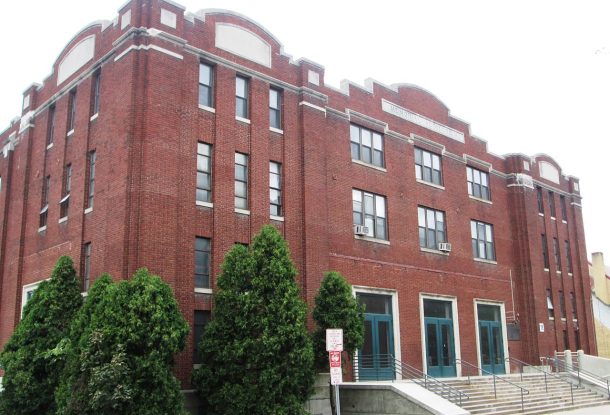
The neighborhood planning assemblies are forums where residents provide feedback to city officials. They’re organized by ward and elect a steering committee to guide their work. At Wednesday’s meeting of all the assemblies, steering committee members discussed what the future holds for Memorial Auditorium and what role the assemblies, known as NPAs, might play in making that decision.
“How we handle Memorial Auditorium will show how much muscle NPAs can flex,” said Jim Holway, a member of the ward 4 and 7 steering committee.
The auditorium was built in 1928 as a memorial to war veterans. More recently its tenants included the teen entertainment venue 242 Main and Burlington City Arts. In 2016 structural problems resulting from deferred maintenance forced those tenants from the building.
Burlington had prepared a request for development proposals for the auditorium and adjacent lots known collectively as the Gateway Block. Last year when the University of Vermont announced it would explore the possibility of an off-campus arena, the request was pulled so the mayor could attempt to woo the university into building its stadium on the Gateway Block.
In February UVM announced it would keep its stadium on campus.
Noelle MacKay, director of the city’s Community and Economic Development Office, said there would be another request for proposals, but not until fall at the earliest. “We just don’t have the staff to run a public engagement process and follow up quickly with requests for proposals,” she said.
She said there are site constraints, as well as infrastructure concerns involving Burlington Telecom, electrical transformers and stormwater upgrades that must be taken into consideration.
But the neighborhood assemblies have nonetheless taken matters into their own hands and are beginning their own community engagement process aimed at deciding what will happen at the property.
“Every NPA in the city has affirmed the plan to try and have a community discussion arranged by the NPAs about what should happen to Memorial Auditorium,” said Martha Molpus, a member of the steering committee for wards 4 and 7.
Charles Simpson, of the Ward 6 steering committee, has taken the lead in gathering public input on the future of the space. Simpson is active with the advocacy group Coalition for a Livable City, which has sparred with the mayor and City Council over development issues. He lost his bid for the Southern District council seat in March.
Simpson outlined a process Wednesday that would include collecting data on the demand for civic space in the Queen City and exploring potential users of Memorial Auditorium.
“We’re opening a window onto this conversation,” he said. “It will be work, but the gain is enormous. To maintain this facility as a civic space into the next century.”
At the meeting’s close, attendees said the next steps would be reaching out to residents and assembly members to begin scheduling public meetings.
Phet Keomanyvanh, community development specialist for the city development office, who facilitates all the wards’ NPA meetings, echoed MacKay’s stance.
“We’re at full capacity,” she said. “We can’t change what happened in the past, but we can go forward and assure there will be a public process.”
