


A Senate committee is pushing for a new tax on prescription opioids, the proceeds of which could serve as a financial weapon in the state’s fight against substance abuse and addiction.
The Senate Health and Welfare Committee introduced the idea Friday after discussing addiction-treatment funding needs. Though many details have yet to be worked out, lawmakers — including Senate President Pro Tem Tim Ashe — believe the proposal could get through the Legislature before the end of this session.
Preliminary estimates say the tax could pump millions of dollars into treatment and recovery programs.
“It’s a really logical way to fund it, and it doesn’t take money from other programs that need it already,” said Sen. Claire Ayer, D-Addison and the committee’s chair. “So we’ll see what happens.”
If the measure passes the Legislature, it might run into opposition from Gov. Phil Scott, who has stood firm behind his pledge to impose no new taxes. But Human Services Secretary Al Gobeille did not immediately rule out the opioid proposal.

“Just because it includes (taxes or fees) does not mean we should not consider it,” Gobeille said Friday afternoon. “It’s worth having the debate.”
Gobeille said the key question was whether such a tax would be effective. He said other questions, like where in the supply chain the tax would be imposed, also needed to be explored, and that he did not know enough about the proposal to comment further.
The state has been investing in multiple programs to combat the opioid epidemic including the “hub and spoke” method of medication-assisted addiction treatment. An effort is underway to expand medication-assisted treatment for prisoners.
Vermont also distributes thousands of free doses of the overdose drug naloxone every year. And officials have imposed new limits on painkiller prescriptions.
But overdose reports continue to bear bad news: While a recent state assessment showed that the growth of opioid-related deaths is slowing, deaths involving fentanyl increased sharply.
On Friday, Ayer’s committee heard pleas for more funding from those who oversee addiction-related programs.
Sarah Munro, who leads a statewide coalition of 12 recovery centers called Vermont Recovery Network, said those centers collectively need another $720,000 to provide supervision for recovery coaches as well as additional money for operations.
“That’s our biggest wish right now, is that the centers get the funding they need,” Munro said. “They’re underfunded. They’ve been underfunded for a long time.”
Bob Bick, chief executive officer of the Burlington-based Howard Center, raised a financial alarm for medication-assisted treatment: In the past four years, he said, the center has lost more than $1 million operating the state’s “hub” in Chittenden County.
Bick discussed several other initiatives that need support including the Howard Center’s Safe Recovery intervention program, which has cut its staff from seven to 2.5 full-time equivalents due to decreasing federal funding.
“There clearly is a continuum of resources that are necessary in order to address the substance-use disorder issues that plague Vermont currently,” Bick said.
That discussion led to Ayer’s proposal for a opioid tax. She said she idea came from an article in Governing magazine detailing other states’ efforts to impose such a tax.
In a later interview, Ashe said the concept may make sense when considering the fact that highly addictive prescription drugs have “led to tremendous struggle for many people in the state.”
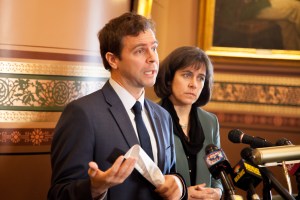
The question, Ashe said, is “should those who have manufactured these drugs … be the ones perhaps who absorb some of the costs for this?”
But the tax idea is not yet fully formed, and there is no clear precedent for it.
Nolan Langweil, a senior analyst in the Joint Fiscal Office, told the Health and Welfare Committee that no other state has passed the kind of opioid tax senators are considering — though several state legislatures have considered it.
There have been proposals to impose a tax per dose or per milligram, or a tax on gross receipts of opioids. Vermont’s proposal is different because senators are discussing a tax on “morphine milligram equivalents,” which is a measurement that gauges a drug’s potency relative to morphine.
Based on a tax of one penny per morphine milligram equivalent, Langweil estimated that Vermont could reap $3 million per year. But that doesn’t include administrative costs and doesn’t make allowances for possible non-payment.
Langweil also cautioned that his research shows prescription opioid distribution declining in Vermont.
“If you were to tax it based on (morphine milligram equivalents), expect that it’s likely to be like a cigarette tax,” he said. “If you’re successful, your tax should be decreasing over time.”
That didn’t dampen the enthusiasm of Ayer and Ashe, who said the tax might be imposed somewhere high in the supply chain — possibly in the initial sale from manufacturer to wholesaler.
The idea is “to have it as far removed from the consumer as possible,” Ashe said. “The farther removed, the less likely it is that they will push the cost on Vermont consumers.”
While it’s relatively late in the session to take up the idea of a new tax — lawmakers generally go home in early to mid-May — there appears to be a possible path forward for the opioid levy.
Ayer said her committee would make a request for the Senate Finance Committee to consider the matter. Sitting a few seats away was Sen. Ann Cummings, D-Washington and chair of the Finance Committee.
“I think you could assume that Finance has heard your request,” Cummings said, adding that the opioid tax language could be inserted as an amendment into a House bill that already had made its way to her committee.
Ayer summed up the process as, “pass it through the Senate, pass it back to the House. And in the interim, we do a lot of homework.”
Ashe, who in his leadership position influences the Senate’s agenda, said it’s not too late for the tax to move through the legislative body.
“There are any number of policy issues that are still being generated or fleshed out,” Ashe said. “This is one discrete concept and in that sense lends itself to being able to work through the legislative process.”
Asked about the governor’s opposition to new taxes, Ayer said she’s seeking a source of annual funding to help deal with a “very difficult situation.”
“The way that the governor has managed the budget is to take out of one pocket and put it in the other,” Ayer said. “I was looking for something that would be a new source.”
