


Editor’s note: Mark Bushnell is a Vermont journalist and historian. He is the author of “Hidden History of Vermont” and “It Happened in Vermont.”
[F]or Zadock Thompson, few moments could have competed with that summer day in 1849 when he visited a construction site in Charlotte to examine a strange discovery laborers had made. As the state naturalist, Thompson had worked to catalog the multitudinous species that inhabited Vermont. But this was something else entirely.
When workers digging the bed for a railroad line unearthed some large bones, they thought the skeleton might be that of a horse. But an overseer wasn’t so sure. He had the foresight to ask Thompson to take a look.
Thompson’s task was difficult. The workers had smashed the creature’s skull and carted off the pieces with loads of dirt before he was called. But by sifting through the dirt and carefully matching up the pieces, he was able to reassemble the skull.
The rest of the skeleton was largely intact. “A number of vertebrae were found, extending in a line obliquely into the bank and apparently arranged in the order in which they existed in the living animal,” he wrote. From end to end, the animal must have been about 10 feet long.
What Thompson was examining, he soon determined, was a large marine creature, a whale, actually. Once he had reconstructed the skeleton, Thompson traveled with it to Harvard College in Cambridge, Massachusetts. The trip offered him the opportunity both to confirm his identification of the whale as being a type of beluga and to work with some of the world’s leading natural scientists.
To some people, it must have seemed that Thompson had no more business being in Charlotte that day in 1849 than the whale itself did. As a child, it seemed more likely he would end up a poor farmer, like his father. But an odd mix of circumstance and Thompson’s thirst for knowledge combined to make him the state’s leading naturalist and historian. He was also a geologist, geographer, educator and editor.
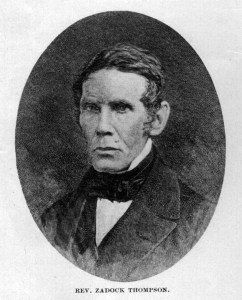
By his death in 1856, Thompson had laid out, as never before, pretty much everything that was known about the state of Vermont. It’s all there in his crowning achievement, “Natural, Civil and Statistical History of Vermont.” The three-volume book contains detailed descriptions of the state’s known animal and plant species, histories of each of the state’s cities and towns, and a panoply of statistics, including the annual mean temperature and weather for Newbury, the water levels in Burlington and the dates when he first saw various birds arrive and buds bloom each spring. The breadth of Thompson’s passions and knowledge is stunning by today’s standards, where we honor experts for knowing more and more about less and less.
Thompson was a polymath, a human encyclopedia of all things Vermont. Such broad knowledge was expected of learned men in his day. Scholars in the 19th century thought they could get a good grasp on how the world worked – the entire world, that is – if they just applied themselves.
Thompson was living proof. He was born with no natural advantages. In fact, he faced serious obstacles. First off, he was born in 1796 in Vermont, which at the time was not exactly a hotbed of scientific inquiry. As late as 1840, he explained during a lecture, “a respectable library for the use of a naturalist could not be culled from all the public and private libraries and all the bookstores in the state.”
He had been born into a poor farming family in the small town of Bridgewater, and was probably expected to take up farming, too. During his childhood, the demands of the farm meant he seldom attended school regularly.
That changed in 1808 when he was out cutting wood during maple sugaring season. Thompson got careless and slashed his foot with an axe. The wound bled so badly he almost died. But instead of killing him, the wound gave his life new meaning. During his long recovery, Thompson took to bed, and to books.
His brother Salmon hinted at the family’s opinion of Zadock’s intellectual calling. “He gave early evidence that he liked to read better than to work,” Salmon recalled.
As a young man, Thompson decided he’d attend the University of Vermont and that he would write a comprehensive history of the state, covering both the human and nature worlds. To pay for tuition at UVM, which then charged the princely sum of $69.25 for three years, Thompson wrote pamphlets in the style of Benjamin Franklin’s Poor Richard’s Almanac. Thompson’s included astronomical data, weather predictions, treatments for consumption, a list of historical events and holidays, and lectures on the evils of liquor (he would later become an Episcopalian deacon). Thompson borrowed money to print his booklets, got his sisters to sew the spines together, and sold them by traveling from town to town.
Thompson’s almanacs drew a loyal following because of his weather forecasts. Once, while producing an almanac, a clerk noticed that the forecast for July was missing. “Say, snow about that time,” Thompson supposedly responded, either jokingly or peevishly. When snow fell that July, readers must have thought he was psychic.
The year after graduating from UVM, Thompson began to make his mark. He published his Gazetteer of Vermont. He also married his childhood sweetheart, Phebe Boyd, who would be his assistant throughout his life and would continue his work after his death.
“(When) this work was commenced,” he wrote later, “we were aware that the accomplishment of our design would be attended with much labor and difficulty.”
In 312 pages, he offered readers descriptions and histories of every town, river and lake in Vermont and a brief catalog of the state’s plants, minerals and animals. To complete the town histories, Thompson relied heavily on contributors. He wrote to local postmasters, asking them to enlist anyone interested in helping draft their town’s history. Thompson wrote more than 100 of the histories himself, choosing towns he knew well or that no one else would cover.
His historical work coincided with a national fixation. For the first time, Americans were getting interested in their past. The veterans of the American Revolution were dead or dying and their children and grandchildren were getting nostalgic. Though he cribbed much of his history of the state’s early days from published works, his account of life during the early 1800s was original and forms the backbone of what we know today.
Despite Thompson’s efforts, his career seems to have foundered. He took a stab at publishing, refocusing “The Iris and Burlington Literary Magazine” and “The Repository,” another literary magazine, toward his interest in natural history. The change was fatal to both. Thompson’s essays, such as “A Brief History of the Tea Plant,” failed to capture the public’s imagination, or enough subscribers. Around this time, he and Phebe founded the Burlington High School for Young Ladies, which they operated out of their home. That, too, soon folded.
Hoping for better opportunities, the couple moved their family to Canada, where Thompson taught high school. But four years later, they returned to Vermont, with Thompson planning to write his magnum opus. Using his “Gazetteer of Vermont” as a framework, he would write an all-encompassing “Natural, Civil and Statistical History of Vermont.”
Today we would say he was self actualizing. Here was a man who wanted to know it all, getting the chance to write down what he knew. Thompson dedicated his life, and his home, to the task. A visitor to the Thompsons’ small white cottage, located near the UVM green, recalled its having beautiful gardens and “pens, cages and tubs in which were kept many living animals, whose daily life was under closest scrutiny.” Seemingly every shelf and in every drawer was lined with mineral and plant specimens waiting to be studied.
Thompson’s comprehensive history, which he published in 1842, contained 656 pages of what was the most up-to-date information known about Vermont. But the book also showed how Vermont was changing. In it, Thompson remarked at rarely seeing passenger pigeons, catamounts, bald eagles, lynx or wolves anymore. Their disappearance, caused by wasteful hunting and bounties paid for killing “nuisance species,” saddened him.
It all seemed so shortsighted. “We have even paid a bounty for the destruction of crows,” he wrote, “while in consequence of that destruction our fields were suffering from the ravages of grubs, which the crows are designed to check.”
Ironically, while change was devastating some Vermont species, it also brought Thompson’s greatest finds to the surface.
In cutting the Burlington and Rutland Railroad, workers in 1848 unearthed what Thompson called an elephant (later identified as a wooly mammoth). And the following year, with the help of those same workers, Thompson found his whale.
The discovery lent credence to the prevailing theory that as the glaciers receded north, the so-called Champlain Sea had covered much of western Vermont some 12,000 or so years ago. The whale, Thompson wrote in the American Journal of Science in 1850, had died in a salt marsh “on the shore of the Pleistocene sea.”
So, while laypeople may have been mystified to hear of a whale being discovered in Vermont, he knew the whale was right where it belonged.
And so was he.

