


[B]URLINGTON — After securing a third term as Burlington mayor, and taking a couple days off, Miro Weinberger is charging ahead.
Weinberger is refocusing on issues he campaigned on — such as revamping city-owned buildings and continuing the fight against opioids — but also tackling new issues. Among them: guiding the city’s response to a referendum opposing the basing of F-35 fighter jets at Burlington International Airport.
The advisory question on the F-35, one of the full slate of seven items that were approved, was adopted by a 55-45 margin.
“We are way down this road, it’s not clear to me exactly what the future means given how far we’ve come,” Weinberger said minutes after giving his victory speech.
“Given that a majority like that have spoken, I think I owe it and the City Council owes it to listen to the people of Burlington, look at where we are, look at the new reporting that’s come out,” he said.
Weinberger said he hasn’t changed his thoughts on the vote, and said the council will likely be taking up the issue as early as this month.
The mayor said he held a post-election meeting with his department heads but has not conducted a formal goal-setting session with his deputies. He said he plans to lay out a more comprehensive vision during his state of the city address on April 2.
“We’ll define at least what the next year will be about,” Weinberger said.
Weinberger said that after the Town Meeting Day results were announced, he spoke with both of his challengers, Infinite Culcleasure and Carina Driscoll. Driscoll made a “very gracious” concession call that night, and Weinberger said he wants to talk more, but the two haven’t reconnected since.
“I think after the grueling campaign we needed a little time away after that,” Weinberger said. “She’s someone who cares a great deal about Burlington and certainly brings an important perspective.”
Weinberger also spoke with Culcleasure last Thursday, he said, and plans to keep talking. But Culcleasure does have his hands full with a new baby boy, born just days before the election, Weinberger said.
After the dust settled, the results of Burlington’s election turned out to be pretty much as expected: All the incumbents on the City Council who ran won back their seats, with the only seat that turned over staying in Progressive hands, and Weinberger, himself an incumbent, winning his seat.
The mayor largely shied away from commenting on another pressing question in Burlington politics: Who will be the next City Council president?
“It’s something the council needs to resolve on their own,” Weinberger said. “It’s not really the mayor’s place to weigh in on that.”
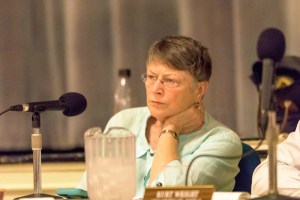
Jane Knodell, P-Central District, is the current president. She said last month that she has decided to give up the position. The council president largely directs council discussion and sets the agenda, but generally stays out of the debates themselves. The council president also serves as second-in-line to the mayor.
Only Kurt Wright, R-Ward 4, has thrown his hat in the ring for council president, and Knodell said she supports him. Wright is the sole Republican on the council.
Weinberger, a Democrat, and Knodell, a Progressive, have clashed in the past, but Weinberger said he was grateful that Knodell had supported the Burlington mall redevelopment project, despite some political headwinds.
“That took some political courage on her part, and I think there was clearly some political costs to her taking that stand,” Weinberger said. A vocal redevelopment opponent, Genese Grill, nearly unseated Knodell during her re-election campaign last year.
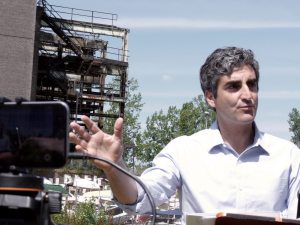
With the mall redevelopment approved and largely moved out of the city’s hands and into those of the developer, Don Sinex, the city is directing its energy toward the future of two major Burlington buildings that now sit empty — the Moran Plant and Memorial Auditorium.
Weinberger said that figuring out the future of those two public buildings is a “front-burner” issue, adding that both projects likely will require more public engagement, and perhaps a public vote.
The city already has about $6 million set aside for the former Moran generating station, Weinberger said.
“We have this money that is dedicated, essentially targeted toward Moran,” Weinberger said. “The new goal is to how to use that substantial amount of money in a way that complements the northern waterfront.”
As for Memorial Auditorium, Weinberger said he was sticking to a plan he articulated often on the campaign trail — his administration will have a proposal to restore the nearly century-old auditorium by the fall.
“That’s a big lift. That’s a lot of work to do between now and then,” Weinberger said.
Burlington’s efforts in combating the opioid epidemic that claimed more than 100 lives in Vermont last year were recently augmented with the launch of a “Safe Response Team” in January.
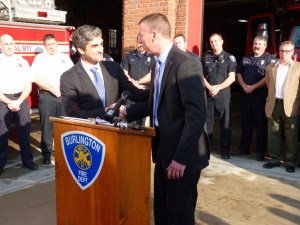
The team — made up of Burlington Deputy Police Chief Shawn Burke, Fire Chief Steven Locke and city opioid policy manager Jackie Corbally — will pay a personal visit to anyone who has overdosed and talk about getting help.
Fortunately, the team has only had to respond to one overdose since its inception, Weinberger said.
“We’re focused as a city not just on this direct, individual responses but also on broader public health,” Weinberger said.
He is supporting a bill moving through the Legislature, S.166, that expands treatment in prison, and wants to see more data and transparency in the state’s prescription monitoring system.
He, and a coalition of mayors, support expanding Vermont’s “hub and spoke model” of opioid treatment that recent studies show are leading to more people breaking the cycle of addiction.
Having just prevailed in a hard-fought race in which he was nearly always the target, Weinberger said he believes the process will help him in the long run.
“There is something about an election,” he said. “Coming out of it you sort of take stock.”

