


This is the third in a series of profiles of Burlington’s three mayoral candidates running in next Tuesday’s Town Meeting Day election.
BURLINGTON — Few knew what to make of Infinite Culcleasure, a longtime community organizer with an unusual name, when he entered the race for Burlington mayor as an independent last December.
But with a week to go before election day, he has emerged as a serious candidate, and one who’s campaign may end up wielding political power well into the future — regardless of what happens at the ballot box next Tuesday.
With no campaign office and about $10,000 in donations — compared to the war chests of his opponents, fellow independent Carina Driscoll with about $47,000 and incumbent Democrat Miro Weinberger with more than $100,000 so far — Culcleasure is running a lean campaign.
However, Culcleasure says he has run a campaign driven by volunteers, and surpassing the $10,000 goal was a high water mark for his candidacy.
“We just have a really strong volunteer corps,” Culcleasure said before heading to knock on doors at the Northgate Apartments in Burlington’s New North End. “Everyone you see in here has really believed in the values and really believed in that we’re asking different questions and we’re bringing a different vision, trying to, to the city.”
“Money won’t put us into office, the people will,” he said.
When facing off against his opponents on the debate stage, it’s clear Culcleasure is a different type of politician. He eschews notes, choosing to rely on anecdotes, personal experiences and the kind of expertise that comes with a master’s degree in urban policy analysis and years of community organizing. He also uses a dash of disarming humor.
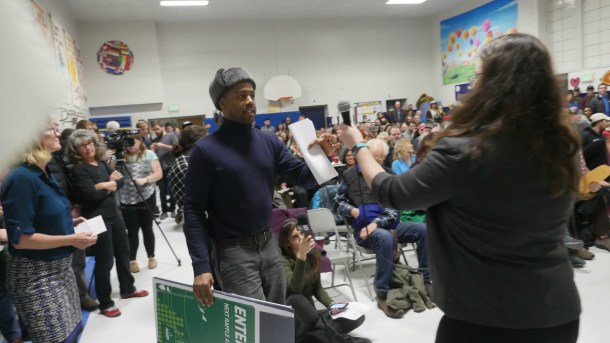
During a Feb. 15 forum, as candidates were giving their final statements, Culcleasure chose to leave the audience with several anecdotes about memorable experiences he has had at the ECHO Center, the venue for the debate.
“When I was a DJ, I threw a huge New Year’s Eve party in this building, and it was a hot mess. I’m telling you, we had some casualties, really. But no one got hurt, we didn’t lose anybody,” Culcleasure said, as the audience broke out laughing.
“And it was really my job to help people have a good time. And my partner and I, with some help from my friends, made that happen,” he said, adding he’s a “community builder” as well as a community organizer.
Then, shifting gears, Culcleasure reminisced about another memorable moment in the waterfront ECHO Center when he disrupted a community conversation on race and diversity hosted by Weinberger during the mayor’s first term.
“The other most memorable time I’ve had in this space is actually calling you to the carpet, Weinberger,” Culcleasure said. The event he was referring to was somewhat of a “dog and pony show,” he said that gave Weinberger an opportunity to say he was doing something about racial discrimination in the city.
Racial tensions, however, remain a problem, Culcleasure said, particularly inside the city’s police department. Weinberger later said he remembered the event and that he had reflected on it in the months and years that followed.
“At the time, I think my reaction was a little bit defensive, and I think I learned something from that night,” Weinberger said. “I learned how important it is to listen in moments like that.”
Much of Culcleasure’s platform rests on finding ways to incorporate the community into city decision-making: He wants to empower the Neighborhood Planning Assemblies and give city employees a say in who their department heads will be. He often talks about how affordable housing may not be the same as low-income housing, and has repeatedly suggested that the city consider rent control policies.
Culcleasure has otherwise largely stayed away from jabbing his opponents on the debate stage, and both of his opponents say they like him.
“I do think it’s important that I maintain a positive attitude toward the opponents. And yeah, I think it’s easier to say what’s wrong with what other folks are saying than it is to offer an alternative,” he said.
Political observers and decision makers in Burlington say Culcleasure has injected a different perspective into the race — though most believe his chances of pulling out a win are slim in a three-way race.

Culcleasure’s campaign has impressed a lot of people, said Neale Lunderville, a Weinberger ally and general manager of the Burlington Electric Department.
“He has surprised a lot of folks with a very clear vision for Burlington, and with an obvious passion that shines through,” said Lunderville, who describes himself politically as a “Yankee Republican.”
“I think he’s got a future in elected politics in Burlington,” Lunderville said, even though he doesn’t think Culcleasure will be able to unseat the incumbent or his well-established challenger, both of whom have name recognition. As a newbie to Burlington politics, Culcleasure is not a household name.
Burlington’s City Council president, Jane Knodell, a Progressive representing Burlington’s Central District, said she is supporting Driscoll in the race, but that Culcleasure is bringing something “completely different.”
“He obviously advances a completely different approach to the whole job of mayor. He is saying, ‘I would be a community organizer,’” Knodell said. She said that the qualities that make him an effective organizer may hurt his ability to do the executive, decision-making work.
“Otherwise nothing will happen,” Knodell said. “But some people feel like that’s what they want, there’s too much change.”
Echoing Knodell, Democratic Councilor Joan Shannon of Burlington’s South District said that based on what she has seen, Culcleasure may not be well versed enough in city issues to be an effective decision-maker, especially when compared to Weinberger, whom she supports. But he has proved to be more credible than expected, she said.
“He has grappled with his own set of issues, and he does bring a very interesting perspective,” she said.
Culcleasure, who is 44, grew up in Brooklyn and moved to Burlington when he was 18 after graduating from high school. According to his online biography, he “struggled to find his way in this new environment and experienced quite a few setbacks, including the loss of half his nuclear family to institutional and domestic violence.”
In the 1990s, he was twice convicted on felony drug charges and served several years behind bars. It was in prison where Culcleasure, whose birth name was Percy, changed his first name to the one-time nickname “Infinite.”
When news reports detailing the drug convictions appeared just days after announcing his candidacy, his supporters charged that the stories failed to put Culcleasure’s early record in the context of a life that has otherwise been filled with helping others.
“As a young man of color, to be approached for drugs in Burlington is a common experience,” Culcleasure wrote in a “Statement on Transformation and Redemption” that he released after the stories began to hit websites and newsstands. “It’s often the case that some of us do wind up internalizing this identity that’s imposed on us. That’s what happened to me.”
Many came to Culcleasure’s defense, sharing anecdotes of his various struggles for equality and arguing that he had never tried to hide his past. After his release from prison, Culcleasure completed his psychology degree at the University of Vermont and went on to earn a master’s degree from the Schools of Public Engagement at the New School in New York.
Culcleasure has occasionally been critical of the media’s coverage of him, and said the press may have a hard time figuring out what to do with a somewhat unconventional candidate.
“They don’t know what to do with a candidate that is unendorsed, doesn’t have a campaign office,” he said.
He also made a few observations of the press corps covering his campaign: They are young and white.
“Maybe the press could benefit from diversity training. Maybe stuff like that could be beneficial for the press. We all have been miseducated, not just the press,” Culcleasure said.
Within his community organizing work, Culcleasure played a key role in a recent Winooski City Council decision to provide better bus routes for schoolchildren in the winter, ACLU attorney Jay Diaz said after news of his prior convictions came out.
Diaz was an attorney for Vermont Legal Aid at the time, and specified that his comments were his own thoughts and opinions, and were not made on behalf of the ACLU.
“Before they agreed to do that, which was just recently, Infinite himself would help drive kids to school,” Diaz said.
Recently, Culcleasure has been a familiar face at ongoing racial justice rallies at UVM. The demonstrations were sparked by the appearance of signs associated with white supremacists on campus. The signs, with slogans like “innocent lives matter, not guilty ones,” and “white privelaged (sic) and proud of it,” were found taped to a display case containing information about the university’s Mosaic Center for Students of Color.
Student organizers with the group NoNames for Justice are demanding university reforms, including the renaming of some campus buildings and mandatory diversity training. Culcleasure was present as students shut down Main Street last week in order to put pressure on UVM President Tom Sullivan to start negotiations, which are now ongoing.
“If we win this election, it will really change how this city works. Including what is going on with the University of Vermont,” Culcleasure told The Vermont Cynic.
Student organizers sometimes offer Culcleasure the megaphone during rallies, which he declines. But he is welcomed into the movement —- during a sit-in Monday night at Waterman, UVM’s main administrative building, Culcleasure’s campaign team used an empty classroom.
Culcleasure is drawing support in largely progressive neighborhoods like the Old North End, but he has a particular affinity with students, said supporter Andy Simon. “Students are really paying attention,” he said, “and certainly people of color at the university, but not just them.”
The campaign has been registering students to vote and Culcleasure benefits from his ties to UVM, as a graduate and co-coordinator of UVM’s Summer Enrichment Scholarship Program, a summer-long residency for incoming first-year students.
“We need to encourage people to vote who haven’t voted,” Simon said. “It’s the people who haven’t been voting who are more likely to vote for someone like Infinite.”
Simon, a Ward 5 resident, he has lived in Burlington for about 40 years, he said.
The campaign has struggled with name recognition and simply getting its message out, Simon said. “He’s not a bombastic and loud political figure,” he said. “He’s had to get used to the idea that he’s the spokesperson who needs to be the one to talk.”
Culcleasure has described his campaign as a movement that goes beyond simply “beating Miro” next Tuesday, but Driscoll has worried that Culcleasure may split support with hers and bring them both down, securing a Weinberger victory.
Culcleasure bristled at the idea, and posted in a campaign blog that his campaign was “all-in” until election day and beyond. Driscoll later said it’s his choice what to do in his campaign, but that a three-way split would be an unfortunate outcome.
“We have articulated over and over again that we intend to keep working with each other beyond March 6. So given that proclamation, given that goal, we have to be really careful about how we engage with each other, how we engage with other people,” Culcleasure said.
Whatever Culcleasure’s campaign morphs into, he said there are clear goals that they can reach for to accomplish political change.
They could start to campaign for ballot items, or start to focus on statewide races in November, which would be easier to campaign for because the weather is better, Culcleasure half-joked.
Should he win the mayor’s race, Culcleasure said he is “not shy” about having difficult conversations, including asking department heads to re-apply for their jobs.
“It’s about meeting with department heads and saying look, I respect the work you’ve done here, and it’s not about you. It’s about building a city that’s of the people,” Culcleasure said.
Culcleasure said he would like to “slow things down” in city government, but his first order of business after election day will likely be the same no matter the outcome: fatherhood.
The Infinite for Mayor campaign sent a representative to Tuesday night’s mayoral debate at UVM, because Culcleasure’s partner, Sephirah Feinberg, had gone into labor earlier in the day. Feinberg was due on March 7, the day after election day.
The campaign said Wednesday evening it had no new information to share on the status of the birth. Culcleasure previously had said they had not decided on a name, and didn’t yet know the sex of the child.
“Infinite” might work either way, he joked, adding they are looking for other options.
“We want to give it an easier, normative name,” he said.
Read VTDigger’s profile of Burlington mayoral candidate Carina Driscoll here.
Learn more about incumbent Burlington mayor Miro Weinberger’s track record here.
