

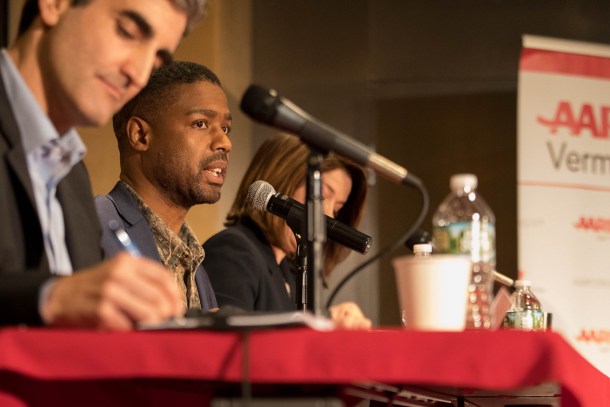
BURLINGTON — Mayoral candidates squared off Thursday night on housing, infrastructure, the power of neighborhood planning groups and other livability issues during a debate less than three weeks from election day.
Incumbent Democrat Miro Weinberger touted his six-year record in office, which Independent challenger Carina Driscoll, a former city councilor and state representative, sought to cast as being carried out without the consent of the governed. Fellow Independent Infinite Culcleasure, a longtime community organizer, often offered competing ideas without getting caught in the crossfire between Weinberger and Driscoll, who he has described as being the “establishment” candidates in the race.
The event at the ECHO Center, sponsored by VTDigger, AARP, the Burlington Business Association and Local Motion, was moderated by Fran Stoddard, a longtime producer for Vermont Public Radio. (Watch the full forum on a livestream provided by Channel 17.)
Some of the starkest differences between candidates could be seen during a question on what to do with Burlington’s inclusionary zoning ordinance, a law that requires a portion of any new housing to be affordable to people who make significantly less than the average area income.

Driscoll said the ordinance works, when it is enforced. In some cases, developers can get around the ordinance by paying a fee up front instead of making units affordable. The city can do more to leverage its assets, she said, and should not be so quick to sell off real estate like a parking lot that was sold to create housing and a 76-bed hotel.
Using one of five “rebuttal” cards candidates were given for the debate, Driscoll chided Weinberger for being apprehensive in his support of affordable housing developments, such as the South Meadow Apartments or Farrington’s trailer park, which she said were at risk of becoming market-rate housing.
“The first instinct of City Hall has not been to protect affordable,” Driscoll said, adding that the city’s nonprofit housing organizations have had to take up more responsibility in recent years.
Pushing back, and using a rebuttal of his own, Weinberger said it was “just not true” that his administration does not care about permanent affordable housing.
“It’s in my bones to care about permanently affordable housing,” Weinberger said, citing his work in City Hall and previously as a developer.
His administration has supported affordable housing efforts and worked to maintain older housing, Weinberger said, while also supporting major development projects that bring an influx of market-rate housing like the Burlington mall redevelopment and the Cambrian Rise project in order to alleviate pressure on a housing market with very low vacancy rates.
Culcleasure pointed out that there is ambiguity over the definition of “affordable”. Renters are eligible for affordable housing if they make 65 percent of local average income — buyers are eligible if they make 75 percent — and incomes from both Burlington and more affluent South Burlington are used to measure the local average income, a statistic called the Area Median Income. As of last year that income was $82,400 for an average family.
“What we actually need is some low-income housing, which we haven’t built, which the federal government hasn’t built since the 1980’s,” Culcleasure said. He also suggested starting a conversation around rent control, a system in which the government regulates pricing for rental housing.
Early in the debate, Driscoll was eager to point out that she had garnered the endorsement of about 200 unionized city employees, their first endorsement in recent memory.
“This endorsement is a vote from within city government for change,” Driscoll said during her opening statements.
Later in the debate, Weinberger noted that three other unions who represent city employees — the firefighters, police and electrical workers — have all come out in support of his campaign.
People in the audience also got a glimpse of some history between Culcleasure and Weinberger. Culcleasure, during his closing remarks, recounted memorable times DJing in the ECHO Center, and disrupting a community conversation on race and diversity hosted by Weinberger during his first term.
“The other most memorable time I’ve had in this space is actually calling you to the carpet, Weinberger,” Culcleasure said. After the event, Culcleasure said the event he was referring to was somewhat of a “dog and pony show” that only served to allow Weinberger and the administration to say they were doing something on race.
Culcleasure said that racial tensions continue to exist particularly within the city’s police department.
Weinberger said he remembered the event, where at one point Culcleasure stood up and disrupted him. Weinberger said he reflected on it in the months and years following.
“At the time I think my reaction was a little bit defensive, and I think I learned something from that night,” he said “I learned how important it is to listen in moments like that.”
Hear highlights and analysis from Thursday’s candidate forum in this week’s Deeper Dig podcast:

