


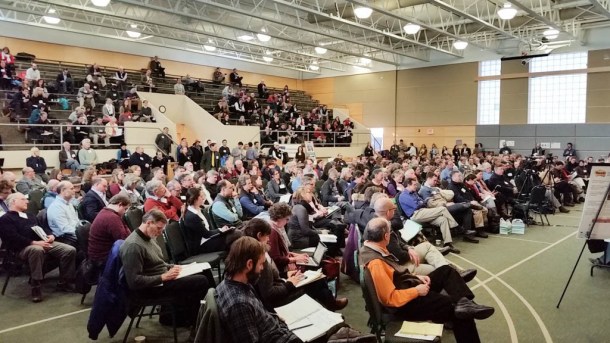
[R]esident of 35 towns in Vermont voted overwhelmingly to support this week of resolutions urging Vermont officials to halt construction of new fossil fuel infrastructure, commit to 90 percent renewable energy and ensure an equitable transition to renewable energy.
Some of the language in the resolutions mirrors bills proposed in the Vermont legislature that have stalled. And though state leaders have said they are committed to protecting Vermont from climate change, they have been slow to take major steps like a fossil fuel tax.
Maeve McBride, director of 350Vermont, which led the local climate change initiative, said the resolutions are the first formal statements from towns and municipalities that acknowledge climate change and pledge action on a local level.
“What is so significant about this is the preamble to each resolution basically saying climate change is happening now, and we know we have to change and we know we have to do something about that,” McBride said.
The 2016 Comprehensive Energy Plan, developed by the Department of Public Service, commits Vermont to meeting 90 percent of its energy needs from renewable sources and reducing greenhouse gas emissions by 85-90 percent below 1990 levels by 2050.
Gov. Phil Scott supported those commitments in an executive order signed in July 2017 that created the Vermont Climate Action Commission. However, when that commission called for a feasibility study for a tax on fossil fuels as a step toward reaching Vermont’s renewable energy and greenhouse gas reduction targets, Scott rejected it.

“Clearly we are not meeting the goals we have laid out in statute, not meeting the goals of the Paris Agreement that last year everyone from the governor on down supported,” said Sen. Chris Pearson, D-Chittenden. “That has been the central part of my argument around a carbon tax, that we keep stating these goals and doing very little to meet those commitments.”
A bill calling for a moratorium on new fossil fuel infrastructure, except when approved by the Federal Energy Regulatory Committee, was referred to the House Committee on Energy and Technology in January. The bill, H.746, did not make it past a first reading in that committee.
“If anybody thinks we are going to reduce our carbon emissions because we don’t allow infrastructure, I think that’s very foolhardy,” said Rep. Curt McCormack, D-Chittenden and vice chair of the committee. “Look at Vermont Yankee. Vermont Yankee shut down for one reason. It cost more than natural gas did for a period of time that they could not sustain.”
Both the House and the Senate have reviewed bills this session, H.791 and S.284, that propose a tax on fossil fuels that Vermonters would receive back as rebates on their electric bills. While neither bill made it to crossover, Pearson said the House had “vigorous discussion” on whether to fund a study that would provide further information on such a plan.
Some were more optimistic that the resolutions would spur more local efforts to combat climate change.
Brattleboro was among the towns that augmented the resolution calling for state action with non-binding resolutions requesting that each town “do its part.” Suggested actions included supporting weatherization, roof-top solar, denial of easements for pipelines and creating more pedestrian and biking infrastructure.
“We’ll be pushing for town leaders to turn the suggestions contained in our resolution into local policy,” stated Daniel Quipp, member of 350 Brattleboro, in a 350Vermont news release.
Greensboro Selectboard Chair Susan Wood said that while Greensboro residents overall supported the resolutions, they too questioned the “practicality” of no new fossil fuel infrastructure. She said residents were already very conscious of their own environmental impact. “I don’t think we will see things change here,” she said.
Vermonters had already taken steps to address climate change on a local level prior to the passage of the 350Vermont resolutions. Over 100 towns in Vermont have town energy committees that work to develop town energy plans and to implement renewable energy projects.
“Montpelier’s municipal operations have reduced greenhouse gas emissions by 56% since 2011,” said Anne Watson, the new mayor of Montpelier. “There has already been a local movement away from fossil fuels, so this is further affirmation for us that we’re going in the right direction. As municipal leaders, we have a mandate from the people to continue this work.”
Whether that message is taken up by the governor and legislators in the Statehouse is another matter.
“This reaffirms my commitment and Vermonters’ commitment to this issue,” said McCormack. “But when push comes to shove, when there’s something to do about it, I wonder how the vote would go.”


