

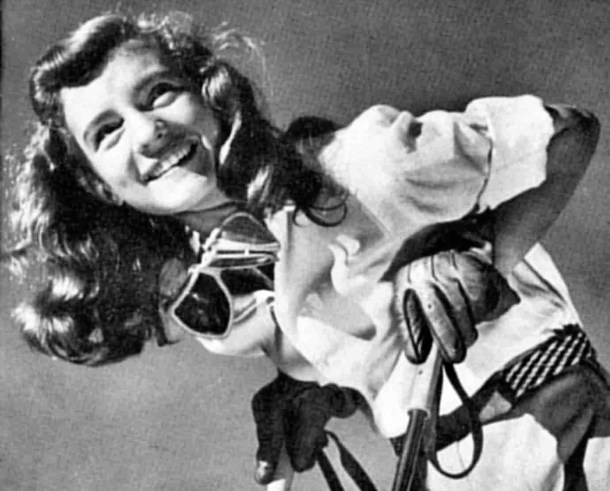
[T]he Vermont-schooled skier, still basking in the shine of her newly won giant slalom gold medal, stood atop the Olympic mountain with high hopes for another victory. Then came the stumble, the fourth-place first run, the pressure to make up enough time in her second try to win another gold.
Last week Mikaela Shiffrin, a 22-year-old graduate of Burke Mountain Academy, found herself in the same precarious position faced by another Green Mountain State skier, 66 years ago.

Shiffrin did not get the hoped for happy ending, but nonetheless remains the talk of South Korea for her history-making quest to win multiple alpine skiing medals. That other Vermont skier, Rutland-born Andrea Mead Lawrence, still holds the American record she set by snagging two alpine gold medals at one Olympics.
Lawrence’s record landed her on the cover of Time magazine during the 1952 Winter Games in Oslo, Norway, and sparked headlines a half-century later when Sports Illustrated named her the top Vermont athlete of the 20th century.
Lawrence died of cancer in 2009. But Shiffrin’s recent celebrity is shining a spotlight on the late legend whom historian Bud Greenspan decreed the “Greatest Winter Olympian of All Time.”
‘That was great fun’
For Lawrence, life began April 19, 1932, with three lines by poet Robert Browning: “Speak as they please, what does the mountain care? Ah, but a man’s reach should exceed his grasp, Or what’s a heaven for?”
Her mother was just about to give birth when she read that poem, titled “Andrea del Sarto” — the namesake “who embodied to mother the whole of human striving in a single sentence,” the athlete wrote in her 1980 memoir “A Practice of Mountains.”
Lawrence’s parents, Bradford and Janet Mead, founded the Pico Mountain Ski Area in 1937 and installed the first T-bar lift in North America in 1941. They gave their daughter the stuff of storybooks. She often spoke of waking atop the mountain in a stone house shaped like a castle and falling asleep to the song of a whippoorwill.
Everything changed at age 10. First, her father died in the fall of 1942. Then her mother, a competitive skier, captained a national team at Lake Placid, New York, the following winter.
“I just went along for fun as sort of the mascot,” Lawrence recalled in a 2002 interview with this reporter. “Someone said, ‘Would you like to forerun the slalom?’ I remember going into a hairpin, tearing around the curve — that’s where I felt this sensation. The rhythm, the timing … there was a connection, a great coming together between what the course required me to do and my natural instincts. I call it a ‘psychic click.’ You suddenly find yourself in a moment and say, ‘Aha, that’s for me!’”
Growing up slope-side, Lawrence often enjoyed “snow days” from classes — so much so, she never graduated from high school. Instead, she got her education traveling the world.
The girl known as “Andy” was 14 when she became the youngest U.S. skier to qualify for the 1948 Winter Olympics in St. Moritz, Switzerland. But she didn’t strike gold until she was captain of the U.S. women’s ski team at the 1952 games in Oslo, Norway.
On Feb. 14 of that year, Lawrence started her first event, the giant slalom. The New York Times described the hill as “icy as a bobsled run.” But the 19-year-old newlywed (she had married fellow skier David Lawrence in 1951) finished on her feet that Valentine’s Day to become America’s sweetheart.
“Mrs. Lawrence, from Rutland, Vt., streaked down Norefjell’s twisting, hazardous 1,640-yard precipice in two minutes and 6.8 seconds to outclass 44 of the world’s finest feminine skiers from 15 countries,” the Associated Press reported. “She wove her way brilliantly down the wooded mountainside, swirling through the 59 control gates like a gifted ballerina.”
A Vermont correspondent was equally awed.
“A roar of amazement burst from the crowd as the time was announced, although it was obvious from the start her brilliant maneuvering of the tricky course would not be matched,” her hometown newspaper reported. “She was mobbed by hundreds of spectators and racers before being separated from the crowd to pose for news photographers. … She showed the strain of the race, but recovered quickly and shortly afterwards wolfed down two Norwegian hot dogs.”
Decades later, Lawrence remembered what sparked her hunger: She hadn’t eaten breakfast that day.
‘The defining moment’
The gold medal Lawrence won bore the Latin words “Citius, Altius, Fortius” — a call to go “Swifter, Higher, Stronger.” And so she did.
“The defining moment in my life,” she recalled just before her death, “is when I won the second gold.”
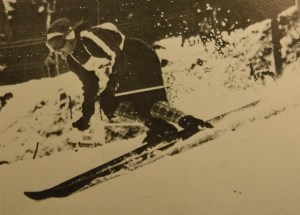
It came in the slalom event that required two runs. Lawrence began the first, only to stumble halfway down when her ski caught on a gate. Lesser skiers would have surrendered. Lawrence instead sprang up, made her way through the gate and finished the run fourth.
“Her second run would have to be better than good if she hopes to offset this low placement,” one newspaper columnist said at the time. “When her turn came, breaths were held and fingers crossed.”
Lawrence jumped through the first eight gates, “racing with her skis flat rather than take a chance on losing time by edging them for more control,” the columnist reported. “She fairly whistled with speed. The crowd, aware that a record was likely at stake, yelled itself hoarse watching this young daredevil with lightning on her feet … When she tore across the finish line, the clock showed her time to be one minute, 3.4 seconds — two seconds faster than any of the world’s best women skiers had been able to do all day.”
Add that to her first run and Lawrence won the event by eight-tenths of a second.
“My purpose wasn’t to go to the Olympics, my purpose was to do the best job I could,” she said in 2002. “I set a standard for myself that every single time I left the starting gate, I would put 150 percent of my effort into it.”
Even so, Lawrence barely remembered that slalom.
“When I was racing, I was pretty much oblivious about what was going on around me,” she recalled. “I went into the zone. You’re into the center of your energy. It’s the absolute blending of the mind, the body and the spirit. It was one of those few times in life when you realize you have become the very thing you are doing.”
‘Typical American girl?’
Her Vermont hometown went wild — even before her win.
A month before the 1952 Olympics, Rutland threw a day in her honor (even though she was away training in Austria). A sculptor from Boston carved her likeness in 7,000 pounds of ice in the center of downtown, while “restaurants featured special Andy Mead dishes and soda fountains offered Andy Mead sundaes,” the local newspaper reported.
Lawrence got a taste herself when she returned to Rutland March 24, 1952, to a 5,000-spectator parade and fireworks that spelled out her name. President Harry Truman sent a telegram calling Lawrence’s victories “a great honor for the United States.” Mademoiselle magazine named her one of its 10 Young Women of the Year. Newsman Lowell Thomas narrated a black-and-white documentary film.
“This is the story of Andy Mead, all-American ski champ,” Thomas began. “Doesn’t she fulfill your idea of a typical American girl?”
That was debatable. Having dreamed of marriage, she went on to have sons Cortlandt and Matthew and daughters Deirdre, Leslie and Quentin. But most typical Americans don’t simultaneously raise toddlers and compete in their third Olympics (nearly winning another medal by finishing fourth in the giant slalom in Cortina d’Ampezzo, Italy in 1956) or see the Associated Press report their divorce (in 1967).
That’s when Lawrence went west. She started in Colorado, settled in California in 1968 and later won election to the Mono County Board of Supervisors in 1982, serving until 1999.
“Having been raised in the Green Mountains,” she told the New York Times in 1991, “they give me a sense of place and they have been a compelling force in my life. I felt that when I was racing and feel it now in my concern for mountain communities.”
Some Vermonters didn’t understand why Lawrence traded her childhood home for the Sierra Nevada, a land of extremes ranging from Death Valley — the lowest point in the continental United States — to Mount Whitney — the highest.
“I am moved by great mass landscapes,” she said.
To preserve them, Lawrence helped form the Sierra Nevada Alliance an organization of almost 50 grassroots community groups working to protect the environmental and economic health of the area.
“Skiing now has gotten to be a lot of glitz,” she said in 2002. “Mountains are here for the human spirit. They’re not made for theme parks.”
“Big developers view where we live as commodities,” she added in a 2004 homecoming speech in Rutland. “I care about our communities, not just the bottom line. We need to reconnect to the land and the value of where we live. You can’t just keep consuming without looking at what the cost is.”
‘Yes, you can’
Watching developers bulldoze slopes for condominiums, golf courses and snowmaking systems, the Olympian founded her own nonprofit environmental protection organization to integrate “economic vitality and ecological integrity” within the Sierras.
“A lot of it has to do with the values that come out of being a Vermonter — a sense of community, a caring about where I live,” she said in 2002. “I love the whole notion of town hall meetings. I think people have a right to comment about the direction and quality of their community. I don’t think you go along to get along. There’s a certain independence.”
“My spirit is in the West,” she added, “but my soul is in Vermont.”

Growing up in the age before performance-enhancing drugs, Lawrence didn’t believe in pushing to win at any physical or mental cost.
“I was raised in what I consider to be a very fortunate era,” she said. “We did it just because we loved it. Nowadays we’re making career professional athletes. I don’t know how many racers go on to become doctors or lawyers and have a whole life other than skiing. I’m not taking anything away from their talent, but it’s not my world.”
Even so, Lawrence always carried a torch for the Olympics. She was pregnant with daughter Quentin when she became the first woman to escort the flame into an opening ceremony — on skis, no less, at the 1960 Winter Games in Squaw Valley, California. In 2002 — the 50th anniversary of her medal wins — she reunited with the torch by carrying it with Quentin just before its entrance into Salt Lake City’s Olympic Stadium.
Few knew how far she had come. Just two years earlier, the retired athlete had been diagnosed and had surgery for brain cancer. Regaining her health, Lawrence returned to her home state for her 2002 induction as the first person in the Vermont Ski Museum’s Hall of Fame in Stowe.
Then in the fall of 2008, Lawrence learned her cancer had spread to her lungs. Deciding to forgo toxic treatment, she enjoyed her last days by her fireplace in Mammoth Lakes, California. Shortly before her death March 31, 2009, the 76-year-old, speaking by phone, put life into perspective.
“I’m looking out on a great snowstorm, and I really am just taking it moment by moment,” she said. “I’ve had friends who thought I’ve been neglected by history, which isn’t true. The race does not stop at the finish line. It goes on. And you do have to give something back.”
