

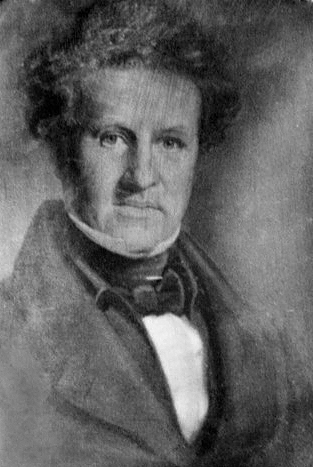
Editor’s note: Mark Bushnell is a Vermont journalist and historian. He is the author of “Hidden History of Vermont” and “It Happened in Vermont.”
[J]ohn Wilson hated to be the subject of speculation. But people couldn’t help themselves. He remained the talk of the town, even as he moved from town to town through Vermont. The whispers started as soon as he set foot in Dummerston, followed him as he moved to Brookline, Newfane and finally Brattleboro, and then metastasized into full-blown allegations after his death.
And no wonder. It is only human nature to speculate about a secretive stranger. And the more someone tries to guard secrets, the more people will try to uncover them.
Wilson arrived in Dummerston shortly after landing in Boston in 1818. He was tall, muscular, handsome, educated and cultured. Why then did he decide to seek his fortune in the hinterlands of Vermont rather than the bustling city of Boston? That was the first of many mysteries.
Wilson told people he had been a doctor in his native Scotland and he set up a practice in Dummerston. Apparently the local population was either too small or healthy to support him, so he also taught during the school year. He proved to be a strict, if somewhat lazy, disciplinarian. Instead of striking misbehaving students with a short stick, he fashioned a long rod with which he could smack rowdy students without leaving his seat.
Within a couple of years, Wilson moved on. While living and teaching in Brookline, he designed the town’s round, brick schoolhouse, which still stands. Observers later claimed he made it round so that he could see trouble coming.
Many of the so-called facts that came out about Wilson after his death seem to have been created to confirm later suspicions about him, as if people were afraid to admit they never realized he had something to hide. Take the schoolhouse with its supposedly great view. The building doesn’t offer any better view than a square one would have.
Some of what people remembered about Wilson was no doubt true, but some of it was probably concocted. So read the recollections that follow with a grain of salt.
Wilson was better known for his capable doctoring and his knowledge of the world, which must have far outstripped that of most residents in the small Vermont towns he called home. With effort, Wilson could be drawn into conversations in which he would talk evocatively of the British countryside. Apart from discussing landscape, though, he avoided talk of his past.
As a result, neighbors remembered him as aloof and protective of his privacy. Indeed, his desire for seclusion could go to bizarre extremes. When someone knocked unexpectedly at his door, his first instinct was to hide. He even, according to one rumor, had a small secret room built into a closet to serve as a hiding place. Despite his stories about Great Britain and his obvious Scottish brogue, Wilson tried to disassociate himself from all things British. When a Dummerston hostess offered him tea, he is said to have rudely rejected it, saying, “Coffee, woman, coffee!”
When he chose a chair in a room, it was invariably one in the corner, where no one could sit behind him.
And he had odd habits involving clothes. When buying shoes, he always borrowed a pair from the store to try on at home and he wore a large cotton cravat around his neck, even in the hottest weather.
Then there was the matter of his aversion to dancing. As an eligible bachelor, Wilson was frequently invited to quilting parties, which would end with some dancing. He would vigorously refuse invitations to dance. On the few occasions he accepted, he would dance energetically before often stumbling and falling.
Wilson was married briefly to a well-borne woman from Brattleboro, but she sued for divorce due to his abusive behavior, apparently brought on by drinking.
No question: The guy was an odd duck. But what does being a hard-drinking, clumsy dancer, who disdains tea and has bouts of pathological shyness add up to? People talked endlessly about their peculiar neighbor, but didn’t add the clues up until after he died.
Wilson was as quirky on his deathbed as he was during the rest of his life in Vermont. When he became sick (of what illness is unclear) he sent for the doctor, who arrived to find his patient lying in bed, fully clothed. Wilson made the doctor promise he would be buried in those very clothes.
When Wilson died, the doctor realized he could not keep his promise. To receive a proper burial, Wilson’s body would have to be washed and embalmed. When Wilson’s body was undressed, people learned that he had managed to disguise numerous injuries. Beneath the cravat was a long scar extending from near the carotid artery to the back of the neck.
By wearing extra pairs of drawers and wrapping his leg in wadded cotton or paper, Wilson had hidden the fact that his left leg was shriveled and shorter than the right. The calf of that leg also bore a strange scar – a round, cent-piece-sized wound with a scar line radiating from it. The heel of that foot was missing, apparently having been shot away. Wilson wore a piece of cork to compensate for the missing heel and to make his legs appear to be the same length. Hence, his trouble dancing.

Townspeople suspected that Wilson had been protecting more than his own vanity and reported their findings to the sheriff. Poring over his list of wanted criminals, the sheriff latched onto a seemingly unlikely but spectacular theory: Vermont’s quiet, unassuming Dr. John Wilson had in his youth been the rakish British highway robber Captain Thunderbolt. During his brief career, the thief, whose real name was John Doherty, had terrorized wealthy travelers on the roads of Ireland and Scotland. His swift robberies earned him his nickname and his refusal to rob ladies or the poor made him something of a folk hero.

After working alone for several years, Doherty decided he needed an associate. One day in an Irish pub, which like many in Ireland may have contained a wanted poster for his arrest, Doherty met a young thug named Michael Martin. After a consuming an extravagant amount of rum, Doherty revealed his identity to Martin and offered to make him a partner. “I cannot part from so clever a fellow as you are,” Doherty told the man who would become his accomplice under the name Captain Lightfoot.
The quote comes from “The Confession of Michael Martin,” a pamphlet Martin dictated in 1821 while awaiting execution in Massachusetts. After his years with Thunderbolt, Martin had immigrated to the United States and had, unwisely, continued his career. He was eventually caught, tried and hung in Massachusetts, the last highway robber the state would execute.
But in his “Confession,” Martin describes a man who shares Wilson’s height, build, approximate age and experience. He speaks of the two spending time in Ireland and Scotland with Wilson posing as a doctor and Martin as his assistant.

“The captain had so much skill in medicine and surgery, that we picked up a good deal of money,” Martin says. “He had a number of quack medicines, and having a good gift of the gab, he could pass them off very well among the natives.”
Martin paints the pair as sort of latter-day Robin Hoods, saying they gave some of their booty to the poor.
Martin says his partner was a master of disguise – indeed, when the two met, Doherty was dressed as a priest. He also said that Doherty was almost impervious to pain. Once, while being chased, Doherty was shot in the calf. When they had safely fled, Doherty told Martin to use his penknife to remove the ball.
“Cut as near the lead as you can; I can afford to lose a little blood,” he said. Martin cut a straight line from the wound and removed the ball.
Wilson came to this country several months after Thunderbolt and Lightfoot ended their careers in the British Isles. Martin couldn’t tell authorities whatever became of Thunderbolt, but he said he held no grudge against him.
“Although he was the cause of much trouble to me, yet I feel a strong affection for him,” Martin said, “and trust that he will die a repentant and honest man.”
Perhaps he did.

