

Editor’s note: Mark Bushnell is a Vermont journalist and historian. He is the author of “Hidden History of Vermont” and “It Happened in Vermont.”
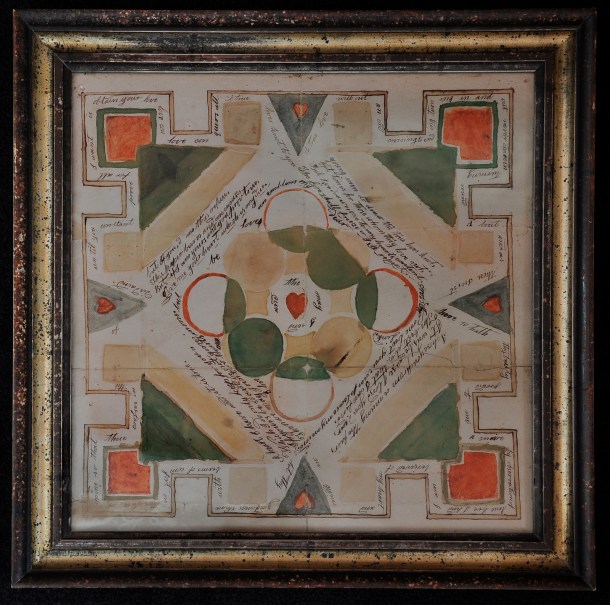
[T]his is not your usual Valentine. The young man spelled out his affection for the young woman of his desire in verse, then he set his verse in blocks of curvy script that he placed at odd angles around the page to fit within the pattern of geometric shapes he had painted in watercolors. The triangles, rectangles and circles share the page with several hearts placed around the note’s edge and at its center.
This is no simple, store-bought trifle. The 200-year-old note, in the collection of the Vermont Historical Society, is a labor of love, or at least of infatuation.
The artwork may be original, but the art form is not. What the young man created is known as a love knot, which was a traditional way to express one’s love in colonial times and early America. Clearly the sender knew the art form, and even its name, because on the note he wrote:
“Young men do draw the true love knot,
oft times to those whom they love not,
But I’ve drawn one to my heart’s content,
The fire shall freeze ere I’ll repent.”
You can fault the man’s poetry — he was no Shakespeare — but not his ardor.
He might not have known it but, the love knot that he drew derived from Germanic and British Isles traditions. In those societies, an intricate, intertwined knot represented the endlessness of love. In pagan times, a woven, knot-like pattern was thought to ward off evil.
Love notes are often associated with Valentine’s Day, a holiday with ancient roots. But Valentine’s Day is believed to be a Christian version of a pagan Roman fertility festival called “Lupercalia,” which was celebrated on Feb. 15. It remained popular into the fifth century A.D. By then, however, a Christian alternative was emerging.
The new celebration revolved around St. Valentine, who had supposedly been executed in 270 A.D. for performing marriage ceremonies for Roman soldiers against the orders of Emperor Claudius II. Claudius seemingly thought marriages would weaken his army’s fighting resolve. The date of Valentine’s death was thought to be Feb. 14.
Cards are, of course, not the only way people have expressed their love. Sometimes a man would give a woman one of his gloves as a sign of love. If a woman gave her glove to a man, he would pin it to his sleeve for the rest of the day, hence the expression “wearing your heart on your sleeve.”
We don’t know whether the sender and recipient of the love knot at the Vermont Historical Society had professed their love so publicly, or indeed whether they even were in love. In fact, we know little about the circumstances surround that love knot.
We can speculate that if they were actively courting, they would no doubt have been carefully chaperoned during their time together. That said, they might have been permitted liberties that people don’t commonly associate with the era. In some households in New England and elsewhere, a couple planning to marry would be allowed to “bundle,” which meant sharing the same bed, but only in the home of the young woman’s family. It wasn’t the most romantic of settings. Other family members would sleep in the same room — space was tight in their homes and they didn’t want the couple to get carried away.
“Bundling” meant different things to different people. Sometimes a wooden bundling board separated the couple, to keep passions in check. In other households, however, the couple was allowed to lie, either fully or partially clothed, and caress one another, as long as they didn’t do anything that was likely to get the woman pregnant.
At the other end of the courting spectrum, in some strict households, couples wanting privacy would have to converse using a “courting stick,” a hollow tube that was six to eight feet long. Sitting with family members around them, the lovers would hold the stick between them so that one could whisper into it while the other listened at the other end. The courting stick might have facilitated some private communication, but it made physical intimacy, or even proximity, impossible.
The awkwardness of courtship traditions didn’t keep young people from falling in love. Clearly the writer of the Vermont love knot was smitten:
“A heart I have and it is true,” he wrote. “Which I do only keep for you, If yours be so and be not gone, Then we may join two hearts in one.”
Much about this love knot remains a mystery, other than the young man’s words. It seems he didn’t want to wait until Valentine’s Day to profess his love. He sent the note on Nov. 1, 1816.
The knot was sent to an Eliza Pullen in Guilford. Pullen was only 15 years old at the time. From the context of the note, the sender was apparently a young man. (Though given the different mores about the suitable age of a suitor in those days, the sender, in theory, could have been an older man.)
On the back of the note is written something about a debt owed to a Stephen Bucklen. The debt is apparently owed by a William Mower — though the last name is hard to make out. It is possible that Mower was owed the money for delivering the note.
The idea that the note was penned by Bucklen makes some sense. Both the Bucklen and Pullen families came to Vermont from Bristol County, Massachusetts, and they had a habit of intermarrying. So Stephen might have fancied his chances with Eliza.
But it was apparently not to be. Eliza’s heart would belong to another. Records show that in 1821, at the age of 21, she married George Wood, whose family also came from Bristol County and also regularly married Pullens. George and Eliza had four children together.
At that point, the answers end and we are left only with questions. Would Eliza have been happier if she had married the creator of the love knot? And why does the note still exist at all? Did Eliza preserve it because it was such a flattering note? Or perhaps it reminded her of an unrequited love? Or was it Stephen — or William or whoever sent it — who kept the note after Eliza refused to accept it?
Those mysteries, like the love the knot was meant to represent, might never end.

