

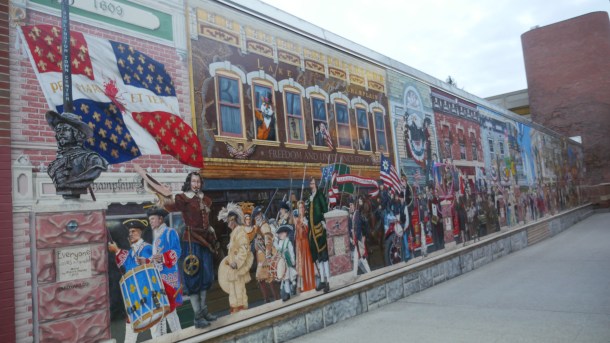
[B]URLINGTON — City officials have begun the process for deciding what to do with a controversial downtown mural that has been called inaccurate, non-representative and racist.
When Burlington activist Albert Petrarca spray painted the words “Off the Wall” on the prominent Church Street mural meant to depict the history of Burlington last October, he likely sparked the events that led to Monday’s city council decision to have the city attorney report on the legal ramifications of its removal.
Petrarca was making a political statement at the time, and through his act of vandalism was attempting to show the lack of racial and historical representation in the mural.
The mural, which depicts figures from Burlington’s history was done in 2012 to celebrate the 400th anniversary of Samuel de Champlain’s arrival in the Champlain Valley in 1609.
The mural works as a loose timeline, with de Champlain’s likeness at the beginning of the mural on Church Street with figures like Elvis, a Ben & Jerry’s storefront, Sens. Patrick Leahy and Bernie Sanders, and other contemporary figures like popular Vermont singer Grace Potter and Burlington Mayor Miro Weinberger at the far end of mural.
During Monday’s city council meeting, every public commenter who addressed the mural called for a change. Many said the mural is racist because it doesn’t accurately depict the American Indians who were in Vermont before Samuel de Champlain, and ignores several other historical figures and people.
Councilor Ali Dieng, D/P-Ward 7, a vocal opponent of the mural, has often pointed out that more than one-third of students in the Burlington School District are people of color, yet people of color are sparsely represented on the mural.
The chief of the Nulhegan Abenaki Nation, Don Stevens also addressed the council during Monday night’s meeting. He agreed that the mural should change, but was hesitant to give an outright endorsement for a solution, choosing instead to focus on telling councilors that the tribe wants to work with the council on ways that the Abenaki culture can be promoted.
Stevens also said although many have been trying to speak for the Abenaki, they speak for themselves.
“We are a sovereign nation, and we have a government-to-government relationship with the city of Burlington,” Stevens said. “We speak for ourselves. We are not victims, we are survivors.”
Dieng has been leading the charge on the council to take down the mural. Leading up to Monday’s meeting, Dieng had intended to introduce a resolution that, if the council approved it, would have quickly led to the mural’s removal.
Instead, Dieng’s resolution asks Eileen Blackwood, the city attorney, to examine how the mural could legally come down. The mural was paid for with private money and is on a privately owned building, but the city has an easement for the wall the mural is on.
For Dieng, who is the only non-white member of the council, the mural’s message is clear.
“Me, as a new American, when I looked at the mural the first impression that I have is that this is not inclusive,” Dieng said.
Many on the council agreed with Dieng’s sentiments about the mural; it’s non-inclusive, historically inaccurate, and something should be done.
Councilor Joan Shannon, D-South District, said she appreciated Dieng’s work on the issue, but said when she polled friends who are people of color, none of them told her they wanted to see the mural come down entirely. They did say, Shannon told the council, that they wanted the council to look at ways to make the mural more inclusive.
Shannon had proposed a resolution that would have established a task force charged with heading a public process that would consider a wide range of options for the mural, including its removal.
The task force resolution was tabled until Blackwood reports back to the council on March 12, but it’s a move that many on the council indicated they would support for a number of reasons, including the idea that a quick removal could do more harm than good.
“That was a sentiment that was expressed to me by many. That if we take this issue, and we have kind of a knee-jerk reaction to it, and an extreme reaction, we actually can inflame our race relations,” Shannon said.
Councilor Max Tracy, a progressive who often allies with Dieng, cast the debate in Burlington over the mural as part of a national dialogue in which communities are questioning their own histories, and how they can more accurately represent that history.
Some have suggested adding to the mural the likeness of people who should have been on in the first place, an idea that would be “terrible,” Tracy said.
“That would be, quite literally, adding people of color as an afterthought,” Tracy said.
