


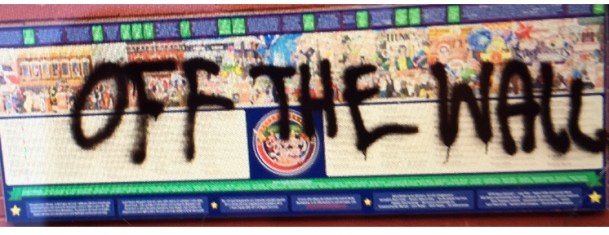
Albert Petrarca defaced the mural to honor the holiday, which has been unofficially renamed “Indigenous Peoples Day.” Petrarca said the event was organized in response to frustration with the Euro-centric depiction of the region’s history.
Native Americans who lived in the Champlain Valley prior to white settlement in the region were not included in the painting. The mural’s timeline begins in 1640 with the arrival of French explorer Samuel de Champlain.
Petrarca said using a white man’s discovery of the region as the starting point for the mural is “fake history.” “You obliterated an entire race, nation, culture of people from that history,” he said.
The mural, which depicts figures from Burlington’s history ranging from singer Grace Potter to Bernie Sanders was painted in celebration of the 400th anniversary of Samuel de Champlain’s arrival in the Champlain Valley in 1609.
Petrarca made two demands after the incident: That the mayor state publicly that he does not support the mural, and that records be released about the conception of the project. After releasing the demands, Petrarca turned himself in. He said he did so to make clear that this was a political action, not an act of vandalism. He was given a fine and a court date for later this month on a charge of public mischief.
Mayor Miro Weinberger said the action was “unfortunate” and “unnecessary.” “Vandalism of public space is a crime,” he said. “Even if the city respects the ideas that might motivate it, the city still supports its police department in treating the act accordingly.”
While Weinberger denounced the defacement of the mural, he said the city should offer a more complete history.
“Communities across the country are engaging in the important process of assessing the art and monuments in their public spaces and considering whether they accurately reflect the history and diversity of their communities,” the mayor said.
Ron Redmond, executive director of the Church Street Marketplace, said the business group plans to expand the mural to include the Abenaki people, Buffalo soldiers, an all-black calvary in the Civil War, and Daisy Turner, a civil rights activist.
