

[I]n the coming months, Vermont will sharply reduce estimates for online and out-of-state sales tax payments.
In a little-noticed change lawmakers passed this year, the amounts that people are told to use when calculating tax are being cut in half, effective for the 2017 tax year.
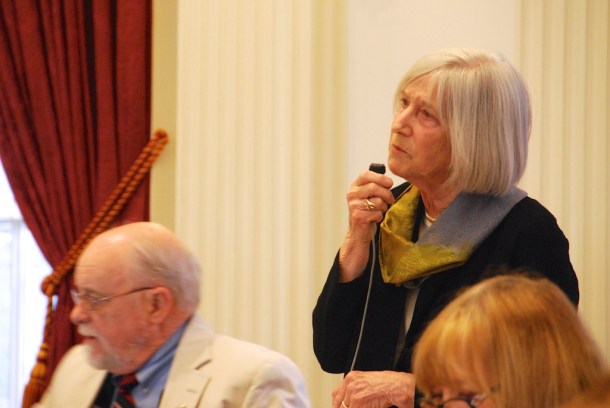
“The thought was that by reducing the table” with which the substitute sales tax is calculated, “we would be able to improve compliance,” said Rep. Janet Ancel, D-Calais, chairwoman of the tax-writing House Ways and Means Committee.
For years, the state has asked taxpayers who buy things in sales-tax-free New Hampshire or from an online or catalog retailer that doesn’t charge the 6 percent Vermont tax to do one of two things: tally untaxed purchases and pay sales and use tax when filing their state income tax, or use a table supplied by the Tax Department to estimate purchases based on income.
Most Vermonters have been doing neither. About 10 percent of Vermont’s roughly 370,000 tax filers make any year-end effort to square up on the sales and use tax, according to Tax Commissioner Kaj Samsom.
Over time, the state’s sales tax collections have declined because many consumers in Vermont are buying products online and have avoided paying sales tax. The Joint Fiscal Office has estimated that online sales have generated a decline in sales tax revenues of about $30 million a year.
This year, the Tax Department sent letters to 18,000 people to collect lost online sales tax revenue. About 2,600 people responded and the state collected about $900,000 with the effort.
One common complaint, Samsom said, is that the Tax Department’s table significantly overestimates what is owed by a taxpayer who does not keep receipts and pay based on actual purchases. The estimate is called a “safe harbor” amount; the state agrees not to assess additional tax unless a purchase of more than $1,000 is unreported.

Until now, the estimated sales tax was calculated as 0.2 percent of household income, meaning that a family with an adjusted gross income of $100,000 would be asked to pay $200 for routine purchases, plus 6 percent on any untaxed items costing more than $1,000.
The $200 is the amount that would be charged on $3,333 of online purchases – about 111 books priced at $30 or 222 music downloads at $15 apiece.
Now the estimate is being cut in half — to 0.1 percent of adjusted gross income. The same family with $100,000 in income would be assumed to have made about $1,667 worth of untaxed purchases. The thought is that people will see that as more realistic and be more likely to pay, officials said.
In addition, Samsom said, the safe harbor table will be capped, with a maximum payment of $500, or 0.1 percent of $500,000 in income. Consumer purchases tend to “flatten out” in the upper income brackets, he said. Someone making $1 million would not be expected to make twice as many untaxed purchases as someone making $500,000.
Ancel said she believes that Vermonters don’t set out to be tax cheats, but that many simply throw up their hands because they don’t know the rules. It’s hard for most residents to remember what is taxable and what is exempt. A list provided by the Tax Department shows, for example, that belts and suspenders are exempt, but “belt buckles sold separately” are not.
Then there are “casual sales,” which can be of big-ticket items but are not taxed. Samsom was asked about an example of a private sale for $1,200 of an antique firearm, which would not be taxed if it met four criteria:
- The sale must be isolated or occasional.
- The seller must not be regularly engaged in the business of selling that type of property.
- The property must have been obtained by the person making the sale for his or her own use.
- The property must not be an aircraft, snowmobile, motorboat or other vessel 16 feet or more long.
The $900,000 collected from the September letter is still a small piece of a tax gap — the amount owed the state that goes uncollected — that’s been estimated at up to $30 million a year.
Officials said one big step forward was when Amazon.com earlier this year agreed to Vermont’s long-standing request and started applying the state tax to sales to Vermont residents. Samsom said that given Amazon’s dominance in the online retail marketplace, it appeared that untaxed retail sales would drop, helping to justify the decision to cut the “safe harbor” amount in half.

