

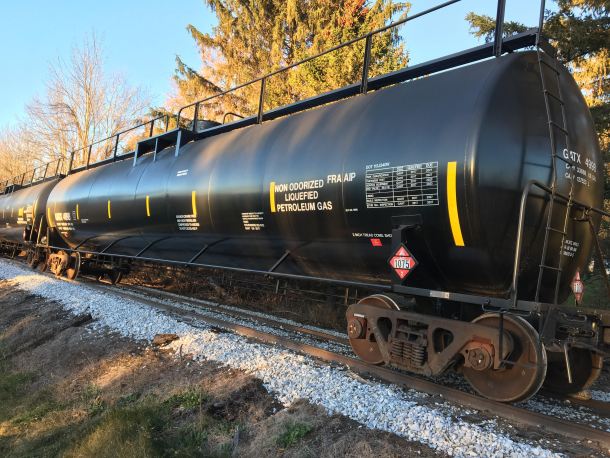
State lawmakers have raised the issue with Scott administration officials and the railroad. Sen. Brian Campion, D-Bennington, is developing legislation to regulate the storage of rail cars with hazardous materials in residential or environmentally sensitive areas.
Rep. Timothy Corcoran II, D-Bennington, a member of the House Committee on Transportation, said Tuesday he’s considering filing similar legislation in that chamber.
After hearing from resident Al Bashevkin during a meeting Monday, the Selectboard asked Town Manager Stuart Hurd to draft a letter to state and federal lawmakers and the governor’s office. The local officials said they understand that railroads are regulated by the federal government, but they believe they should weigh in with their concerns.

He said it appears the rail line is “being rented out for storage” by Vermont Railway, which confirmed through a spokesman that the tankers hold propane destined for commercial customers. The intent, the spokesman said, is to avoid propane shortages during severe winter weather.
The black tanker cars reportedly totaled about 80 at one point, stretching both directions from a road crossing. However, a number of the cars recently were moved away from homes near the crossing.
Vermont Railway Vice President Selden Houghton said Monday that the movement of cars was not related to complaints from residents and area lawmakers, but was part of “the normal course of doing business” in supplying commercial customers with propane.
Houghton said he didn’t know whether the area would be again used for storage, adding that “it’s all based on business needs” and on the weather over the winter.
Hurd and Selectboard Chairman Thomas Jacobs noted that the Federal Trade Commission has regulatory jurisdiction over railroads, so the town’s and the state’s leverage concerning the rail tankers could prove limited.
Vermont Railway does operate under a contract with the state, which owns the rail rights of way, Hurd said.
“The problem you run into is, whose jurisdiction is it?” he said.
Jacobs asked for a board resolution to “communicate to the powers that be” the town’s concerns.
“This is not something that is appropriate to a community like ours,” as opposed to a more rural section of track, he said.
Bashevkin asked whether a regulatory line could be drawn between storage of rail cars with nonhazardous material and those with hazardous or flammable contents.
“I’m hopeful there can be a determination that prohibits this kind of storage in the future, but I just don’t know,” Hurd said.
Not all notified
Hurd said the railroad did approach the North Bennington and Bennington fire departments to notify them of the storage of a flammable material. Houghton said the railroad also provided training information on how to react to an emergency.
However, Hurd said the railroad didn’t directly notify town government of the situation, which investigated after receiving a complaint.
Shaftsbury Fire Chief Joseph Vadakin, whose town closely borders the area, said in a letter to Campion that he wasn’t notified.
Should the parked tankers catch fire or explode, he said, “the devastation would be incalculable. The loss of life, property and the ecology would be catastrophic.”
Vadakin added, “So to make my point clear, the company has offered no warning that this was going to happen, no training if something were to go wrong.”
Houghton said previously that the rail company has complied with all federal reporting and other requirements and contacted Bennington fire and emergency management personnel.
The parked rail cars also are being monitored, he said, and safety procedures “beyond federal regulations” were put in place by the company.
At the request of Selectboard members, Hurd said he will ask the Bennington fire departments for their assessment of the situation and plans for confronting an emergency involving the tankers.
Exploring legislation
“I have reached out to legislative counsel about drafting a bill that would let Vermonters know the contents of such tankers and not allow tankers that contain hazardous materials to be parked anywhere near residential areas,” Campion said this week.
Corcoran said he is exploring what the state can do, given that the railroads are regulated by the federal government, and he’ll try to “piggy back” with any legislation sponsored in the Senate by Campion and Sen. Dick Sears, D-Bennington.

Corcoran said he was disappointed that Vermont Railway chose an area near homes to store flammable materials.
“Personally, I just can’t believe where they stored those cars,” he said. “I think you have to have a little common sense.”
Campion, the vice chairman of the Natural Resources and Energy Committee, said the legislative approaches he is exploring include:
• Requiring those subject to the federal Hazardous Materials Transportation Act to submit “registration statements” and “transportation security plans” to Vermont’s secretary of transportation and the commissioner of public safety.
• Requiring the State Emergency Response Commission (or Emergency Management Division) to submit an annual report to the General Assembly that would summarize its activities regarding emergency response training relating to the transportation of hazardous materials.
• Requiring the commission to report the amount in federal grants it has received under HMTA for training; summarize activities that give the commission authority to ensure that a state plan will go into effect when an accident occurs; and describe how the state emergency operations plan addresses coordination with local emergency response plans.
• Instituting civil penalties and criminal fines against individuals in actions brought by the state for failure to comply with requirements of the HMTA.
“We need to get on the offensive,” Campion said. “This situation continues to be very worrisome to me, and we need to do everything we can within our powers as a state to protect our citizens.”

