

(“Then Again” is Mark Bushnell’s column about Vermont history.)
[M]ills Andross could be forgiven if at some point he wondered what he was doing in Texas, so far from his childhood home in Vermont. If that moment came, it might have been on Feb. 23, 1836, when a Mexican cavalry unit rode into view. The horsemen were the vanguard of a much larger force that soon enveloped the fort that Andross and the nearly 190 other Texas soldiers had made inside an old Spanish mission known as the Alamo.
Two weeks later, when the Mexican president and military commander Antonio Lopez de Santa Anna grew tired of waiting for the Texans to surrender, he launched a series of attacks that seized the fort and killed all of its defenders, including Andross.
Nearly two centuries after the famous battle, the question persists: What was a Vermonter doing at the Alamo?
The details of Andross’ life are hazy. Historians have tried to piece together a picture of it, but they have been frustrated to find that Andross can be seen only periodically, when an event like his birth, marriage or death generated some sort of document that still exists. Otherwise, Andross remains largely hidden beneath the surface.
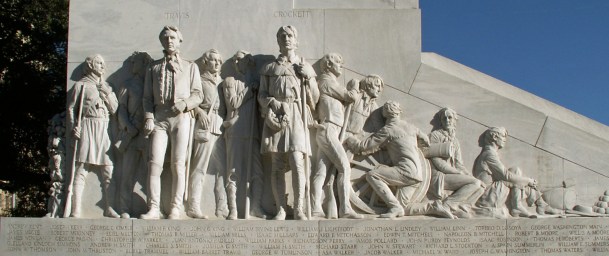
Here are the basic facts. Mills Andross (sometimes written as “Miles,” including on a monument at the Alamo) was born in 1804 into a prominent family in Bradford. His grandfather Bildad Andross was one of the town’s earliest settlers. Bildad Andross’ neighbors elected him in 1777 to represent the town at the convention in Windsor that drafted the Vermont Constitution. As such, he can be considered one of the state’s founders.

By the time he was 14, Andross was living in Massachusetts, outside Boston in the town of Reading.
According to an 1818 court document, Jacob Goodwin, a doctor, successfully petitioned to become Andross’ guardian. Goodwin was his uncle, so perhaps Andross’ parents had helped settle him in Massachusetts.
While there, Andross met a local woman, Eliza Peabody, a member of a leading Massachusetts family, whom he married when he was only 18. The couple had two sons, born in 1823 and 1825.
Some researchers have looked into Andross’ life, particularly his eventual journey south and death at the Alamo, and suggested he abandoned his family. It wasn’t necessarily like that. Around 1830, he and his wife moved to Bradford and tried to make a go of it as farmers. But that apparently didn’t work out as they might have hoped.
A few years later, something drew Andross away. As thousands of Vermont men would do during the Gold Rush in the 1840s, Andross set off to find a way to make a richer living. Many of the men who left for the Gold Rush had plans to summon their families once they struck it rich. Maybe Andross had a similar plan.
In Andross’ day, what drew young men away was not a gold rush, but a land rush. In 1821, Mexico, which had just won independence from Spain, began offering land to settlers in hopes of populating the territory. Soon, Mexico was selling settlers 4,428 acres for next to nothing, $30. In exchange, the settlers swore allegiance to the Mexican government and promised to become Catholics, at least in name.
Stephen Austin was among the first arrivals, leading a group of 300 American settler families to the Mexican territory of Texas, where they blended relatively easily into the local culture.
The settlement policy soon proved too successful, however, as Americans poured across the border. By 1830, American settlers outnumbered Mexicans 3-to-1. And these settlers proved temperamentally different from Austin’s band; these settlers had no interest in assimilating.
To stop the deluge, Mexican authorities banned further American immigration in 1830 and outlawed slavery in the territory. The actions did no good: Americans ignored the laws, and immigration only increased. By 1835, an estimated 1,000 American immigrants a month were flowing into Texas. Some 30,000 Americans, including 3,000 slaves, had settled in central and eastern Texas. They now outnumbered Mexican inhabitants 10 to 1.
Mexico was gripped by another crisis. Santa Anna had seized power in 1834 and become the country’s military dictator. Texas settlers took this moment to try to break away from Mexico and establish a new republic or join the United States. They formed an army to drive Mexican forces out of the territory.
The prospect of a vast new territory with virtually free land, run by Americans, was too much for people to resist. Americans caught “Texas fever,” burning Santa Anna in effigy and rallying in support of the Texas upstarts. Thousands of Americans headed into the territory, including Mills Andross.
On his way south, Andross traveled through New Orleans, where he probably joined the Greys, a volunteer outfit that was sending troops into Texas. Some researchers have noted a parallel between his life and that of his grandfather Bildad. Both men were involved with the founding of independent republics. But if he was like most men, Mills Andross was probably drawn to Texas more by the prospect of free land than by ideology.

The small garrison at the Alamo, which included Andross and the now-famous Jim Bowie and Davey Crockett, was in the Mexican army’s path. The Mexicans attacked the Alamo on March 6.
An officer’s muster report had listed Andross as present but ill on Feb. 11. By early March, he was presumably well enough to participate in the fort’s defense.
From the Alamo’s walls, the Texans kept up a withering fire at the Mexican troops, who were trying to cross the open area around the fort and scale the walls with ladders. The Texans repulsed the first two assaults, but in the third assault, the Mexicans made their way into the Alamo. They spared none of the defenders. The Mexican casualties are unknown.
Estimates range anywhere from 23 to 2,000 dead, though most sources seem to settle on roughly 600 killed and wounded.
Word of Andross’ demise eventually made its way back to Vermont. His widow, Eliza, later remarried and moved with her new husband, Noah Newell, to Wisconsin, a much safer place to settle than Texas.

