

[S]OUTH ROYALTON – In the years-long debate about reforming Vermont’s alimony law, the question of fairness has come up often.
But there are two very different perspectives on what constitutes “fair” when it comes to divorce and financial settlements.
Reform advocates, who dominated a hearing on the issue Monday at Vermont Law School, argue that the alimony statute is outdated and allows far too much judicial discretion.
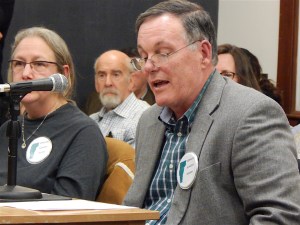
“The laws are unfair and unjust,” said Jim Young, a carpenter and alimony payer from Norton. “They do not consider the life of the payer – just the recipient.”
But others urge caution, saying alimony is inextricably intertwined with women’s issues like the gender pay gap, childrearing expectations and antiquated notions of dependence.
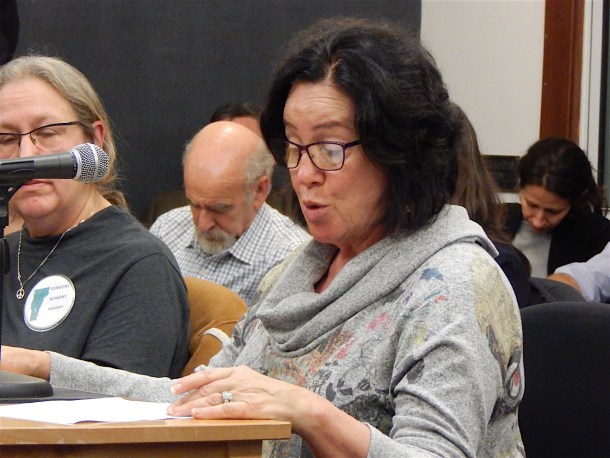
“As the IRS says, alimony is coded as earned income. It is earned income,” said Trudy Stanley, of Shelburne. “I sincerely earned every penny that I get in alimony. And I think most women do.”
Vermont Alimony Reform, a Brattleboro-based group led by businessman Rick Fleming, has for several years been leading the charge for an extensive revision of the state’s alimony law.
But the Vermont Judiciary has argued against making wholesale changes in the law. Earlier this year, a state Supreme Court oversight committee issued a report recommending the adoption of new alimony guidelines based on income and marriage length but opposing “rigid” rules that would curb judicial discretion.
After further lobbying from Fleming’s group, the Legislature created a task force to review the law and recommend changes.
The Spousal Support and Maintenance Task Force includes legislators and representatives of the legal community as well as a member of Vermont Alimony Reform and a representative of the Vermont Commission on Women.
The task force, which is scheduled to issue a report next month, held a public hearing Monday night in a packed law school classroom.
Numerous members of Vermont Alimony Reform – some of whom wore buttons and carried signs – told the task force stories of burdensome long-term alimony payments that have affected their lifestyles, careers and ability to cope with illness.
Ralph Colin, an East Dorset resident who’s about to turn 85, said his spousal support and interest on a related bank loan combine to eat up 70 percent of his income. “I’ve just about run out of assets to sell,” Colin said.
“I’m rather desperate at this point and hope that perhaps you will be able to do something about this,” he told the task force.
Several reform advocates told stories of judges refusing to lower alimony payments despite payers’ decreased earnings or changing life circumstances. Fleming, who lost such an appeal in the Vermont Supreme Court, argued for changes that could bring “consistency, predictability and fairness” to alimony proceedings.
“More predictable outcomes will lead to more cases being mediated out of court,” he said.

“It’s very likely that I will not live to see my last alimony payment, which is at age 65,” Harvey said. “I suspect that there is no chance that I will get that reduced or removed. So while I might like to retire a bit early just to have some time before I have no time, I probably can’t do that.”
She urged the task force to consider a question: “What is alimony for, and for who?”
There is pushback, however, from those who express concerns about the impacts of curbing alimony awards.
A key goal for the reform group is the end of alimony when a payer reaches retirement age. But Carol Buchdahl, a Saxtons River resident who serves on the Vermont Commission on Women, told a story of an older woman who is “slipping into poverty” due to a lack of ongoing alimony payments.
“Older women are already significantly economically disadvantaged compared to their male counterparts,” Buchdahl said. “In Vermont, the average Social Security draw for women is half that of men. And women are significantly more likely not to have a pension and have reduced retirement savings.”
Hannah Lane, a Commission on Women staffer, told the task force that temporarily dropping out of the workforce to have and raise children has “lifelong impacts on advancement and earning potential” for women.
She argued that it’s unfair – and bad public policy – to subsequently penalize an “economically disadvantaged spouse” by tying continuing alimony payments to a recipient’s future personal relationships.
“The idea that spousal maintenance should automatically terminate upon the cohabitation or remarriage of the recipient is rooted in patriarchal notions about responsibility of care passing from one man to another,” Lane said. “And this doesn’t consider that spousal maintenance, in many cases, is compensatory in nature and shouldn’t be subject to this kind of modification.”
Stanley, who was married for 33 years and has four children, said leaving the workforce to raise those children “was the hardest decision I’d ever made at that point” and forever changed her economic situation.
“I understand that this task force wants to do the right thing and keep up with the times,” Stanley said. “But as a mother, a wife, an employee … I have to say that Vermont has not moved that far forward. Women are still back where we were long ago as far as the earning potential out there. It’s drastically reduced by those years spent raising our kids.”

