


(“Then Again” is Mark Bushnell’s column about Vermont history.)
[H]enry Moses Dufur was the world’s best wrestler, as far as he was concerned, and he aimed to prove it. So in 1879 he placed an ad in The New York Clipper, a sporting paper, challenging another vaunted wrestler, Jim Owens, to a match. The winner would take home the world championship belt, a side bet between them, plus a share of the gate.
Owens, like Dufur, was a highly regarded competitor in the sport known as collar and elbow wrestling. They were also both Vermonters. In fact, they were both from Franklin County; Dufur was from Richford and Owens from Fairfield.
What might sound extremely unlikely today — two Vermonters squaring off in a world championship — was anything but in its day. Indeed, wrestling fans might have been surprised if both competitors in a title match weren’t from Vermont.
The state owned the sport. Despite its small population, Vermont turned out more top wrestlers than any other state. During the sport’s heyday, the four decades starting in 1856, Vermonters won 21 accredited championships, according to “The Magnificent Scufflers,” an entertaining history of the sport written in the 1950s by Charles Morrow Wilson. Of those 21 championships, 14 were won by men from Franklin County.
When Dufur and Owens met June 11, 1879, it was something of a grudge match. The two had wrestled four years earlier. After five hours, that match had been declared a draw. Since then, each had reeled off impressive unbeaten streaks – Dufur’s would eventually reach 127. And each held titles from competing governing bodies. In the rough-and-tumble world of collar and elbow wrestling, competitors often laid claim to essentially the same titles.
Now they would wrestle, best of three falls, before a large crowd at the gloomy Howard Athenaeum in Boston. The hall was lit that day by a pair of smoky gas jets. The stage on which the wrestlers tumbled was only thinly padded.
Dufur was considered the favorite, Owens the upstart. At 192 pounds, Dufur had a 22-pound weight advantage on Owens and stood half a head taller. He was also more experienced.
Experience won Dufur the first fall. He pinned Owens in 43 minutes, fairly quick for a championship match between equals. After the first fall, they immediate resumed the match. Eighty minutes later, Dufur knocked Owens to the mat again, and the judge ruled Dufur the champion.
However, Owens argued that the pin hadn’t been clean. When the judge reversed himself, the floor manager refused to award the money or the belt to Dufur, declaring the match over and the championship undecided.
Dufur took the decision in stride, telling the muttering crowd that, “All I have to say is that as a wrestler Jim Owens is the best man I ever had hold of!”
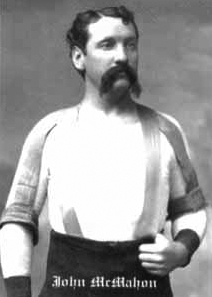
With the result of their match in dispute, both Dufur and Owens accepted the challenge and deposited $100 with the newspaper, which it would pay the winner. Then, to prove his mettle, Dufur offered to wrestle both Owens and McMahon “as one man.” But the paper’s editor returned the money, saying he wanted no part in a Vermont hard cider brawl.
Dufur was outraged by the comment. He was no drinker and no brawler, he shot back, but he was world champion. McMahon mocked the comment, asking Dufur whether he meant “In this world or the next?”
While waiting to arrange a match with McMahon, Dufur wrestled and beat the massive George Flagg, of Swanton, winning himself the Vermont championship. The match was just a tune-up for Dufur, who finally faced McMahon in March 1880 in the Boston Music Hall. The two tussled for six hours, without a fall and with only a 10-minute break. The match was called at 2:30 a.m., when the organizers’ 12-hour lease on the building expired.
The pair didn’t meet again until three years later. After two hours of feints and attacks, McMahon saw that this match was heading toward another frustrating draw. He withdrew, explaining tersely, “Don’t choose to go on with this. Makes me feel plumb silly.”
A more civilized sport
Despite the rancor between the Vermont champions, collar and elbow wrestling was a gentler alternative to a no-holds-barred version of wrestling that was also popular at the time.
The sport’s name derives from the starting position of each match, in which each wrestler grabs his opponent’s arm near the elbow with one hand and seizes his opponent’s shoulder, near the collar, with the other. This position prevented the lunges, rushes and throat grabbing that characterized other wrestling. Wrestlers often remained linked up like this for a match’s opening minutes, with each man refusing to let go of his opponent.
In this position, strength, balance and quick feet were the keys. Wrestlers would try to knock down their opponent with trips or throws, then pin them, shoulder and hip, to the floor. Collar and elbow wrestling, at least in its opening position, helped mitigate any size advantage one of the men might have.
In the 1830s, Irish immigrants brought the sport with them to Vermont. The sport had several advantages: It required no equipment, gave young men a way to vent energy and aggression, and didn’t injure them to the point where they couldn’t do their farm chores the next morning.
The matches were held in the backyard, the schoolyard, even the churchyard. Any flat place would do. In cold weather, matches moved indoors, often into town halls. Here, makeshift padding on the floor offered wrestlers some protection. McMahon, perhaps the greatest champ the sport ever knew, said his mother stuffed comforters with wool from Merino sheep to pad her son’s contests at Bakersfield’s town hall. These early efforts at padding, some claim, were the precursor to the wrestling mat.
Wrestling was one of America’s first mass spectator sports. It was wildly popular during the 19th century, when baseball and football were still in their infancies, and basketball had not yet been invented. Compared with the other main pugilistic sport of the day, bare-knuckle boxing, collar and elbow wrestling was almost genteel. Biting, kicking, head butting and choking were all banned, as were nose holds and any holds that covered an opponent’s eyes.
Many of these rules come from a book of regulations written by Dufur, who helped popularize the sport.
The Dufur Rules, as they were known, also addressed how wrestlers should dress. In country matches, men often went shirtless and shoeless. Once matches moved indoors, they wrestled in tight-fitting long johns. In his book, Dufur called for a more formal, urban look. He said wrestlers should be outfitted in tightly fitted jackets with strong seams.
It made sense that Dufur cared how wrestlers dressed. Having moved to Massachusetts, he cultivated a gentlemanly image and ran a haberdashery and tailor shop when not wrestling.
Other Vermont stars
Viro Small had his own way of dressing. Born into slavery in South Carolina, Small was emancipated during the Civil War and became a bare-knuckle boxer known to favor pink boxing shorts. Deciding to take up collar and elbow wrestling, perhaps as a way to lengthen his athletic career, he moved to the Rutland area to learn the sport. Between 1882 and 1892, Small won 63 matches and was briefly Vermont state champion. Records don’t show whether he wore pink for those matches.
Standing 6-foot-4 and weighing 220 pounds, Swanton’s Flagg was Vermont’s largest, if not its greatest, champion. He enlisted with the Vermont 2nd Infantry at the outbreak of the Civil War and took his love of wrestling with him. Like many Vermonters, Flagg helped introduce other Union soldiers to the sport. During his service, he outwrestled the champions of six other regiments and was crowned champion of the Army of the Potomac.
After the war he gave up wrestling for 11 years but eventually got the itch again, winning 40 straight professional matches. He lost the 41st to Dufur. Soon afterward, he decided to give up the sport again. “I quit money wrestling because it was taking me outside Vermont,” he said. “Never truly liked being outside Vermont; drinking water don’t taste right, air don’t breathe right, and a man don’t sleep right.”
One Vermonter who didn’t mind traveling was Ed Decker, who also lived in the Swanton area. P.T. Barnum hired Decker for his circus to take on all challengers. Barnum offered $100 to anyone who could defeat Decker. He’d pay $50 to anyone who could remain upright with Decker for three minutes. It must have looked like easy money to many men. Decker stood 5-foot-6 and weighed 156 pounds. But looks were deceiving. Barnum never lost his bet.
Eventually, word of Decker’s prowess spread, and challengers became scarce, so Barnum changed the act, hiring McMahon to take on Decker. McMahon, who first claimed a national championship at age 20, had gained an international reputation by winning matches on tours that took him to Europe, South America and Australia.
After two years of tussling before Barnum’s customers, the two Vermonters called it quits. They returned to their Vermont farms, preferring to wrestle with the soil than with each other.

