



A Vermont legislative committee has postponed a decision on a proposal to lengthen the otter trapping season. This postponement, voted on last week, adds another chapter to a long and vigorous public debate.
“It’s a highly contentious issue,” said Brenna Galdenzi, president and founder of animal advocacy group Protect Our Wildlife. In a phone interview following the hearing, she said, “Whenever there’s an issue of trapping, it really gets people active and speaking out. It really gets people going.”
That has been the case in the debate over P-1704, a proposal now before the Legislative Committee on Administrative Rules.
The committee will meet again July 20.
P-1704 grew out of a petition submitted to the Fish and Wildlife Board in October 2015 that requested six modifications to Vermont’s trapping regulations. In a year and a half, Vermonters on both sides have flocked to public meetings, barraged state officials with emails, and submitted opposing petitions.
“We’ve received hundreds and hundreds of emails,” Catherine Gjessing, general counsel for the state Fish and Wildlife Department, said in a phone interview. The department provides staffing and scientific recommendations to the Fish and Wildlife Board when it considers changing hunting, fishing or trapping regulations.
Kimberly Royar, a state furbearer biologist, said that public sentiment toward trapping sometimes focuses on sympathy with individual animals at the expense of considering how best to manage an entire species.
“Part of what trapping does is keep these animals wild, so people can value them as wildlife species and not as vermin,” Royar said. “People tend to love wildlife until there are beavers flooding your driveway or a black bear is on your porch.”
At last Thursday’s LCAR session, Gjessing and Royar testified in support of the proposal that would extend the otter season.
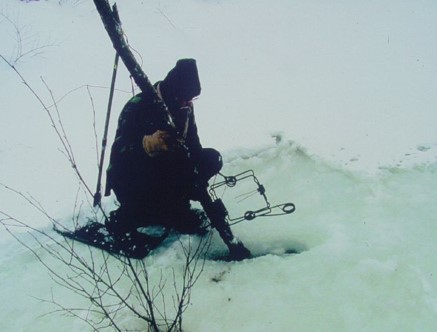
Beaver and otter are caught using the same traps, but otter season ends at the end of February and beaver season ends March 31. This means trappers going after beaver in March are required to modify the trigger mechanisms in their traps to allow otter to pass through unscathed.
Gjessing and Royar identified two primary reasons the department supports P-1704, both related to different end dates of the otter and beaver seasons.
First, they said the department has heard reports from trappers that the modified traps used in March sometimes simply pin beaver until they drown instead of breaking their necks, leading to inhumane kills. Extending otter season would remove the requirement that trappers use the modified trigger mechanism.
They also said the department would prefer trappers who catch otter in March to be able to take their pelts or otherwise use them, something which is prohibited for animals captured out of season.
“It’s not a matter of increasing the otter take,” Royar said. “It’s allowing trappers to utilize the otter that are taken during that expanded beaver season. That’s really the goal of this.”
Royar emphasized that the department’s analysis of otter population and trapping data suggested that extending trapping season by a month would have a minimal effect on the health or growth of Vermont’s otter population. She noted an upward trend in population growth over the past several decades.
Royar said also that the state’s otter population is small, somewhere between 2,500 and 3,000, but its trapping community only has an average of 63 active trappers. According to a summary of background information about P-1704 the Fish and Wildlife Department published on it website, the annual number of otter trapped in Vermont has averaged 178 over the past 10 years. The department’s summary characterizes this rate as “relatively light in comparison to the estimated population.”
Royar reported that the average number of otter inadvertently trapped during March has hovered between zero and one. Sen. Michael Sirotkin, D-Chittenden, asked why a rule change was necessary given the low number.
Royar said the department sought to be transparent.
“There were some proposals to just say ‘let them keep those animals that were taken inadvertently,’ but we wanted to do this legally and expand the season by a month,” she said.
Representatives from two different wildlife advocacy groups urged LCAR to vote against the proposal.
Galdenzi, with Protect Our Wildlife, challenged many of the claims Gjessing and Royar made. In particular, she questioned the reliability of the data the Fish and Wildlife Department has on Vermont’s otter population.
“They do not have otters who are trapped and killed who are out of season in defense of property, so they don’t have a full collection of otter carcasses to complete their analysis,” she said.
Galdenzi also argued that the department’s rationale for supporting the proposal was “completely arbitrary and unfounded.”
Galdenzi told the committee that she had spoken with Royer and was told the modified traps used in March rarely malfunction.
“I don’t know what problem we’re trying to fix is,” she said. “The trap is only catching zero to one otters during the month of March, and the traps are working as they’re supposed to work.”
Galdenzi suggested that the real motivation behind the proposal was accommodating trappers.
“This has nothing to do with what’s best for otters or what’s best for wildlife or what’s best for those of us who don’t want to extend trapping seasons,” Galdenzi said. “Our feeling is that the request is to satisfy trapper convenience and we shouldn’t be basing wildlife management on what’s most convenient for the 0.15 percent who trap in Vermont.”
James White from the Vermont Wildlife Coalition also asked LCAR to question the reliability of existing otter population data.
White noted that Dr. Thomas Serfass, an otter specialist and professor at Frostburg State University in Maryland, wrote a letter to the Fish and Wildlife Department in which he stated that otters’ low reproductive rates and habitat requirements make them especially vulnerable to overharvesting.
“We believe that because the otters are under threat and vulnerable,” White said, “adequate monitoring and data become especially critical, especially when you’re proposing to increase the harvest of this species. And we feel that the monitoring and data that has been available up to now isn’t adequate.”
Speaking from the audience, Louis Porter, commissioner of the Fish and Wildlife Department, sought to reassure the committee that his department’s otter data was sound.
“No data on a wild population is ever complete,” he said. “It just can’t be. It’s not a lab, it’s a wild population. We do the absolute best we can and I’m as confident in this data set as I am in any data that we base any of our wildlife decisions on.”
Ultimately, a majority of LCAR’s members found Galdenzi’s and White’s concerns about the quality of the department’s otter data compelling.
Near the session’s conclusion, Rep. Linda Myers, R-Essex, motioned for a vote on the proposal. She and Sen. Joe Benning, R-Caledonia, both stated that they intended to vote in support of P-1704.
Myers’ motion for a vote was tabled in favor of a vote to adjourn, though, after Sens. Mark MacDonald, D-Orange, and Michael Sirotkin, D-Chittenden, and Reps. Robin Chesnut-Tangerman, P-Middletown Springs, and Michael Yantachka, D-Charlotte, said they wouldn’t support the proposal and wanted time for further discussion.
LCAR will resume discussion on whether to extend otter season and approve P-1704’s other provision at its next meeting on July 20.
