



(This story was updated June 21 at 11:15 p.m.)
[A]fter weeks of stalemate, the compromise that lawmakers and Gov. Phil Scott put in place on the issue of teacher health insurance in many ways mirrors what the Senate passed back in May.
In an announcement explaining the deal, Scott said he would rather give in on his demand for a statewide teacher health care contract than let the government shut down. He had vetoed the budget over the issue.
Scott had said in May that the proposal endorsed by Senate President Pro Tem Tim Ashe, D/P-Chittenden, did not promise enough long-term savings.
The new compromise will reduce payments to local school districts by $13 million — the amount they would save by moving to the health care plan Scott has called for. Scott’s plan reduces payments to the schools from the Education Fund accordingly. If school districts are unable to negotiate an 80/20 split on health care with the local teachers’ union, they will have to cut their budgets.
Ashe’s plan from May would have reduced payments to school districts by $13 million in the upcoming fiscal year, which starts July 1. The newly approved plan gives school districts a two-year window to absorb the cuts: $8.5 million in the first year and $4.5 million the next.
The mechanism will work this way: The state will send each district enough money from the education fund to cover the cost of the health care benefits Scott prescribed, plus a bit extra. Districts that don’t achieve those parameters in negotiations over things like out-of-pocket costs and premium sharing will have to make up the difference.
That means that while contract negotiations stay at the local level, school boards will either have to stay in a tight box or dig into their budgets — which voters have already approved — to get savings to taxpayers.
The school districts that have already finished contract negotiations would need to cut their budgets over the next two years to provide the savings. School districts that have declared an impasse in negotiations will be allowed to reopen collective bargaining if part of the dispute was over health care.
The deal yields some tax savings.
Homestead property taxpayers will see a 2-cent reduction in their tax rates from last year.
The nonresidential property tax rate will go down 2 cents from the rate in the May tax legislation. That means it will remain flat from fiscal year 2017 at $1.535.
Key dollar figures known as the yield rates, which are used in calculating local property taxes, remained the same as in the previously approved property tax legislation.

Lawmakers used millions in one-time money to buy down the tax rates, and a number of lawmakers are concerned that taxes will increase significantly next year as a result. To lower the nonresidential tax rate, $8.5 million in expected savings from teacher health care was used.
“I am concerned this sets up an increase in taxes next year, but that ship has sailed,” Rep. Cynthia Browning, D-Arlington, said of the one-time money, which was also in the bill lawmakers passed last month.
The compromise adds three members of Scott’s administration of a nine-member panel that will study whether the state should implement a statewide teacher health insurance benefit. School contracts would all expire in 2019 so lawmakers could implement the recommendations of the commission.
Who won?
Even before negotiations began, Scott stated that he wasn’t willing to cause a government shutdown over his desire to move teacher health care negotiations from local districts to the state. Some lawmakers thought he weakened his hand by doing so.
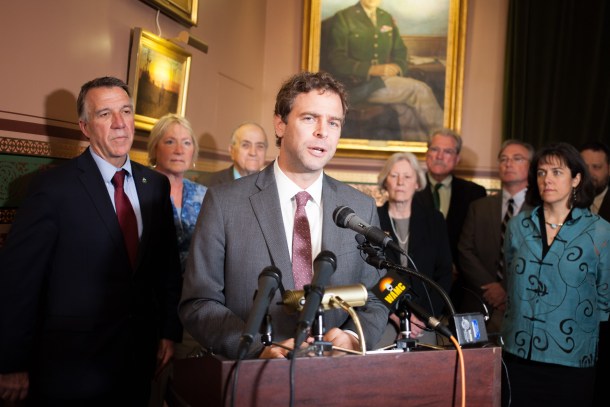
“During negotiations, you have to compromise, and I wasn’t willing to go into July 1 without a budget, and so we came to the table with the right attitude,” Scott said at a press conference Wednesday morning announcing the deal.
At the same event, Ashe did not declare victory either. Instead, he shook his head when a reporter compared the compromise to the Senate-passed proposal that came to bear his name. Ashe said more than 20 other people had signed on as sponsors of that language.
“It does differ,” Ashe said. “There are additional encouragements for districts and teachers to arrive at a more aggressive health care value for their contracts, and that is part of the pressure of negotiation.”
Ashe said the new plan clearly signals to school boards that they will be in a “safe harbor” if they can meet the benchmarks it sets: getting workers to pay 20 percent of their premiums on the Gold Consumer-Directed Health Plan and requiring them to pay at least $400 out of pocket for each person on the plan.
“A majority of the Senate didn’t philosophically oppose the idea of a statewide teacher health care benefit,” Ashe said. “We thought that if we were going to do it we needed to think more deeply about the different ramifications.”
He also said the commission — which originally would have had an even number of union representatives and school board representatives — has been fleshed out to make sure the parties would not hit an impasse.
“I think it is a signal to teachers and school boards that … they should prepare for recommendations that could go either way,” he said.
House Speaker Mitzi Johnson, D-South Hero, said negotiators received data from school districts that have settled contracts showing that the school boards have earmarked money saved on teacher health care for other things like fixing roofs or buying new athletic uniforms.
Johnson also said school districts will be in a better position than under the Senate’s original plan because they have two years to make the budget cuts. “It gives districts more time to plan,” she said.
Later, she told her caucus that the compromise was “not an easy bill” but something they needed to pass “to make sure that we have a government and education system that is funded and functioning.”
She added: “Next year I hope that we can count on an administration that comes to the table in a timely fashion to respect the legislative process and respect the voices of Vermonters.” Democrats had criticized Scott for not proposing a statewide teacher insurance plan until April.
At least one lawmaker, Rep. Scott Beck, R-St. Johnsbury, believed the governor came out ahead. Beck introduced legislation based on the governor’s original plan to move health insurance bargaining to the state level.
“This to me seems like the governor got a pretty good deal,” Beck said.
Both Beck and Rep. Adam Greshin, I-Warren, thought the governor limited his ability to negotiate by saying he would not allow the state government to shut down at the start of the fiscal year July 1.
Mixed reviews from stakeholders
The Vermont School Boards Association, which had allied with Scott on the original health care proposal, gave the compromise a lukewarm reception. The Vermont-NEA, the union that represents teachers, criticized the plan.
The legislation will hurt the 25 or so school districts that already settled contracts, according to Nicole Mace, who heads the Vermont School Boards Association. Some districts will have a difficult time making up for the shortfall in funding from the state, she said.
School districts that are still negotiating, including those that have gone to impasse, now have a clear signal that the money needs to go back to taxpayers, Mace said. The compromise plan also defines a benchmark health care benefit that produces savings and gives school boards a leg up when and if they go to impasse during their negotiations.

The president of the Vermont-NEA, Martha Allen, said: “The part that we can find that’s positive out of this is that collective bargaining for health care is not being removed from the local districts. And then after that, we have a lot of questions.”
Jeff Fannon, the union’s executive director, said a provision allowing districts that are at impasse to reopen their negotiations raises legal questions.
“This does allow a window to allow one side or the other, in fairness, to say, ‘I don’t like what this is doing. I want to revisit what we’d offered a month ago,’” Fannon said. “You can go backwards in time and regressively bargain for less than what you had previously.”
Fannon said the compromise is very similar to what the Senate passed in May, but further “muddles” a process already underway between school boards and the teachers union.
Lawmakers criticize deal, process
Throughout the day Wednesday, lawmakers across party lines raised questions about the details of the compromise. At the end, the House struck down two amendments and passed the original deal.
Rep. Heidi Scheuermann, R-Stowe, didn’t like that the compromise plan would “claw back” savings from school districts — like hers — that have already settled their contracts. She thinks her district could lose as much as $200,000.
“The challenge is the same as it was with the Ashe amendment,” Scheuermann said. “It punishes those districts that were ahead of the game, came to the table, had fair negotiations, came to a resolution in a timely, responsible manner, and that is unfortunate.”
Beck said school districts could deficit spend in 2018 and then make up the difference the following year. “There are multiple ways they can deal with the shortfall, and it is mitigated with 65 percent this year and 35 next, and the 5 percent flexibility band mitigates it as well,” he said.
Rep. Anne Donahue, R-Northfield, said the compromise didn’t go far enough to protect school boards. She offered an amendment that would have temporarily put the benchmark benefit into session law, meaning negotiators would be required to adopt the recommended plan, not urged to, as the compromise does.
“Doing that retains local bargaining,” she said. “It is the only way to ensure local districts will not be forced to reduce their budgets and their programs for students based on an inability to meet the targeted savings.”
Rep. Jean O’Sullivan, D-Burlington, said the deal goes too far in restricting collective bargaining. She asked if Democratic leadership could guarantee there would not be adverse effects on future union negotiations.
Rep. Valerie Stuart, D-Brattleboro, said: “I have a real problem passing legislation when I don’t have a clue of the potential ramifications.”

Rep. Kurt Wright, R-Burlington, supported Poirier’s amendment. He said nonresidential taxpayers were the only taxpayers getting money from the health care savings.
“What, as a result of this deal, are we giving specifically to property tax payers?” Wright asked. “This deal does not do anything more for them.”
“That is what happens when you negotiate behind closed doors, but now it is out, and I’m concerned about it,” he added.
Some questioned whether amending the legislation would throw a wrench in the compromise among leaders and the governor’s negotiators.
Wright urged his colleagues not to worry about “messing with a negotiated deal.” He added, “I appreciate the hard work they have done, but we were not part of that, and we are part of this, here today, and I think it is appropriate to weigh in on behalf of our taxpayers.”
Others looking forward sensed a shift in thinking about how the state insures teachers. The negotiations and the debate have shown that there is an interest in exploring a statewide health benefit for school employees, according to Greshin.
“This takes us a step in the right direction. I believe this debate has helped ease the acceptance of a statewide school employee contract,” Greshin said.
/
