

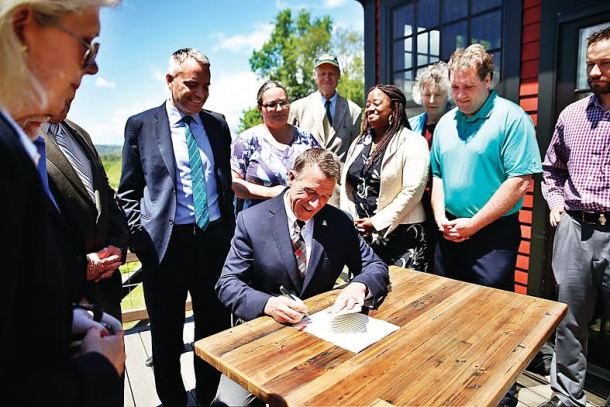
Seated on the restaurant’s sunny deck, with sweeping Harwood Hill views of the Bennington Battle Monument, Scott signed legislation that makes anyone who has released PFOA (perfluorooctanoic acid) into the environment liable for funding a source of clean drinking water. Locally, that is estimated to involve more than $30 million for town water line extensions to affected properties.
“Today, you have your entire state team here reaffirming our commitment to the people of Bennington County impacted by PFOA contamination,” Scott said, adding, “While we may not always agree on issues, as you may have read, we are in lockstep on this issue, across party lines.”
The legislation (S.10) was sponsored by Bennington County Sens. Brian Campion and Dick Sears and supported by the entire area delegation in both chambers, most of whom attended the signing. The bill was filed this year in response to discovery in 2016 of PFOA in private wells over a widespread area around now-closed ChemFab Corp. factories in Bennington.
The state and the current property owner, Saint Gobain Performance Plastics, have been negotiating over the costs associated with providing long-term solutions to the contamination. PFOA is a suspected carcinogen used in the manufacture of Teflon, which was in turn used in the coating of fabrics created by ChemFab and in a number of consumer products sold for decades around the country.
Discovery of PFOA contamination in early 2016 “hit us like a ton of bricks down here,” Sears said. “You read about it in the papers, at Flint, Michigan, and in other states — in nearby Hoosick Falls. But you don’t think it’s going to hit here. And then you find your neighbors, your constituents, with the homes that have been awfully affected by this PFOA.”
He said the legislation was “a fairly simple concept, but a difficult bill,” one that required cooperation and support from many in state government.
“A lot of times in Bennington County you feel like the forgotten county,” Sears said, but on this issue he praised the Legislature, the Scott administration and the former administration of Gov. Peter Shumlin for presenting a united front on PFOA contamination and “being with us every step of the way.”
Campion said that extra-mile cooperation extended to a field trip by his Senate Committee on Natural Resources and Energy to take testimony in Bennington on the experiences of residents dealing with PFOA in their well water. “That was an extraordinary evening, and it was a great example of democracy in action,” he said.
Campion also thanked area residents “for your patience and fortitude during this process. You have heard everyone who has spoken: We are going to be with you until this is over, until a solution is found.”
He added that the Legislature continues to work on bills aiming to better protect Vermonters and the environment from similar industrial contamination.
Scott said the legislation provides the state Agency of Natural Resources “with another tool” to deal with environmental contamination and force responsible parties to pay for water line extensions to secure safe drinking water. The bill acts as a back-up option, he said, should negotiations with the company fail to produce an acceptable solution to the contamination.
At this point, Scott said, negotiating with Saint-Gobain still seems the best course and the one that could produce results within the shortest timeframe. Should the talks break down, or the state be forced to impose a demand for payment under the new legislation, the governor and other officials acknowledge that a lengthy court battle could follow.
Town Manager Stuart Hurd said following the signing ceremony that “this is good legislation, but we don’t get where we need to be any faster if it goes to litigation. That would be years.”
In that regard, Scott said his administration intends to fund construction of town water line extensions if no settlement with the company can be reached and to seek to recoup the costs in court.
“The state will continue to step up,” he said, adding that although state resources are limited, “we’ll do what’s right.”
Saint-Gobain has supplied bottled water and carbon filtering units for private wells with PFOA contamination, and the firm has agreed to fund final design of water line extensions to about half the affected properties while not yet agreeing to fund the construction work.
Engineering and other work is in progress to document the scope of the contamination in the other sections with PFOA in wells, with state officials planning to use that information in negotiating a settlement with the company or, if necessary, to identify the responsible party or parties for future court proceedings.
The overarching goal of the legislation and other steps, Scott told those present, has been to “hold Saint-Gobain responsible for municipal water line connections should negotiations ultimately fail to produce a result that is in the best interests of your community.”
He added, “I still feel we can reach an agreement with Saint-Gobain, representing the best and fastest way to provide this community with long-term drinking water solutions.”
The state wants to begin construction on part of the project this year, Scott said, “but we need Saint-Gobain to continue to cooperate to provide that certainty.”
The governor said he and state Attorney General T.J. Donovan agree that “we will only continue to pursue the settlement option if it represents the best result for this community. If circumstances change, we’ll change course, but we’re not there yet.”
ANR Deputy Secretary Peter Walke, who also attended, affirmed that that state’s priority is for long-term clean drinking water solutions. He praised the cooperation and supportive efforts of residents, local and state officials in dealing with the contamination, but he cautioned that “this is massive investigation, cleanup effort, remedial action; it’s going to take several years to get done. But we are working faster here than we ever have.”
Also speaking was Rob McDougall, environmental protection division chief in the AG’s office, who thanked lawmakers for taking quick action on S.10. He also assured residents that “no one has forgotten about Bennington in Montpelier. My team and I work every single day for the people of Bennington, for the people of North Bennington. We literally are in communication with the Agency of Natural Resources and their attorneys multiple times a day.”
On his first day in office, Donovan “made time for a full briefing on Bennington on day one,” McDougall said. “The attorney general believes that clean drinking water is a human right.”
/

