

(Jon Margolis writes political columns for VTDigger.)
[I]t happens every May.
No, change that to the plural. It should be “they happen” every May, as the Vermont Legislature strains and stumbles through its final days, as it is (probably) doing this week.
Three things happen.
One is that almost everyone, including the elected lawmakers, spends most of their time standing or sitting around doing nothing while a handful of leaders, committee chairs, staff experts and sometimes the governor meet behind closed doors to try to make deals.
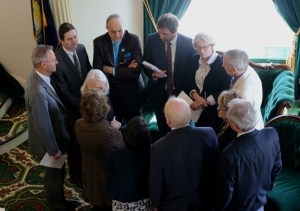
Sure. As Rep. Mark Higley, R-Lowell, a thoughtful rank-and-file member of the minority, noted, “Until this point, we’ve had enough influence in the committee process and with our floor votes.”
So the leaders, committee chairs and top executives are making their final deals within the parameters (mostly) established through the process in which all legislators participated.
Besides, as even self-described “good government” advocate Anthony Pollina acknowledged, there probably aren’t any alternatives. Sen. Pollina, P/D-Washington, said he was not concerned by the closed-door meeting but by the “very rushed” conclusions forced by “artificial deadlines.”
But he agreed that the session had to end sometime, and that the most contentious issues would always be resolved just before adjournment.
“That’s the dilemma,” he said.
The second thing that happens at the end of every session is that rumor runs rampant.
“What do you hear?” is the phrase most commonly heard in the corridors and the cafeteria. The question is asked indiscriminately of legislators, lobbyists, reporters, staff members and assorted hangers-on. While it would be wrong to say that none of them knows anything, rarely does anyone know very much.
A failing that does not stop them from passing on what they have heard, even if what they have heard is merely another person’s surmise. On Wednesday, shortly after lawmakers passed a marijuana legalization bill, word went around that Gov. Phil Scott would threaten to veto it unless Democratic leaders of the Legislature agreed to amend the budget bill to his satisfaction.
That seemed unlikely. Not that Scott would veto the bill; he’s had reservations about legalizing pot from the outset. But that the veto threat would be an effective bargaining ploy with the Democrats.
But who knows? It’s the end of the session. Anything is possible.
The third unavoidable end-of-session phenomenon is that much will be made of little, or at any rate that too much will be made of whatever is holding up adjournment.
This year, what is holding up adjournment is that budget amendment Scott wants. It would transform negotiations over health care for public school employees. Instead of being part of district-by-district collective bargaining, the employee unions and the state government would negotiate health care agreements statewide.
It’s an interesting proposal that, like most interesting proposals, has its potential benefits and its potential drawbacks. But its acceptance or rejection will not shake the foundations of the earth, or of Vermont. The state’s future prosperity does not depend on the outcome. Nor does the vigor of its enterprise, industry or culture. Nor, to any great extent, does its tax structure, though property tax reduction is the governor’s aim.
But it’s what’s holding up adjournment. It’s the controversy. It’s the subject of all those “what do you hear?” questions. So — human nature here — it has to be very important. It has to be significant even if its actual significance in the real world (the one that lies outside the Statehouse) is indeterminate and probably modest.
Scott thinks the benefit to property tax payers could be “up to $26 million.” Like all dollar figures out of context, $26 million means … absolutely nothing. Like all dollar figures, this one is a percentage of something, and in this case it isn’t even clear what it is most sensibly a percentage of. If it’s the numerator, what’s the denominator? The (roughly) $1.6 billion the state expects to spend on elementary and secondary education in fiscal year 2018? The $590 million to be raised by the homestead education tax? Or something else?
By any calculation, $26 million is not a very large percentage of any of those numbers, and the saving for any taxpayer is likely to be in the tens of dollars per year, not the hundreds or the thousands, and that’s assuming that the new system works as envisioned, or even that it works at all.
An analysis of the plan by the Office of Legislative Council doesn’t seem sure that it will. The analysis notes “legal questions regarding how the negotiations would occur” on a statewide level, as well as “considerable question about how much savings will actually be realized by the Governor’s plan.”
None of this renders the proposal worthless or the debate inconsequential. It does suggest that the consequences are unlikely to make much difference in anybody’s life.
Such mere reality does not diminish the Statehouse chattering, which at any rate concentrates less on the substance of the dispute than on its politics. The Republicans argue that the Democrats are insufficiently committed to tax reduction and too beholden to the Vermont National Education Association. Some Democrats complain that Scott has manufactured the controversy because he thinks it’s good politics. One veteran Republican agreed, saying Scott should veto the budget bill if it lacks his plan because “it’s a winning issue, the only winning issue he has.”
Meanwhile other Democrats are angry at their leaders for trying to reach an agreement with the governor rather than just opposing him.
They may all have a point.
/

