


[L]eaders of a coalition of lawmakers backing Republican Gov. Phil Scott’s plan to change teacher contract negotiations were elated and bewildered and disappointed all at once as they won the debate late last night, only to have the House Speaker cast a vote against them and kill their bill with a tie vote.
The House narrowly defeated a plan to move teacher health care negotiations from local school boards to the state. The proposal had 74 votes for and 73 against, when the Speaker cast her vote against it making it a tie and killing the governor’s hope for offering property taxpayers some relief. Two members – one a sponsor of the measure – had left the late night session and both were for the proposal, according to Minority Leader Don Turner, R- Milton.
“That is the closest I’ve ever come to winning,” Turner said. “I think the debate was enough to get some people to change their mind or vote with us. We got more votes than we thought we were going to have,” he said.
At issue were two different approaches to tapping $26 million in savings on health insurance for teachers to lower property taxes.
Gov. Phil Scott and the House and Senate GOP proposed using a statewide teacher’s contract for health care benefits as a mechanism to reduce costs across the state. In the House, this plan was outlined in the Beck amendment.
Democrats, who hold majorities in both the House and the Senate, say Scott’s proposal would interfere with collective bargaining and they proposed keeping local negotiations in place. The House leadership pitched the Webb amendment, which featured a grant mechanism to incentivize local districts to save money on teacher health care.
Scott first proposed the idea of moving bargaining over teacher health care benefits to the state level several weeks ago. His communications director, Rebecca Kelley, said that the House vote shows the proposal has legs.
“While the Speaker’s vote ensured this savings proposal was not adopted tonight, this vote is a clear indication that enough votes exist in the House to ensure that, one way or another, the governor’s proposal can still become law, saving taxpayers up to $26 million each year, without asking teachers to pay more or cutting programs for kids,” Kelley said.
Jeff Fannon, head of the Vermont NEA, blamed the close vote on “misinformation” and said such a dramatic change should happen only after a lot of vetting.
“There was no genuine committee hearings about this and people were wowed by a $26 million number that I believe was fictitious,” Fannon said.
Rep. Johannah Donovan, D-Burlington, said teachers have been missing in all these conversations. “They were never brought into this discussion at all. That is a travesty. That is why we should vote no, defeat this and then we can move forward and include everyone in this discussion.”

A former teacher and school board member, Rep. Tommy Walz, who voted against the Beck amendment, said it set up a strange kind of collective bargaining.
“Neither party is at the table, you have the state and a statewide union bargaining for local teachers and local school boards you have taken power completely away” from localities, Walz said during the late night debate Wednesday.
Turner said the next step will be to ask the governor to veto the budget or another bill because he believes they have the votes to sustain it, Turner said.
“We have proven we can stick together, proven this is an issue important to Vermonters,” Turner said.
Up until now, the governor has stopped short of using the V-word. He has simply repeated that it would be irresponsible to leave savings for taxpayers on the table.
In a press conference on Wednesday, Scott said, “You can threaten a veto, but I like to give legislators the latitude to do the right thing. If you take the politics out of this — sometimes I’ve found over the years that to paint someone in a corner they come out and are very defensive. I think this is the right thing to do; you can put the partisanship aside and do the right thing and this would be advantageous for all Vermonters.”
Scott insisted that the savings Democrats say they want to achieve through the Webb amendment would be on a “hope and a prayer” in 2019.
“That doesn’t do it,” Scott said. “We can realize those savings immediately and receive the benefit.”
“If [the Democrats] don’t like a statewide teachers contract concept, maybe the NEA or some other organization should put forward a plan,” Scott said.
The governor and a coalition of lawmakers were pushing what became known as the Beck amendment, named after one of the lead sponsors, Rep. Scott Beck, R-St. Johnsbury. The amendment was attached to the education tax bill that was approved later in the night.
Republicans forced the House into a debate over the governor’s proposal by refusing to suspend rules.
Speaker Mitzi Johnson said she had to either allow a debate on Beck’s amendment, fail to move important bills or stay in Montpelier for several more weeks. Adjournment is set for Saturday.
The Senate leadership has said if Beck’s proposal passed it would go through the traditional committee process and most of those committees are shut down, according to Johnson.
The Democratic leadership of both houses proposed an alternative known as the Webb amendment that would keep bargaining at the local level. The House voted on the Webb amendment after Beck’s measure failed, and it was approved.
The coalition of House members willing to vote for the Beck proposal seemed to fall apart when the Democratic leadership presented an alternative bill early Wednesday.
“We had the votes this morning,” said Rep. Heidi Scheuermann, R-Stowe.
As the day wore on, the Webb amendment gained momentum and it appeared it had siphoned off enough votes to guarantee the failure of the Beck amendment.
The hastily prepared language in Rep. Kate Webb’s amendment would allow negotiations over health care to continue at the local level, and it calls on school districts to report any savings they garner to the state. Any savings that might be collected would be given back to localities in the form of a grant and a mandate that towns use the money to lower property taxes in fiscal 2019.
Rep. Janet Ancel, D-Calais, said the proposal “gives us information and we will know whether there was savings.”
“I really like the reporting requirement — no matter what even if we weren’t trying to push those savings toward lower property taxes,” Ancel said. “What the bill does, is it tries to the extent we can make sure that those savings show up and we can lower tax rates.”
Some lawmakers worried the Webb amendment offered too little incentive for local districts to reduce spending.
Scheuermann said the Webb plan won’t bring in the savings “and there is no incentive for the local school boards, so why should they fight with their teachers?”
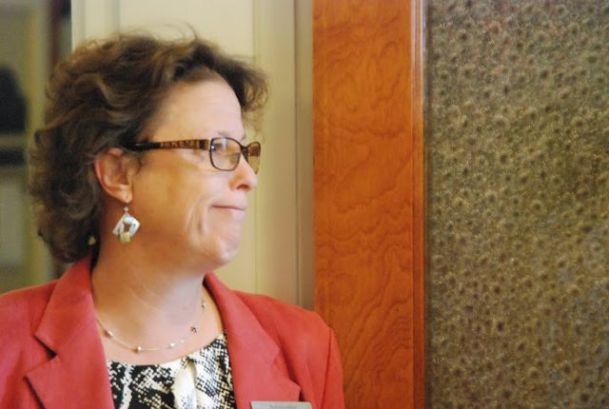
Rep. Brian Savage, R-Swanton, said the Webb plan is worse than doing nothing.
The governor didn’t like the bill either, but he stopped short of using the V-word.
“We must make certain there is a statewide mechanism in place to ensure the savings are, in fact, secured for taxpayers,” Scott said in a statement. “Anything that does not achieve these outcomes would not be an acceptable alternative.”
Minority Leader Don Turner, told his caucus that conversations with the leadership broke down when they refused to allow the governor to bargain on behalf of the state.
Moving bargaining to the state is “a key component that levels the playing field with the NEA and local school boards,” Turner said.
For two days, Speaker Johnson put off deliberations on the education tax bill, H.509, to avoid a floor debate on two amendments that would change the way the state negotiates health care for teachers.
Two weeks ago, Scott, with the support of school board members and school superintendents, proposed moving negotiations from local districts to the state because of an unusual situation in which all teachers are currently adopting new health care plans at the same time.
Nicole Mace, executive director of the Vermont School Board Association, said the governor’s proposal establishes a new baseline for health insurance.
“If it isn’t done carefully and in a coordinated manner across the state it could undermine our ability to have lower more sustainable health care costs,” Mace said. “If premiums start to go up and districts are still paying all of the out-of-pocket costs then there is a real risk of missing this one-time opportunity and we will be paying a lot more in three years.”

Rep. Adam Greshin, I-Warren, one of the sponsors of the Beck amendment, said it is about more than money, it is also about governance.
“The governance part provides the long term annual savings. It allows for the negotiation of health care at the state level with professionals on both sides so it levels the field — that is the long term savings,” he said.
The Democratic leadership’s proposal leaves out the governance piece and that is critical to long-term savings, according to Greshin. “If you want to do something for your folks back home, not just taxpayers but school board members and administrators, that is huge. The amendment they proposed (Webb) is waving a carrot in front of you that doesn’t do much.”
The Webb proposal would only be in place for one year to capture any savings local districts might accrue from the six months that teachers will be on new plans in fiscal 2018.
It is estimated that if school districts all negotiated an 80/20 split and paid just as much for out-of-pocket costs as teachers have on their current plans then up to $13 million could be saved in the first six months of the fiscal year.
Webb’s plan would take the savings from the local school districts, then return them to them as grants and require they be used to lower property taxes.
Rep. Kurt Wright, R-Burlington, said that isn’t any different from what school districts can do right now and it will make more paperwork for the school boards since they will have to apply for their own savings.
“On any level, the Webb plan does not do what we are trying to do,” Wright said.
Editor’s note: This story was updated at 7:26 a.m. May 4.

