The governor and Vermont Attorney General TJ Donovan insisted the law did not conflict with federal regulations. If it did, that could put federal funding to Vermont at risk.
The signing of S.79 came just days after U.S. Attorney General Jeff Sessions threatened to withhold or revoke law enforcement funding from so-called sanctuary cities and states that block police from telling federal authorities about unauthorized immigrants in their custody.
A New York Times graphic paints the entire state of Vermont as limiting local police cooperation with federal immigration authorities. The source for the map cites Vermont’s requirement for bias-free policing, which includes provisions related to immigration.
Scott and Donovan pushed for S.79 after Trump issued executive orders signaling a crackdown in immigration enforcement. Scott said Trump’s executive orders would do little to combat immigration problems but instead introduced “a certain level of uncertainty for states, law enforcement, citizens and noncitizens alike.”
Donovan called Trump’s executive orders “un-American and unconstitutional.”
The bill was fast-tracked through the Vermont House and Senate.
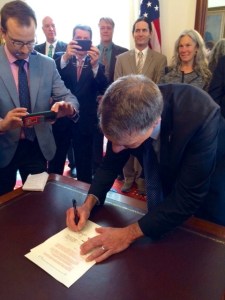
The law says state and local police need Scott’s approval before participating in certain federal civil immigration enforcement actions. Trump has promised beefed-up enforcement, which state officials worry could threaten Vermont’s dairy industry because it relies on farmworkers who are in the country illegally.
Officials say many of those workers should not be deported unless they commit crimes. Some advocate for a visa program similar to what’s available for apple pickers and others who are allowed in temporarily to harvest.
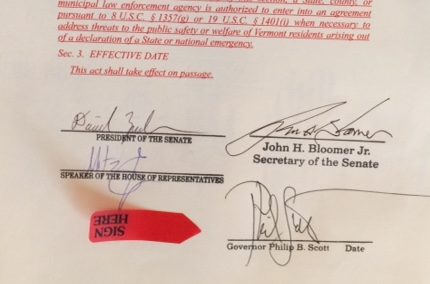
The law, effective upon Scott’s signature, also seeks to “proactively prevent” the state from sharing personal information, including one’s religion, should federal authorities try to establish a registry.
After the ceremony, Donovan said minor changes in the policy on fair and impartial policing were needed for Vermont to be in compliance with federal requirements but that he did not have details. And if the law signed Tuesday posed a problem, Donovan said, the state would seek a meeting before federal authorities withheld or revoked funding for police grants.
“If there’s an objection, let’s have a conversation about it,” Donovan said.
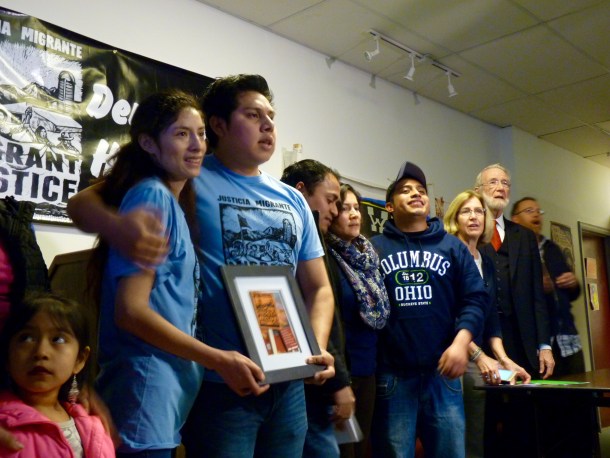
Scott and Donovan have been clear the law’s provisions would not prohibit U.S. Immigration and Customs Enforcement officials from conducting their own enforcement actions. Nor would the law have done anything to prevent the recent arrests of three members of an advocacy group that helps immigrant farmworkers in Vermont, because no local or state police were involved.
At Tuesday’s bill signing, the governor framed the enforcement issue as the federal government violating the rights of states and individuals.
“This sort of federal overreach to commandeer state resources for federal purposes, in my opinion and under the guidance of legal counsel, would violate the 10th Amendment,” Scott said, adding he believed the federal crackdowns could violate Fourth Amendment protections against improper law enforcement searches and seizures.
Officials have acknowledged the Vermont law may be symbolic, but they say it also carries an important message. Donovan portrayed the need as a human rights issue.

Scott was flanked by members of his administration and leaders in the Legislature from all three political parties during the signing ceremony in an effort to show broad support.
The city of Montpelier, which has adopted a broad policy on fair and impartial policing, was included in a recent ICE report requested by Trump to crack down on “sanctuary cities.” The policy in the capital includes not holding people based solely on a civil immigration warrant.
Mayor John Hollar has said Montpelier was singled out in the ICE report and that other communities have adopted the same policy.
After the ceremony, Hollar said of the federal threats to take away funding: “So what are we going to do? Duck and hide and not do anything that might (run counter to federal regulations)?”
The head of the American Civil Liberties Union in Vermont, James Lyall, blasted the U.S. attorney general’s warnings about funding. “This is yet another attempt by the Trump administration to intimidate local officials to take actions that jeopardize public safety and risk legal liability,” Lyall said. “Vermont’s municipalities and state agencies have no obligation or authority to enforce federal immigration law. The attorney general’s scare tactics are legally indefensible and antithetical to our federal system of government.”
Donovan has issued guidelines to police agencies that complying with so-called detainer requests is voluntary and complying with them without probable cause would violate the rights of those picked up.
“Do we not protect people’s rights as we interpret them or do we? And do we run the risk of having this argument?” Donovan said. “And what I’m saying is, look, we think we’re well within the law. If there’s a disagreement, tell us. Don’t just identify us as a sanctuary city or state. Tell us specifically what we’re out of bounds on.”