


Despite around-the-clock arm-twisting and closed-door negotiations, Republicans abandoned their plans for a floor vote late Thursday on the replacement legislation, called the American Health Care Act.
Chaos and confusion permeated Washington on Thursday as Republican leaders projected confidence in the bill’s passage amid a growing chorus of concern coming from Capitol Hill. House Speaker Paul Ryan twice delayed a news conference on the bill before canceling.
Shortly after the vote was delayed, the White House indicated a floor vote could come as early as Friday morning. Still, Thursday’s turmoil unmasked the deep divisions that remain in the Republican Party over how health care reform should be accomplished.
House Republicans need 215 votes to pass the AHCA and send it over to the Senate, where it is expected to be significantly moderated. House Democrats are unified in their opposition to the bill, meaning the Republican House leadership cannot afford more than 22 defections. Media estimates Thursday suggested up to 40 members were leaning toward rejecting the bill as it is currently drafted.
The legislation — drafted and promoted chiefly by Ryan and Trump — has been flayed in recent days by Republicans of all stripes.
Members of the conservative House Freedom Caucus see the bill as keeping too many of the protections and regulations mandated in the Affordable Care Act, also known as Obamacare.

But to woo conservatives, Republican leaders may have to strip out some of the most popular provisions of Obamacare, including the mandate that insurance plans must cover so-called essential benefits, like mental health and drug addiction treatment as well as maternity care.
Another regulation targeted by the House Freedom Caucus currently prohibits insurers from setting prices based on criteria including gender and medical conditions.
The Freedom Caucus rejected a deal Thursday afternoon that Trump proposed. It’s unclear what exactly Trump offered, but Freedom Caucus leader Mark Meadows, of South Carolina, said Thursday afternoon that he had whittled down his members’ requests from the rollback of six ACA regulations to just two.
“We are certainly trying to get to yes, but indeed we’ve made very reasonable requests and we’re hopeful those reasonable requests will be listened to and ultimately agreed to,” Meadows said shortly after his meeting with Trump.
If Ryan and Trump endorse the proposed changes by the right flank of the party, they risk alienating the Tuesday Group, a coalition of moderate Republicans. At handful of Republicans in the group oppose Trumpcare in its current form, including the leader, Rep. Charlie Dent, R-Pa.
“I believe this bill, in its current form, will lead to the loss of coverage and make insurance unaffordable for too many Americans, particularly for low- to moderate-income and older individuals,” Dent said in a statement Thursday.
Of chief concern to many moderate members is a recent report from the Congressional Budget Office that forecasts up to 24 million people would lose their health insurance under the Republican plan.
While the ACA mandated that health plans for the elderly could cost no more than three times the price of plans offered to young people, the Republican bill scraps this requirement. It sets looser restrictions, allowing insurance companies to charge the elderly up to five times the price of plans available to their younger counterparts.
Obamacare created income-based subsidies that took into account the local cost of insurance in every state and at every age. The Republican plan instead offers consumers tax credits that are less generous and are calculated based on age. The credits would increase based on inflation.
By reformulating how subsidies are offered, the CBO estimates the effects of the Republican plan as “substantially reducing premiums for young adults and substantially raising premiums for older people.”
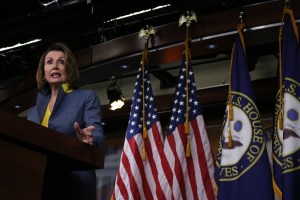
In a news conference Thursday morning, House Minority Leader Nancy Pelosi, D-Calif., said 20 million Americans gained insurance under the law. The ACA also created new consumer protections and is credited with slowing the rate of premium increases.
She also criticized the Republican deal as a “monstrosity” and called Trump a “rookie president” with poor deal-making skills.
“You do not bring up your bill just to be spiteful of the anniversary of the Affordable Care Act,” she said.
Pelosi said Obamacare remained flawed but declared the Republican plan would raise premiums for Americans and weaken critical care for all sorts of conditions, from drug addiction to cancer.
“Republicans are making being a woman a pre-existing condition again,” Pelosi said. “Stripping maternity care is a pregnancy tax, pure and simple.”
In his first political statement since leaving office, former President Barack Obama called for bipartisan cooperation to fix the ACA.
“If Republicans are serious about lowering costs while expanding coverage to those who need it, and if they’re prepared to work with Democrats and objective evaluators in finding solutions that accomplish those goals — that’s something we all should welcome,” Obama said in an email to supporters. “But we should start from the baseline that any changes will make our healthcare system better, not worse for hard-working Americans.”
Pelosi said Thursday that Democrats hadn’t drafted an Obamacare fix bill alongside the Republican plan because “there’s no use putting something forward that has no prospect of success.”
While legislation hasn’t been introduced, Democrats have floated a few ideas of how best to lower health care costs by tweaking Obamacare.
One idea is to help stabilize markets in so-called risk corridors. The ACA, as passed, set up a three-year subsidy program to help health insurance companies offset the cost of setting up new markets across the country.
The startup costs were much more expensive than imagined, and the subsidy program was gutted in 2015 by Republicans in Congress, led by Sen. Marco Rubio, R-Fla. The lack of payments has left insurance companies reeling and weakened insurance markets.

In an interview with VTDigger about his work on the Affordable Care Act and the push to replace it, Welch expressed frustration with how quickly Trumpcare was considered in the House.
“(Republicans) lack the humility to appreciate what an enormous challenge (health care) is,” Welch said. “They had convinced their voters that it was a simple one-sentence bill: ‘Obamacare is repealed and the replacement is the care you had, that was great.’”
Welch said he couldn’t predict the future of health care reform in Congress and was puzzled by the difficulty Republicans were facing at a time when they controlled both the executive and legislative branches.
“It’s a kind of vote that’s too big to fail. There’s too much damage to them politically if they can’t get a bill out of the house,” Welch said. “But they may not. But as an observer — we are on the sideline watching — it’s hard for me to understand how the Freedom Caucus are making so much noise about a bill that accomplishes two of their goals: unraveling the Medicaid entitlement and cutting taxes.”

