

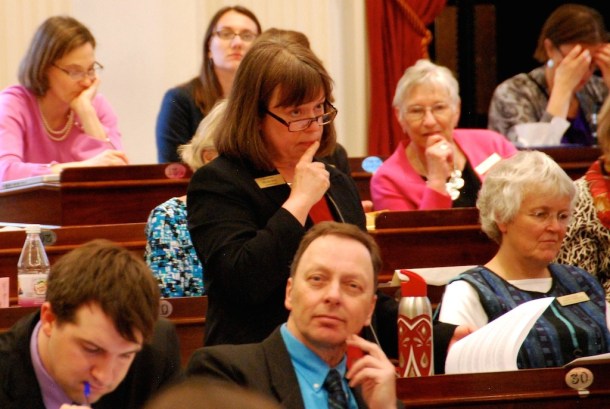
The House approved H.136 in a voice vote with little debate. The bill is scheduled for a final vote in the House on Wednesday before moving over to the Senate.
The bill would require an employer to reasonably accommodate a worker’s condition related to pregnancy or childbirth, unless the employer could prove that accommodating the request would be an “undue hardship.”
Employers would not be allowed to force a pregnant woman to go on leave because of her condition and couldn’t take adverse action against an employee because she requested or used the accommodations. The law would go into effect Jan. 1.
Rep. Helen Head, D-South Burlington, is the chair of the House General, Housing and Military Affairs Committee, which passed the bill 7 to 4 along party lines. She said the bill is designed to require employers to take minor actions to make pregnant women more comfortable.
Head said some examples of accommodations are giving a pregnant worker a stool so she can sit down or extra water to stay hydrated; allowing additional bathroom breaks; and allowing her not to wear her uniform if it doesn’t fit anymore.
She said the Vermont law is required because a U.S. Supreme Court case from 2015, Young v. United Parcel Service, said pregnant workers are not entitled to reasonable accommodations at work in the same way that workers with disabilities are.
“(H.136 is) along the lines of what we did a few years ago, by allowing breastfeeding moms to request accommodation” to pump breast milk in the workplace, Head said. “(Workers) may request it, and employers must consider it, but (employers) do not need to accommodate if it creates an undue hardship.”

But Scheuermann said the bill goes further than the federal Americans With Disabilities Act. She said H.136 could force an employer to create a new job for a pregnant worker if she can’t perform her central duties.
“This bill doesn’t have anything about performing the essential functions of the job,” Scheuermann said. “It just has ‘reasonable accommodations,’ so you could as an employer be forced to create a new job for somebody. If you’re a retail establishment, it can be really challenging.”
She also pointed to two federal laws and two state laws — the Pregnancy Discrimination Act, the Family and Medical Leave Act, the Vermont Parental Leave Act and the Vermont Flexible Working Arrangements Act — that she said are already protecting pregnant workers.
“(H.136) essentially places protections for pregnant women over and above what we have in place for disabled workers,” Scheuermann said, “so it creates essentially a whole new class of worker, and that is a pregnant worker.”
Erin Sigrist, the president of the Vermont Retail and Grocers Association, said she represents 800 companies that take pride in their workforce and try to make accommodations for their employees, but the group has concerns about the bill.
She said the language is overly broad and one-size-fits-all.
“Every individual employee has different needs, and employers work closely with their employees to provide what it is within the confines of their business that they can provide,” Sigrist said. “One employee might need hours off. One employee might need to work a little bit later.”
She said she hopes senators will “at least consider the unintended consequences for the employer.”
Rep. Tommy Walz, D-Barre, said the federal Pregnancy Discrimination Act is not sufficient. Under that law, he said, pregnant workers have to go through an “onerous” process to get accommodations, and “typically the pregnancy is over before the case settles.”
He said H.136 “encourages employers and employees to have a conversation when the employee is pregnant and needs an accommodation because the doctor told her that she needs it.”
Walz said roughly 10 other states have passed laws similar to H.136 and that Vermont is one of about eight states currently working to pass a law.

