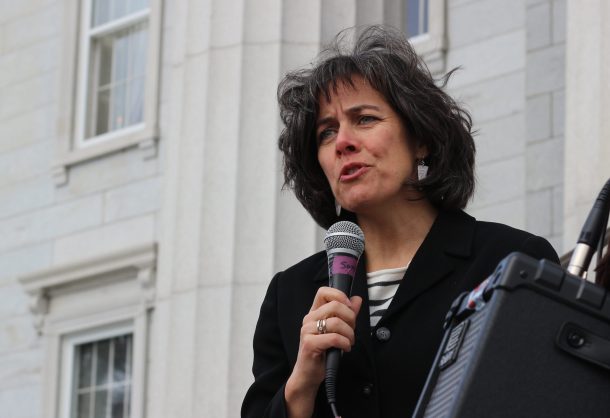
[A] group representing Vermont’s town clerks says a legislative recount of a House race from Orange County would “cast doubt on the integrity of elections in the future.”
The Vermont House of Representatives is set to debate a resolution that would allow lawmakers to conduct a recount in the House chamber for one of their own members this week.
The town clerks say that move could compromise the electoral process by allowing partisanship to color election results. And in the future, they say, it opens the door to more legislative recounts of contested elections.
In a statement, Karen Richard, the chair of an association for town clerks, said town officials are “charged with being responsible for the integrity of elections and this will cast doubt on the integrity of elections in the future.”
“This recount will set precedence for all close races and essentially make the General Assembly have the overarching authority of all close elections,” Richard said.
Rep. Bob Frenier, a Republican from Chelsea, has already been seated in the House, but his opponent in the November election, Rep. Susan Hatch Davis, P-Washington, has contested the original vote count, the certification of the vote by the Board of Civil Authority and a recount. In all cases, Frenier had more votes than Hatch Davis. Judge Mary Miles Teachout ruled in December that Frenier defeated Hatch Davis by seven votes. Secretary of State Jim Condos told lawmakers at the beginning of the legislative session that Frenier had the right to take a seat in the House.
Hatch Davis, who served five terms in the House, then took her case to her former colleagues in the Vermont House.
The last time the Legislature conducted a recount was 1985. Under the Vermont Constitution, lawmakers have the authority to “judge” an election.
House Speaker Mitzi Johnson allowed the legislative recount to move forward because she says “accuracy in democracy in determining the will of the voters is the foundation of our government.”
“We’ve had two other elections this year where the processes and multiple visits to judges have flipped recounts, have flipped elections, both in the primary in my district and in the Buxton-Ainsworth vote,” Johnson said.
Johnson says the Legislature is the ultimate appeals court for electoral disputes in House races and counting by lawmakers isn’t new. The Legislature is “supporting” the town clerks because lawmakers have not overruled determinations made by municipal officials. The recount provision in state statutes, she says, does not adequately address visual inspection of ballots that are counted by tabulators.
“I don’t think it sets precedent because it has happened before, it’s not the first time,” Johnson said. “We need to ensure that the person the voters elected is representing them.”
In the Buxton-Ainsworth case, for example, she says a judge ruled that the ballots should be visually inspected before they are fed into a tabulator. That led to a change in the election outcome. David Ainsworth, a Republican, was seated in the House as a result over Democrat Sarah Buxton. In the Davis-Frenier case, there wasn’t a second recount because the judge ruled narrowly on a few ballots, Johnson said, and as a result the disputed election went to the Legislature.
Johnson, D-South Hero, disputes the process has not been partisan. But votes in the House Government Operations Committee have been divided along party lines, with the panel’s six Democrats and one Progressive in favor. The four Republican members on the panel have all opposed it.
Republicans say the effort is a power grab designed to weaken their position.
The House GOP now has 53 seats, and the caucus needs 51 seats to sustain a gubernatorial veto. Don Turner, the minority leader, says losing the Frenier seat would make it more difficult for his caucus to sustain a veto by Republican Gov. Phil Scott.
Turner and other Republicans say Johnson is not upholding her duty to represent the whole House, regardless of party, and has instead resorted to partisanship in order to strengthen the Democrats’ hand. He pointed to another Orange County race six years ago in which former speaker Shap Smith and Donna Sweaney, the chair of House Government Operations, agreed not to bring a recount to the floor of the House.
“It’s become a very partisan issue,” Turner says. “An election ordinarily is partisan to run, but the process for recounting is done by statute and it’s nonpartisan by nature. Since it’s been here, it’s been very partisan. We’re trying to understand why we’re doing this. We haven’t really heard a justification for undermining the integrity of the electoral process, which is what I think is happening here.”
“If the Legislature takes this action, it opens the door for many other close races,” Turner says. “I am concerned about the way it’s proceeding and going forward. If we are not successful tomorrow, it’s a very slippery slope. We will have no rules, they can write the rules as they want.”
Richard, chair of the legislative committee of the Vermont Municipal Clerks’ and Treasurers’ Association, is calling on House members to reject the recount recommendation by the House Government Operations Committee.
“We firmly believe this is undermining the integrity of all Town and City Clerks as well as the Justices of the Peace, that are elected to serve as members of the Board of Civil Authority,” the statement read.
The association is asking constituents to contact local House members and urge them to vote against the legislative recount resolution that will be taken up on the floor of the House Wednesday.
Richard, who also serves as Colchester’s town clerk and treasurer, said there were “no gross discrepancies” and no procedural errors that affected the results of the Frenier-Hatch Davis election, adding that there is “no evidence” ballots were misread by the tabulator machine used in the recount.
“Nothing surfaced that indicates that a recount is justified,” Richard said in an interview Tuesday. “If there were gross errors, if they discovered something during the recount process, I would understand it.”
Richard added that in the Orange-1 district recount in late November the number of voters checked off the checklist and the number of ballots counted for each town matched.
“At the end of the day,” according to Richard, “our goal is to make sure that the number of voters checked off the checklist and the number of ballots in the machine agree.”
Hatch Davis is pressing her case in the House, which according to Vermont’s Constitution, has the authority to judge “the elections and qualifications of its own members.”
The House Government Operations Committee took testimony over two days and debated a resolution over the parts of four more, before agreeing late last week to send the recount resolution to the full House, which has the final say on the matter.
The House could adopt the resolution, make changes, or decide to do nothing at all. Vermont’s Constitution does not spell out the specific steps the House needs to take to judge the “elections and qualifications” of its members.
The rules for the recount are not spelled out in the resolution. The panel has asked the Office of Legislative Council and the secretary of state’s office to help in recommending rules to follow for the recount, if the full House agrees to their request.
If the resolution is adopted, a special committee of 23 lawmakers will conduct the recount over a two-day period. Rep. Maida Townsend, the chair of the House Government Operations Committee, will be the final judge for each counted ballot. Special security for the Statehouse must be hired to keep watch over the ballots overnight.
Townsend, D-South Burlington, who has championed the recount, said Tuesday that she “stands shoulder to shoulder” with the town clerks in the need to ensure that ballots and votes are counted accurately.
“We all want the same thing,” she said, adding that testimony regarding recounts before the committee showed that the “visual inspection” of ballots before they are placed in a tabulator can result in marks being seen that could lead to additional votes.
“We know if the visual inspection is not paired with the tabulator, it is possible that votes may have been missed,” she said. “We just want to be very, very careful.”
The main issue, Townsend says, is that the same tabulator machine was used in the recount in Williamstown as was used in the initial election. Townsend also insists that votes must be visually inspected before they are counted by a tabulator.
Williamstown is only municipality in the six-town Orange-1 district that uses a tabulator. On Election Day, the five other district towns hand-counted ballots.
According to a fact sheet put out by the town clerks’ group, the Williamstown tabulator was used in the recount, but it a different “memory card” was used than the one used on Election Day to ensure accuracy.
Also, a visual inspection of ballots before they are inserted into the tabulator is not a requirement of a recount, the group’s fact sheet states.
Hatch Davis also argued that town clerks used an “inconsistent” process for determining “defective” absentee ballots, deciding whether or not a ballot and its votes would be counted. The committee, in voting for the recount, decided against considering the 14 defective ballots in a new recount.
That decision could hurt the ability of Hatch Davis to make up the votes she needs to overtake Frenier, who has already been sworn in as a member of the House. Progressives are expected to propose an amendment to include the defective ballots in the recount.
Rep. Ron Hubert, R-Milton, is the committee’s Republican vice chair. He voted against the recount recommendation. He said Tuesday he agreed with the town clerks group that going forward with a House recount of the Orange County race will lead to more candidates on the losing side taking their case their Legislature.
“That’s my biggest fear,” he said, adding that lawmakers could find themselves spending a lot more time counting ballots in disputed elections if a precedent is set with the Orange County race.
“It was confirmed on election night, confirmed on recount, and reconfirmed by Judge Teachout,” Hubert said of the Orange County race. “I would let it be.”
The message a new recount could send to town clerks has come up several times in recent days. Frenier, in a statement issued after the committee voted in favor of a new recount, called it an “insult to every town clerk in the state.”
The committee also debated at one point including a statement in its recount resolution recognizing the “hard work” and “diligence” of the town clerks. However, they eventually decided against it, with Hubert saying it would be like throwing a “bouquet at people you want to slap around.”
Orange-1 House district includes the towns of towns of Chelsea, Vershire, Corinth, Washington, Williamstown and Orange,
According to order issued last month by Judge Teachout, Rep. Rodney Graham, R-Williamstown, was the top vote getter in the two-seat House district with 2,015 votes. He was followed in the race for the district’s second seat by Frenier, with 1,852 votes, seven more than Hatch Davis with 1,845, the judge ruled.
A fiscal note that will be attached to the recount resolution and presented to the House Government Operations Committee on Tuesday stated that the cost of a new legislative recount would range from $1,290 to $3,790.
That include the cost of securing the ballots overnight, since it’s estimated that a recount conducted a panel of lawmakers could span two days.
One option for overnight security involves hiring sheriff deputies to guard the ballots. Two sheriff deputies would be needed, the fiscal note states.
At $60 an hour each, for 12 overnight hours, the total cost to hire two deputies would be $1,440, the note states. However, another option would be to store the ballots in a vault, possibly one belonging to the city of Montpelier. The cost of that option is not clear.
“One consideration: if a vault is used, ballots may need to be delivered before the close of business, meaning that the recount could not go into the evening,’” the fiscal notes states.