

[A]s Greg Cox sees it, agriculture could play a central role in the revitalization of Rutland’s economy. Cox, the founder of the Vermont Farmers Food Center on West Street, is the first to admit he’s got some lofty ambitions. When the nonprofit was formed in 2012, the volunteer farmer-led initiative had $10,000 and a dream.
“Enough people thought we were crazy,” Cox says. “That it was an impossible dream.”
Five years later, the cavernous light filled space is home to a thriving winter farmers market and the Food Center is in the process of expanding with an industrial kitchen open to area farmers, the construction of a shared food storage facility, and plans for an on-site butchering facility. They’ve also recently installed a $116,000 biomass boiler that burns waste products — mostly in the form of grass pellets — from area farms.
If the Rutland City summer and winter farmers market is any indication, there is room for growth. According to Cox, the outdoor summer market has maxed out its number of vendors at 100 and currently has a waiting list. The winter market has 87 vendors and, according to Cox, is “absolutely chock full,” with vendors offering everything from meat and vegetables to hot sauce and preserves. When the summer market launched in 2007 it grossed just over $500,000 in annual sales. In 2015, according to Cox, it exceeded $2 million.
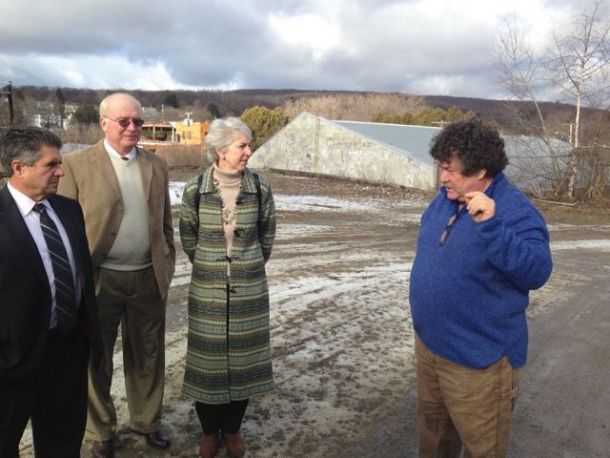
On Thursday morning representatives of the legislative committees on Economic Development and Agriculture toured the facility as part of a larger effort to get out into the communities they serve. Rutland County Sen. Brian Collamore, who serves on the Agriculture Committee, said it was his number one pick and there was some jockeying to get on it.
“The impression I was given was that the agriculture committee has been one that doesn’t have that sort of glamour and pizzazz that the money committees have,” Collamore said. However, in recent years, Collamore says, there’s been a renewed interest in farming, not just in Rutland but throughout the state.
“I’m darn proud of what we have in Rutland,” Collamore said. “And I’m thrilled to be on that committee. It’s a great place to be right now.”
Sen. Robert Starr, who chairs the committee and has served in the Senate for 12 years, said he was impressed with what Cox and others have done with the Food Center and their plans for the future.
“They’ve done a lot by themselves and I think we could almost use that whole program that they’ve put together as a design for other areas of the state,” Starr said.
Cox, who operates Boardman Hill Farm in West Rutland, knows well the costs associated with running a farm. He says he spends more than $500 a month on his electric bill to run compressors and humidifiers for temperature-controlled food storage. In addition, if farmers make more than $10,000 a year in sales on value-added food products, Cox said, their kitchens have to meet certain regulatory guidelines that can often be prohibitive for young farmers.
On Feb. 1, the Food Center will open a new state of the art kitchen for area farmers that will be available 24/7. According to Cox, it has already been booked for 36 hours a week.
Cox is also concerned about the Food Safety Modernization Act, which goes into effect in 2018 and establishes rigid criteria for the washing and packaging of vegetables and greens. Cox says the new rules could put a lot of small farmers out of business.
“We are going to be the regulatory umbrella for new businesses,” Cox said. “Helping them to be able to get through this. Otherwise there will be fewer and fewer new farmers.” This mission at the heart of the Food Center’s model: to help small farmers get off the ground and hopefully grow out of the space, making room for new vendors. Cox points to Castleton Crackers, Vermont Bean Crafters, and Hathaway Farm as examples of vendors who got their start at the Food Center and have since moved on, expanding into wholesale and regional markets.
Starr said the Agriculture Committee will also work to encourage the growth of small farms by pushing to lift the cap on the number of sheep and chickens farmers can keep without state inspection and allowing food gleaned from area farms to be purchased by Vermont schools.
“I can see us putting together a plan to encourage and push things like what are transpiring at the Rutland farmers market forward in all areas of the state,” Starr said.
The Farmers Food Center has plans to add on-site hoop houses that will serve as an education lab for farmers and students. There’s also talk of partnering with a local technical college to develop a food service component in one of the outbuildings.
Perhaps most ambitious though is Cox’s hope of establishing a rail link between the Food Center and farmers markets in New York City. When Cox heard that there was a vintage 1913 Rutland Rail Car that was going to be scrapped, he had it moved to the West Street location. It seems slightly out of place but Cox views at as a natural extension of what the center has already accomplished.
“It’s a symbol of what’s going to happen in the future,” Cox said.

