

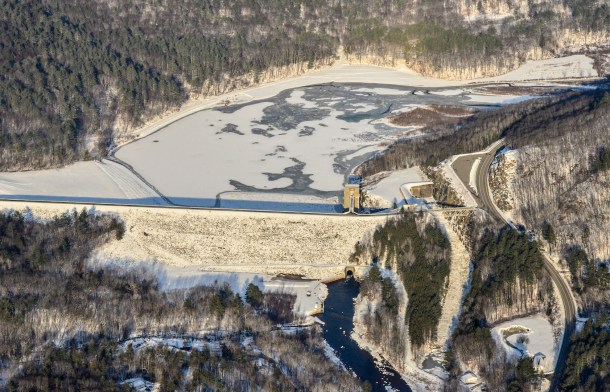
And that’s good news for advocates of the man-made lake behind it, where large amounts of sediment have choked off public recreation and the economic boost it once brought.
The Army Corps plans to remove about 7,000 cubic yards of sediment from the dam this spring “in order to restore beach usage for the upcoming recreation season,” said Tim Dugan, a spokesman for the federal agency’s New England district.
He added that officials also are trying to come up with more comprehensive solutions for the dam site in West Townshend.
The corps is evaluating options for long-term sediment removal in the main body of the reservoir, Dugan said.
The Army Corps’ actions come after public pleas from local residents who are dismayed by chronically low water levels at Townshend Dam.
The federal government built the massive structure on the West River in the early 1960s, and its primary purpose is flood control. As of 2014, the Army Corps estimated that the dam had prevented more than $141 million in damage downstream.
The lake had long been a draw for swimmers and boaters, as well. But the number of visitors to the dam site and to adjacent Townshend State Park has dipped as lake levels have sunk.

The corps spent about $28,000 on a dredging project in 2013, allowing the swimming area to reopen.
But upstream erosion problems have continued. Last year, though the beach technically was open, it wasn’t used much because of the sedimentation and low water levels due to a drought, Dugan said.
Local officials have sought help in solving the problem. Several state legislators and all three members of Vermont’s congressional delegation have responded to various degrees.
In a recent letter to Townshend officials, U.S. Rep. Peter Welch, D-Vt., said his state director has visited the dam site and has been working with the Army Corps, the state Agency of Natural Resources, and the offices of U.S. Sens. Patrick Leahy, D-Vt., and Bernie Sanders, I-Vt.
Welch also wrote that the Army Corps conducted a study of the lake last fall “as an initial step.”
Dugan said that study actually was a topographic and bathymetric survey. Bathymetry is the science of measuring the depth of oceans, seas and lakes; the term also refers to mapping the floor of a body of water.
Information from the survey “was utilized to establish the quantity of sedimentation that has occurred in the swim beach area, as well as the main body of the reservoir,” Dugan said.
That information led to the corps’ planned silt-removal work this spring.
Townshend Selectboard Chairwoman Kathy Hege said she hadn’t yet heard about the corps’ plan but was encouraged by the expected activity at the dam.
“Every little bit will help toward restoring the lake to having some kind of value for the town,” Hege said.
Without some kind of follow-up work, however, this spring’s silt-removal project eventually may be erased by further sedimentation.
It’s not clear what long-term proposals the Army Corps might be developing and how they would be funded. A top regional Army Corps official last year told the Connecticut River Valley Flood Control Commission that the agency has “limited dollars” to operate a multistate district that includes 33 flood management projects and more than 100 recreational areas.
Welch, in his letter to Hege, pledged ongoing assistance and said he’s hoping that, “over the course of time, we will be able to see significant steps taken to improve (Townshend Dam’s) condition.”
“We all share an interest in a comprehensive solution that restores the lake to a condition where it is once again an attractive location for boating, swimming, fishing and other recreational activities,” Welch wrote. “It is my hope that this study will provide a roadmap for the investments and actions that will be required to achieve this goal.”


