


Hunt was speaking Thursday morning to an audience that included staff from all three of Vermont’s congressional offices, two U.S. Army Corps of Engineers representatives and two state legislators. They had come to hear about two pressing issues – the lack of payment in lieu of taxes for Townshend Dam, and the lack of water in the lake behind that dam.
There were no immediate answers. But Hunt and other Townshend officials got the audience they wanted, and the visiting federal officials pledged to look into several ways to help the town.
“I think we have some homework to do,” said George Twigg, district director for Rep. Peter Welch, D-Vt.
Townshend Dam, completed in 1961, is one of a series of federal flood-control projects in the Connecticut River Valley. The benefits of those projects can be measured in the amount of property not lost to flooding since their construction: As of September 2014, officials estimated that Townshend Dam alone had prevented more than $141 million in damages downstream.
Altogether, Army Corps dams in the region have prevented $1.6 billion in damages, estimates show.
But there also was property lost to the massive flood-control projects. Officials here recall many homes and farms displaced by Townshend Dam, which occupies about 1,000 acres. And one reason for the 1953 formation of the four-state Connecticut River Valley Flood Control Commission was to set up a formula so that the states benefiting most from the dams (Connecticut and Massachusetts) could annually “make reimbursements for such loss of taxes and for such hardships” suffered by their upstream neighbors.
But that system has come to seem sclerotic and almost irrelevant to some in Vermont. While the flood-control commission still annually asks towns that host dams about their land values and tax rates, the payments made in lieu of taxes to communities like Townshend have been frozen since 1982. Townshend receives $5,656 annually for a property that the town recently has valued at $1.1 million.
“A thousand acres is worth only $5,600?” protested Irv Stowell, a Townshend Selectboard member, at Thursday’s meeting. He added that, as other states benefit from flood-control in Vermont, “why should we suffer for their advantage?”
Townshend’s letter of complaint to the Greenfield, Massachusetts-based flood control commission brought a December 2014 response saying that, due to the need to reach agreement among the four states, “efforts to facilitate changes and increases in the reimbursement amounts have not been successful in the past and seem unlikely to succeed in the future.”
The commission also asserted that “adjustments to tax reimbursements are not mandatory” under the organization’s compact.
Rep. Oliver Olsen, a Londonderry independent whose district includes the Army Corps’ Ball Mountain Dam, said the towns of Jamaica and Weathersfield have made similar complaints in the past.
“We’ve been beating our heads against this wall for years, and the other states just aren’t going to budge,” Olsen said.
Looking around a crowded table at Townshend’s town hall, however, Olsen noted that “this is the first time in recent memory that the congressional delegation’s been involved.” In addition to Twigg, Thursday’s meeting also included Tom Berry, a field representative for Sen. Patrick Leahy, D-Vt.; and Haley Pero, an outreach staffer for Sen. Bernie Sanders, I-Vt.
“From a state level, there’s nothing, really, that Vermont can do,” Olsen told them. “This is a federal issue, and I think ultimately it’s going to require an act of of Congress to resolve.”
Several options were discussed. Those included the straightforward (congressional offices getting in touch directly with the flood-control commission to express the town’s concerns) and more complex proposals (sifting through the commission’s bylaw changes and its original, enabling legislation).
“We can look at the underlying, authorizing legislation – and we will – to see how specific that is as to the purpose of the commission and what it does,” Berry said.
It did not seem, though, that federal legislators can simply alter the way the commission’s tax-loss payment system works. Berry said that “the whole point of an interstate compact is, it creates an authority that’s separate from the federal government.”
“We can help strategize and apply political pressure, but, probably, we can’t tell the commission what to do,” he said.
Even a relatively significant boost in payment in lieu of taxes will not make a big change in Townshend’s fortunes. But town officials say every bit helps, pointing to their small budget and their large number of tax-exempt properties.
Currently, the tax-loss payments made by Connecticut and Massachusetts total less than $55,000 annually. Berry indicated that an increase would not be unreasonable: “The amount of additional money it would take to get Vermont towns closer to whole is just insignificant compared to the size of the state budgets in those states,” he said.
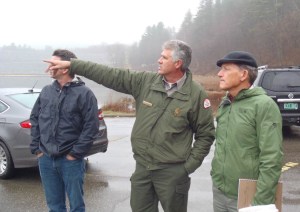
Townshend’s two complaints are related. The flood control commission’s 2014 letter explaining its stance on payment in lieu of taxes ended by pointing out benefits from the dam including “recreational use and business revenue from visitors.”
But since Tropical Storm Irene struck in August 2011, “the dam has been virtually unusable,” Selectboard member Kit Martin said. “If not a health hazard, it’s certainly going to be.”
The problem is large amounts of silt deposited by the storm and by erosion that has continued to occur since. The Army Corps in 2013 spent $28,000 on an excavation/dredging contract at Townshend Lake, removing about 4,500 cubic yards of sediment. But that didn’t resolve the issue, and water levels have dwindled to the point that many swimmers and boaters are not returning to Townshend State Park.
Eric Pedersen, deputy operations chief for the Army Corps’ New England District, said the sedimentation is not negatively impacting the dam’s primary purpose – flood control. But the organization has other worries.
“It’s obviously impacting the recreation,” Pedersen said. “And one of the concerns we have is what’s happening with the fish population and the aquatic vegetation.”
Pedersen is leery of adopting a “Band-Aid” approach to an ongoing problem: Rather, he wants to work with state agencies to develop a plan to better address erosion in the region. “Throwing in a partial dredge here and there (at Townshend Lake) is not going to get us to where we need to be long-term,” he said.
Officials at Thursday’s meeting, though, urged the Army Corps to not abandon shorter-term improvements aimed at bringing in more visitors and more business for local merchants. “If we don’t do that ‘Band-Aid,’ we lose even more,” said state Rep. Emily Long, D-Newfane.
As the meeting ended, Pedersen made no promises. “We are concerned about this,” he said. “We just have to figure out how we can address it.”

