[W]hen Phil Scott kicked off his gubernatorial campaign with a festive, balloon-filled gathering in a hotel ballroom last December, just one floor up dozens of his biggest supporters were holding a celebration of their own.
Members of the Associated General Contractors of Vermont were upstairs, directly above the ground-floor Scott event, holding their annual conference. Many members of the trade group — which consists of more than a hundred excavating, building and related companies — generously supported Scott’s successful gubernatorial bid.
The proximity of the two events at the Sheraton in South Burlington was explained as purely coincidental, but the symbolism was potent.
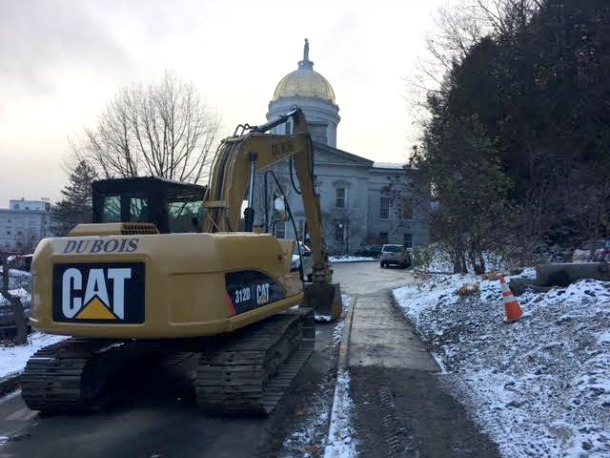
AGC-VT and Phil Scott have had a long symbiotic relationship. The powerful group — of which Scott is a past president — has endorsed all of his bids for statewide office, and his 2016 campaign rented office space owned by the Vermont chapter. The building is next to the Middlesex company where Scott is a half-owner, DuBois Construction. Scott said he would sell his stake in the company to allay concerns about a possible conflict of interest when he takes office next month.
Roughly a third of all the governor-elect’s corporate campaign contributions came from businesses in the construction and building industry, including developers, according to a VTDigger analysis of campaign finance data.
These donors — who gave more than $170,000 throughout the campaign — include residential and industrial construction companies that create everything from house doors to major highways, as well as large real estate developers.

Of those donations, many came from companies that have received millions in state transportation contracts in the last year alone.
Among the supporters are dozens of AGC-VT members, including four of the biggest players in state highway construction: J.P. Sicard (which gave Scott $4,000), G.W. Tatro Construction ($2,500), S.D. Ireland ($2,000) and F.R. Lafayette ($1,500).
Scott won’t be the first governor to have benefited from big business support. Democratic Gov. Peter Shumlin has been dogged by suggestions he is too close to campaign contributors, including EB-5 developers Bill Stenger and Ariel Quiros. The men gave a combined $20,000 to Shumlin through various companies and associates over the course of his 2012 and 2014 re-election bids.
Shumlin has also been blasted for his ties to other contributors, including Green Mountain Power and renewable energy developer David Blittersdorf.
In his final 2014 campaign, Shumlin received some money from the Vermont construction world, though its members showed much less enthusiasm than for Scott. According to publicly available campaign finance reports, none of the big four state contracting companies listed above pitched in for Shumlin’s 2014 bid.
(Scott, in addition to corporate donations from the construction and development world, received tens of thousands of dollars in individual donations from people who run companies or work in these industries.)
Cathy Lamberton, the executive vice president of AGC-VT, is an unabashed Scott supporter and spoke highly of him as an ally to her members. She was a featured speaker at Scott’s kickoff but told VTDigger that the virtual overlapping of the annual meeting and Scott’s event was “a coincidence.”
Lamberton said AGC-VT members feel they have a sympathetic ear in Scott and are hopeful as he lays out his two-year agenda.

“We know that Scott understands the challenges construction companies go through,” Lamberton said. “We don’t believe that we are going to get everything we like. We just want an opportunity to correspond with the governor and his administration.”
This year’s annual conference of AGC-VT again took place at the Sheraton. This time, Scott held no event of his own but gave the keynote address. The conference included Scott’s newly appointed chief of staff, Jason Gibbs, who moderated a panel titled “Leadership Meeting.”
In an interview Monday, Scott did not shy away from his long-standing relationship with the Associated General Contractors of Vermont, recalling that his early work on the trade group’s legislative affairs committee had pushed him to go into public service.
“Their motto is ‘Skill, Integrity and Responsibility,’” Scott said. “And I fully adopt those principles.”
Scott rejects the idea that he would use his position to benefit his campaign contributors or his former company, the same way he frowned at claims during the campaign that he tried to help his business during his tenure as a state senator and then lieutenant governor.
“We will prove ourselves, and I think that’s incumbent on this administration,” Scott said. “We will prove that this isn’t political in nature, this is about getting something accomplished.”
Last year, the Legislature considered, but ultimately did not approve, the establishment of a state ethics commission, whose proposed rules could have prevented numerous contractors from making political campaign donations.
One of the provisions discussed would have precluded contributions in the gubernatorial race from anyone bidding on or holding state contracts, large and small, from highway construction to grass cutting. The idea was to prevent transactions and contracts referred to as “pay to play” in political parlance. Senators dropped the provision after they said too many Vermonters would be affected.
Senators are expected to discuss the establishment of an ethics commission again this session.
Scott’s policy toolbox
Scott’s political ideology draws heavily from his experience running his construction company, and his public comments often echo AGC-VT’s stances. He often describes his broad political vision as a series of proposals that Vermont should “have in our toolbox.”
A higher minimum wage is something Scott doesn’t want in that toolbox.
“I don’t have a magic bank account where there is money available for the cost-of-living increase,” Scott said at a gubernatorial forum in June, warning that businesses like DuBois could not easily swallow a drastic pay increase.
“You are going to pay for it,” Scott told the crowd of consumers.
(In 2007, Scott was one of only four senators to vote against S.27, which mandated a 25-cent hourly minimum wage increase and instituted a formula for gradually raising the wage based on inflation.)

Scott also opposed paid sick leave legislation — which Shumlin signed into law in March — as well as paid family leave legislation, which Democrats appear likely to push for in the next legislative session.
Lamberton said her membership wants to avoid government intrusion and maintain autonomy and flexibility.
“In the building trades, some companies pay for work boots, clothing, truck allowances or gas allowances, sometimes even schooling,” Lamberton said, explaining AGC-VT’s opposition to government decrees like paid family leave. “Some of those things would go away if across-the-board mandates came down from the state.”
Scott has also expressed views that are steadfastly opposed by unions.
In his 2016 questionnaire for the Vermont State Employees’ Association, Scott wrote that he believed in collective bargaining rights, but also expressed support for so-called right-to-work legislation, which mandates that employees do not have to join a union.
Some economists contend that right-to-work laws have resulted in fewer rights for workers and promote poor work conditions and poverty.
In his questionnaire, Scott wrote that “every individual has a fundamental right to decline to join or participate in any organization with which she/he does not wish to participate in.”
In addition, Seven Days reported on Scott’s support for “defined contribution” pension plans for state employees, a policy union leaders claim would undermine retirement security for workers.
Plans for infrastructure
During his introductory remarks at the first gubernatorial forum of this campaign, in November 2015, then-candidate Scott promised to be a chief executive who would remodel Vermont into “the best state in the nation to start and run a small business and raise a family.”
In his five-minute opening speech at the ECHO center in Burlington, Scott laid out his plan:
“Those who want to stay in Vermont — or come to Vermont to start their career or have a family — must be able to find an affordable apartment or find a home in their price range. They also expect us to continue to build and improve our telecommunication and traditional infrastructure. We must prove we are open for business, and open to working families by understanding their needs and creating an environment that is helpful for them.”
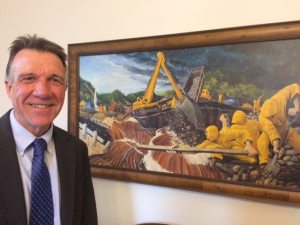
Scott’s overall campaign promise to voters was that he would curb state spending and hold the line on taxes to make Vermont more affordable. A frequent line on the trail was that state government needed to “tighten its belt.”
Yet while Scott frequently called for curtailing budget growth, there were a few areas where he prioritized investment — among them infrastructure and housing development.
On Page 35 of Scott’s 39-page economic plan — which was rolled out during the campaign — he detailed a number of specific policy ideas around the transportation budget.
Scott promised to “prioritize spending” on infrastructure projects and called for the following policy steps:
• Protection of the Vermont transportation fund from any legislative attempt to shift dollars to unrelated state programs.
• Restructuring of the Vermont Agency of Transportation budget with an eye toward more construction funding.
• Lightening of environmental regulations to allow for an easier building process.
• Streamlining of the permit process.
• Development of a long-term vision for the state’s transportation infrastructure that focuses on early intervention and maintenance.
• Restoration of the full research and development tax credit, which could cut costs for infrastructure innovations.
• Establishment of a 60 percent tax credit for investors who put money into three economic areas, including transportation.
Construction executives say they are optimistic about Scott’s infrastructure agenda and that more money may now be directed to highway projects through a restructuring of the transportation budget.
“We are always hoping for more work, no matter who is governor,” said Brent Tewksbury, the co-owner of Lafayette Highway Specialties, an Essex Junction-based company that gave $1,500 to Scott’s campaign. “But we are hoping with Phil in there that he is able to get the right people in place to be effective with those transportation funds and put them into steel and asphalt. That’s where the traveling public sees the most return.”
Greg Tatro, the president of G.W. Tatro Construction, agreed that transportation spending should prioritize bridges and roads.
“A road sees a lot more traffic now than it used to,” Tatro said. “It needs to be upgraded, widened, brought into the age we live in.”
Democratic Sen. Dick Mazza, a longtime friend of the governor-elect who chairs the Senate Transportation Committee, also said he supports “more paving and bridge money.”
Whether the state needs to ramp up its highway construction is an open question.

According to Transportation Secretary Chris Cole, the state’s transportation infrastructure still could use some work, but catching up on overdue work has greatly improved during Shumlin’s tenure. Cole said the improvements were spurred mainly by federal funds. First came appropriations as part of the 2009 economic stimulus, followed by federal emergency money secured after the devastation of Tropical Storm Irene in 2011.
“When Gov. Shumlin took office, 35 percent of our roads were in very poor condition,” Cole said. “At the end of his term, we have it down to 15 percent.”
(The state transportation goal in Vermont is to have no more than 25 percent of roads in very poor condition.)
Cole pointed to other bright spots in the state’s infrastructure landscape, including the accelerated bridge-building program, which has helped cut the number of structurally deficient bridges in half since 2009. Fatal car crashes are less frequent, and the quality of roads is at its highest level since at least 2003, according to Transportation Agency figures.
The overall transportation budget has increased 75 percent since 2006, from $354 million to $618 million a year, which includes state and federal funding.
In an interview Monday, Scott reiterated his support for infrastructure projects. While he acknowledged that road and bridge improvements have accelerated in recent years, he said a backlog still exists.
“We’ve stopped the bleeding somewhat, and I don’t think things are getting any worse,” he said. “But we are not catching up as quickly as we should.”
Despite his pledge on the campaign trail to hold the line on state spending, Scott said he would not seek to cut transportation spending in his upcoming budget. He pledged to protect the state’s share of the transportation fund, a chunk totaling about $260 million that has been raided and shaved in the past in order to support other pressing needs.
Among the allotments in the current year’s transportation budget:
• $111 million for paving roads.
• $105 million for bridge infrastructure.
• $91 million for maintenance — personnel, equipment and materials.
“We now have a governor who is way more committed to maintaining the transportation fund than other governors have been,” said Sen. Richard Westman, a Lamoille County Republican who serves as vice chair of the Senate Transportation Committee. “I think somebody would be foolhardy to try and touch that money.”
Vermont’s transportation fund is fueled primarily from three revenue streams: the state gas tax, the purchase and use tax on motor vehicles, and fees collected by the Department of Motor Vehicles. And while Scott said he wouldn’t look to raise any of these in his first budget, he has not ruled it out in the future.
On top of those state revenues, the Vermont transportation budget is also supported by hundreds of millions in federal dollars.
While Scott has promised not to raise any taxes or fees in his next budget, the state would likely have to come up with matching funds if Republican President-elect Donald Trump’s plan for a major federal infrastructure project comes to fruition, perhaps sometime next year. (The split between federal and state dollars is usually 80-20.)
Scott said such a match would be hard to meet, and he has called for a grand, long-term infrastructure roadmap that would plan out projects years ahead in hopes of approving more preventive road work and stabilizing the transportation budget.
“I know the president-elect talked a lot about investment in infrastructure, and that could be beneficial for Vermonters,” Scott said Monday. “Coming up with more money for the match could be problematic, but if we have time to fully contemplate that and plan for it — and prioritize it — it may make some sense for us.”

Democratic Rep. David Potter, who serves as vice chair of the House Transportation Committee, said Scott may have to re-evaluate his pledge not to raise taxes or fees if a large federal stimulus that requires a match is passed. The state could also use other funding mechanisms, including tax increment financing, to find matching funds, Potter said. (Scott sponsored TIF districts for Milton, South Burlington and Berlin in a 2006 Senate bill but has more recently said the state should be “disciplined” around bonding.)
“Scott has been on the Transportation Committee in the Senate, he knows the score,” Potter said. “He doesn’t want to raise taxes, but then how is he going to increase infrastructure improvements? Where is that money going to come from? I don’t have the answer.”
A push for more housing
Another key to the state’s economic enrichment, according to Scott, is the development of more affordable housing. Again, Scott benefited from contributions from many in that industry.
“I see the housing issue as critical to growing the economy and for providing more affordable housing for the workforce,” Scott said Monday.
A 2015 study conducted by Bowen National Research on behalf of the Vermont Department of Housing and Community Development listed a litany of holes in the state’s housing stock.
Among them:
• Government-subsidized housing and adequate senior care facilities are limited, with Vermonters facing long wait times.
• Rental prices throughout the state are high, especially in Chittenden and Orange counties.
• Nearly 33 percent of Vermont households are cost-burdened, which is defined as paying more than 30 percent of their income toward housing costs.
• 12 percent of households are severely cost-burdened, meaning that associated home costs constitute more than 50 percent of income.
In outlining his housing policy, Scott said he would work to support affordable housing not only for lower-income Vermonters, but for middle-income families who make just enough to no longer qualify for help.
Scott has pitched directing the Agency of Commerce and Community Development to encourage housing development through a pilot project that would streamline regulation and could open up more funding options. He also said he would work to offer tax credits to developers looking to renovate older Vermont homes.
Bristol Republican Rep. Fred Baser introduced a bill last session, H.702, that included the pilot project concept that designated ideal neighborhoods for building, but it did not gain any traction.
In addition to the neighborhood designation, the bill also promoted the construction of larger developments — each with at least 12 units — as an answer to urban sprawl and high costs. (The bill would have also appropriated $1 million to help pay for infrastructure like sidewalks and sewers.)
Legendary Chittenden County developer Ernest Pomerleau gave $8,000 to Scott’s campaign through two of his limited liability companies, as well as more than $3,000 as an individual. Pomerleau said Scott’s proposals could rejuvenate the state housing market.
“Phil has been in business, he knows how to do it,” said Pomerleau, who hailed Scott’s proposed subsidies and tax credits for builders. “If you want developers to hit certain levels in a price zone, but it’s hard to get there economically, it’s smart for Phil to subsidize that delta a little bit.”
In addition to Scott’s support for an uptick in housing construction, one of the governor-elect’s top deputies appears poised to keep his ears open to the concerns of those in construction.
Tayt Brooks was named Scott’s director of affordability and economic growth initiatives. He served five years as director of government affairs for the Homebuilders and Remodelers Association of Vermont, an influential trade group.
Brooks declined to discuss specific policy ideas he might propose in his new post but said he would be looking to hear opinions from all sides.
“Each person, each group that advocates and looks at housing has a unique and interesting perspective, and all those perspectives are important,” Brooks said Tuesday. “All views and all perspectives should be looked at and listened to, and considered.”
Pomerleau said that Vermont’s four seasons make construction harder, adding that Scott also must address a government bottleneck on permits for projects.
“We have to put our pipes deeper, we have to use insulation, we have high energy standards to meet,” Pomerleau said. “Plus we have an enormous permitting process, which adds to the cost.”
Permits and regulations
Throughout the campaign, Scott also voiced the deep frustration within the construction and development industries around the state’s permit process, particularly environmental regulations. He promised Monday to make the building and development process “as user-friendly as possible.”
(Still, Scott has made clear that he believes in environmental protections, and his recent appointment of Julie Moore to run the Agency of Natural Resources won praise from environmental activists.)
A handful of contractors said it often takes months — in some cases years — to approve permits for an industrial job. They pointed at the Agency of Natural Resources and its Department of Environmental Conservation as the least responsive.
“We see a lot of permitting issues, which hampers the ability of things to happen in a timely manner,” said Jason Sicard, the owner of J.P. Sicard construction. “The long process discourages true economic growth.”
Construction president Tatro said he’s been waiting three years on the needed permits for a housing development in Hinesburg. The process, he said, has cost him $250,000.
Tatro said various environmental regulations — including on wetlands development and stormwater runoff — continue to become more stringent and expensive to comply with.
“We don’t want to leave this state or planet worse than when we came here,” Tatro said. “But sometimes the laws go overboard. We do need to take care of our rivers and streams and lakes, but there needs to be a balance, and Phil will hopefully strike that balance.”
(On Page 24 of Scott’s economic agenda, the governor-elect pledges to work toward a maximum three-month wait time for large permits.)
Scott also said he would assign specialists to help contractors navigate Act 250, the state’s 46-year-old environmental protection law that set up a complex application process through district commissions.
Jonathan Levy, the managing partner at Redstone Investments, has developed commercial projects across the country, including a Wal-Mart in Bennington and a handful of Price Chopper supermarkets across Vermont. Levy, who gave Scott $4,000 through two of his limited liability companies, sees Vermont’s regulations as the most cumbersome in the country.
“Act 250 is a very complex and at times difficult process,” Levy said. “Some of the regulations are very good, but some can be a bit overreaching.”
Patrick Malone, a Montpelier-based developer, said he has found it hard to develop commercial projects, even in designated industrial zones.
“I appreciate Vermont’s landscape, and I don’t want it turning into a Massachusetts or a Connecticut,” said Malone, whose company gave Scott $4,000. “I understand what they are trying to protect. But there is a mentality that people like it the way it is, and they don’t want any change at all. But developers are bringing in important projects that create jobs and tax revenue.”
Scott’s DuBois connection
“How did Phil Scott become a multimillionaire?
“Simple.
“While serving as senator and lieutenant governor, Scott pursued and received millions in government contracts for his construction company.”
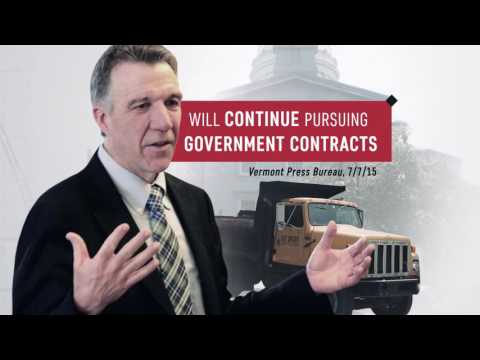
So began one of the harshest attack ads in Vermont’s 2016 election. It was leveled against Scott during the primary campaign by fellow Republican Bruce Lisman, who suggested Scott was profiteering because of his political pull.
After beating Lisman in the primary, Scott faced similar heat in the general election from Democrat Sue Minter, the former transportation secretary, who said she was dismayed that Scott’s construction company was allowed to do business with the state while he was lieutenant governor.
Asked at a VTDigger debate if she had expressed doubts about DuBois obtaining state business, Minter said she did the moment she saw the first contract.
“I did raise questions,” Minter responded. “I immediately went to the assistant attorney general at my agency, threw the contract on his desk and said, ‘How can this be legal?'”
Scott always insisted the integrity of the bidding process for transportation contracts prevented him from being able to gain any advantage.
Officials, including Scott, defend the bidding process as transparent. The sharpness of the attacks from both Minter and Lisman was likely fueled by the intensity of the campaign. (After losing the primary, Lisman donated $1,500 to his former foe’s campaign.)
On Monday, Scott seemed exasperated that the bidding attacks had been so frequent during the campaign.
“Every unit price is shown in a bid,” Scott explained. “If there’s 10,000 yards of earth that have to be moved at $2.50 per yard, that’s all listed. At the bottom there’s a price for that job, and the lowest bidder is picked. It’s a transparent process.”
Transportation Secretary Cole agreed with Scott, saying it was virtually impossible to unfairly sway state bidding procedures.
Cole — who was appointed transportation secretary by Shumlin in 2015 after Minter stepped down to run for governor — said no contracts for the type of work DuBois competes for are awarded without vigorous competition.
“It’s a very transparent process,” said Cole, adding that specific contract details dating back to 2008 are publicly available online.
“I don’t see any way to manipulate the process,” Cole continued. “The process has been laid out by attorneys to be transparent.”
Cole pointed out that the only political appointees Gov.-elect Scott will have in Transportation — the secretary and deputy secretary — don’t participate directly in the selection of contracts. Those decisions are made by a separate committee, and the decision is vetted by the attorney general’s office before the transportation secretary signs off.
Cole said Monday that he has reapplied for his job but had not yet heard whether he would be staying on. That same day, Scott didn’t rule out appointing a transportation secretary from within the ranks of construction.
“We are considering all who apply, and that does involve some from outside the norm,” Scott said, “but we will see where we land.”
While Scott is dismissive of political attacks regarding his connection to the construction industry, he announced in September that he would sell his 50 percent stake in DuBois should he win to avoid any possibility Vermonters would see his ownership as a conflict of interest.
Now that he’s won, Scott says the arrangement will be finalized by the new year. His 50 percent share is valued at $2.5 million.

However, the arrangement Scott set up has been questioned. Instead of a lump payment, Scott said he will be paid over a number of months, which critics said does not provide the clean break needed to remove any risk of conflict. Jeff Newton, the current general manager at DuBois, will take over for Scott as a partner in the company and purchase some of the shares Scott is giving up.
Scott said a lump sum payment would have required DuBois to take out a loan. He said it’s difficult to obtain bank capital for such large purchases, so other options needed to be explored, including self-financing.
On Monday, Scott said that by financing the sale he would help to “make sure the company can succeed in the future.”
He rejected any possibility that by financing the sale himself, he remained a stakeholder who would benefit from any financial success at DuBois.
Scott’s spokesman, Ethan Latour, would not say whether DuBois had specifically asked for a loan. Latour asserted that if DuBois had taken out a loan to pay off Scott “the business would fail.”
Latour’s full statement:
“To understand the complexity and risk of this transaction, it is important to understand that the value of a company includes the value of equipment and other assets such as buildings (some of which depreciate over time and are currently being financed with loans). In the case of construction companies, a very large amount of the value of a company is in the trucks, cranes, excavators and other equipment required. Construction companies are also required to have multimillion-dollar bonding policies that assure customers they can cover the cash-flow requirements of large projects. With these realities in mind, a cash payment on 50 percent of the estimated value of a company (again, much of which is in equipment) would require the company to make decisions that greatly affect its ability operate in its current capacity in the future.”
Several attempts to interview Don DuBois, Scott’s principal partner, were unsuccessful.
Asked Monday if he might return to the company after his tenure as governor, Scott didn’t rule anything out.
“There’s always the possibility, but that’s not the mind-set we have at this point,” he said.
Scott has expressed sadness that he would have to abandon a business he spent 25 years building, but he also said his new job as governor presents equally exciting challenges.
“My entire life has been trying to adhere to deadlines and tight construction time frames and so forth,” Scott told reporters after a question about his transition process. “So it seems to me like a giant construction site at this point.”