

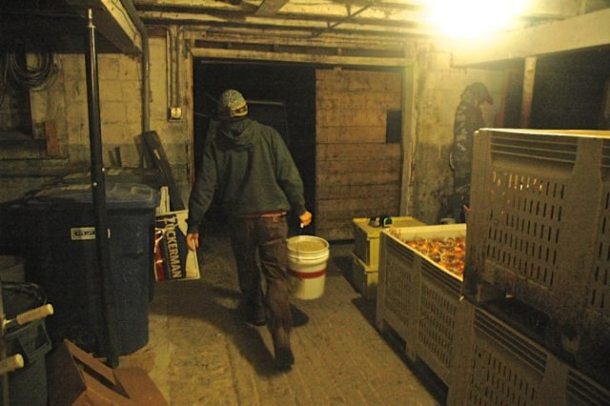
[H]INESBURG — In a dimly lit barn early on a recent Friday morning, pigs oinked in appreciation as David Zuckerman served them whey and hay.
Zuckerman, a state senator and candidate for lieutenant governor, methodically dumped feed in each stall, then checked on a litter of 10-day old piglets resting under a ruby red heat lamp. All good.
With his morning pig chores complete, Zuckerman got into his truck and drove to the vegetables.
It’s been a good year for many of the 50 types of organic produce that Zuckerman grows here on Full Moon Farm, a 151-acre plot in this Chittenden County community south of Burlington. Still, some crops have proven problematic.
After parking in a wet, foggy field, Zuckerman stepped out of his truck into the dark morning air. There, he kneeled down to check on a patch of broccoli. The heads were small and the leaves chewed through by the swede midge, an invasive pest.
Bugs aren’t Zuckerman’s only problem. The drought-like conditions this summer have plagued a number of his other crops, like celeriac, and his irrigation pond is nearly empty.
“Every year, two or three crops – for lack of a better term – shit the bed or just don’t come in really well,” said Zuckerman, who is 45 years old. “And two or three crops explode with bounty and grow really well.”
Zuckerman’s farm persona has heavily shaped his 20-year political career, as was recently exemplified in the fight for the mandatory labeling of genetically modified foods. The bill –which was sponsored by Zuckerman — garnered national headlines when it became law. Shortly after the legislation went into effect this summer, the U.S. Congress overrode Vermont’s law with a more lax labeling policy.
Zuckerman remains a skeptic of GMO foods, and said he keeps an eye on the GMO corn field in close proximity to his farm. Cross-pollination is unlikely because his crops are more than 600 feet removed, but still he is mindful of potential contamination.
“If my corn did end up contaminated, and word was out, then people who wanted organic wouldn’t buy it,” he explained.
After his Friday morning chores, Zuckerman spent a few minutes waiting for the school bus with his wife and farm partner, Rachel Nevitt, and daughter, Addie who playfully zigged and zagged away from him, laughing.
Zuckerman then quickly changed out of his muck boots and traded his Carhartts for khakis. “The Farmer” was now “The Candidate for Lieutenant Governor.”
While Zuckerman has been harvesting broccoli in his time off the campaign trail, his Republican rival Randy Brock has been sowing seeds of doubt about Zuckerman’s competency. In radio ads and public appearances, Brock has alleged the Progressive Democrat from Hinesburg isn’t fit to serve in the state’s second highest office.
Zuckerman has been forced to defend himself in television and radio appearances across the state while also introducing himself to voters and keeping the farm running.
“It’s a juggle,” Zuckerman said, his eyes showing a mix of energy and exhaustion from months of campaigning. “There are days when I start in farm clothes, change into a suit for a political event, then I’ll change back into these closes and farm for four hours or so and harvest some food.”
On this particular Friday, Zuckerman was off to Williston Central School to answer questions from students. Then he drove back to Hinesburg to harvest cabbage before schlepping two-and-a-half hours south to end his day at the Brattleboro Gallery Walk.
One short night of sleep later, the pigs are hungry again at 6 a.m.

Zuckerman often touts his farming background when he’s on the trail and frequently mentions he would be the first farmer to hold statewide office in more than 50 years. He says that background gives him an insight into a key sector of the Vermont economy and the state’s more rural areas. It’s also clearly an effort to align himself with the Aiken legacy.
“I can’t recall any other statewide officeholder who has been closely involved with agriculture since U.S. Sen. George Aiken,” said retired Middlebury College Political Science professor Eric Davis.
Aiken, a fiercely independent Republican, and Zuckerman, an unabashed lefty and standard bearer for the state’s Progressive Party, don’t share the same politics. But like Aiken, who was a nurseryman from Putney, Zuckerman knows farming and he is trying to use his vocation to appeal to voters in more more conservative and rural areas of the state.
In his quest to build this diverse coalition of support outside Chittenden County, Zuckerman’s farming background may hold appeal. (At political events, he frequently mentions that he just got done harvesting a vegetable or slaughtering chickens, and he hands out carrots during Fourth of July parades.)
Zuckerman is also an acolyte of U.S. Sen. Bernie Sanders, whose penchant for challenging the system has appealed to denizens of the backwoods.
“Bernie always runs well in the Northeast Kingdom,” analyst Davis said. “I’m really interested to see how Zuckerman does up there. Is his appeal more than just with urban and professional voters in Chittenden County? I just don’t know.”
Zuckerman talks about farmer in near-spiritual terms.
“Some of our favorite members in our CSA are our pregnant members,” he said. “To think the nutrients those fetuses are getting is partly from the food I created is just very enriching.”
He also sees the gritty work of keeping a farm afloat as evidence of his ability to help run state government.
“You are outside, you are breathing real air everyday,” he said. “Producing food is certainly a mental challenge of balancing what crops on what days, what’s getting planted, what’s getting weeded, the Tetris puzzle of the crew and the crops.”
Zuckerman took out a federal farm loan to help purchase the land, and also had to borrow money to purchase a tractor and a truck. However, unlike many farmers, he received an inheritance after his father died in 1984.
Zuckerman acknowledged that the inheritance allowed him to attend college debt-free, and he said the remaining $70,000 or so allowed him to invest in property and some farm equipment. But he pushed back against the notion that he was only successful because of a trust fund.
“There’s no doubt that in the grand scheme of our country — and certainly the world – I grew up fortunate, and I respect and value that,” he said. “But the picture people paint that I have obscene amounts of money, that’s not reality.”
Zuckerman’s 2015 tax data shows he and his wife made an adjusted gross income of $63,977 consisting of $33,429 in wages and $24,676 in net income from the farm. Brock is retired after a long career at Fidelity Investments and has a net worth of several million dollars.
“As a lefty, I’ve also grown up with old New England Yankee mentality: save and invest well,” Zuckerman said.

While Zuckerman now lives close to the land, he grew up in the affluent Boston suburb of Brookline. His father — who died of stomach cancer when Zuckerman was just 13 — was a lung and heart surgeon. His mother had a doctorate in chemistry and worked in a lab.
“I traveled with my dad to the hospital as a kid on a regular basis to have time with him, so I was certainly exposed to the healthcare system from his illness and occupation,” said Zuckerman. “How he cared for people and approached patients — his bedside manner — was really amazing. He treated people so well when they were in very scary and uncertain scenarios.There’s no doubt that had an impact on me.”
Zuckerman cited his father’s death from cancer when he said he would oppose efforts to remove the philosophical exemption for parents who don’t want to vaccinate their children.
He says that he developed a love of the outdoors on frequent family visits to Virginia’s Shenandoah National Park as a child, and was drawn to the University of Vermont partly because of its pastoral surroundings.
He began his college career as a chemistry major before switching to environmental studies. Outside of class he became involved in the Vermont Student Environmental Program and student government.
“I was pretty cynical in college about the national political scene, the two parties and corporate money in politics,” he said.
Wavering on what to study, Zuckerman took a year off school to hike the Appalachian Trail and worked in a wood pallet factory, cutting lumber.
Back at UVM, in 1992, he helped organize on campus for Sanders’ re-election bid to the U.S. House. In 1994, while still enrolled in classes, Zuckerman ran for the Vermont House and lost by 59 votes.
He graduated in 1995 with a leadership award and a hankering to farm. He said he learned his first agricultural lessons at the Golden Russet Farm in Shoreham.
Former Rep. Will Stevens, who runs Golden Russet Farm, said Zuckerman worked hard for three seasons at the farm, and said Zuckerman frequently talked about the importance of universal health care as they worked the fields.
“He’s always viewed farming as a noble profession,” Stevens said. “Providing food for people means playing a unique role in people’s lives, on a cellular level. He embraced it as a service to to others, which is how he approaches politics, too.”
In 1996, Zuckerman ran again for the House and won. He has served under the golden dome for most of the following two decades, first in the House member until 2010. Then, in 2012, he was elected to one of the six Senate seats in Chittenden County.
He chaired the House Agriculture Committee for four years, and now serves as vice chair of Agriculture in the Senate.
If elected to the post of lieutenant governor, Zuckerman has promised to listen to farmers and take steps to strengthen the rural economy. One idea he is pushing hard is supporting additional infrastructure in Vermont to help dairy farmers turn raw goods into value-added products like cheese and yogurt. With access to locally owned processing facilities, Zuckerman says, farmers can avoid the volatility of the national milk market.
While he has floated a number of ambitious goals throughout the campaign, he says that his top priority is to ensure the Senate runs smoothly. The lieutenant governor presides over the Senate and makes procedural rulings.
The lieutenant governor also serves as one of three members of the powerful Committee on Committees, which selects chairs and makes committee assignments.
“You don’t really radically alter anything,” he said. “The institution itself has built-in temperance on rapid change, and we also have really capable and skilled chairs with expertise.”
Some observers see the makeup of the Committee of Committees as critical to whether the Senate will swing left or right in the next legislative session.

Zuckerman began his career as a member of the Progressive Party but now self-identifies as a Progressive/Democrat. He often makes it quite clear, however, that the ‘P’ comes first.
After surveying a handful of homemade posters made by middle schoolers at the Williston event Friday, Zuckerman took issue with the fact that some students had identified him solely as a Democrat in their drawings.
He pointed out to a school administrator that he was “actually a Progressive/Democrat,” and said she might want to inform her students “for the sake of accuracy.”

Zuckerman has a run afoul of both Democrats and Republicans throughout his political career. He sees both parties as being closely tied to corporate interests. The Chittenden County senator has also frequently pushed hard for liberal hot potatoes — from a $15 minimum wage to marriage equality.
As a long proponent of marijuana legalization, Zuckerman likes to refer to pot by its medical name: cannabis.
In a recent WDEV appearance Zuckerman made clear that he doesn’t use the term ‘marijuana’ because it was racially charged when it was coined during the Great Depression as a way to sow fear among Mexican immigrants.
“They made videos about wide-eyed Mexicans perpetrating crimes on other people,” Zuckerman said.
Zuckerman helped get medicinal marijuana past the finish line back in 2004, and he introduced a bill last session and pushed hard for legalization. It got a lot of attention and passed the Senate, but it stalled in the House.
While Zuckerman admits to smoking at UVM, he said he hasn’t been a part of a “gathering” in a long time. He says with work, a daughter and a political career he doesn’t have time to smoke pot anymore.
Still, he was willing to describe the positive vibes felt in past experiences:
“It’s relaxed, it can make you a little giddy, it can oddly enough focus your mind sometimes. There are a range of varieties, a range of THC content and components. Some are the mellow, chill amorous high and some are the giddy, laughy high. And when you are buying it on the black market you aren’t sure what you are going to get.”
He added:
“I think the smell of it is just a very sweet, aromatic smell. I always enjoyed that – sometimes even more than smokin’ it. That aroma. But in this day and age it’s really not about having the opportunity to consume it because it’s out there, I could consume it if I wanted to.”
Zuckerman pledges that if the drug becomes legalized, he would not grow it on his farm in order to avoid any allegations of pushing the policy for financial benefit.

If elected lieutenant governor, Zuckerman will look to rally support around legalization next session. Rep. Chris Pearson will almost certainly be a key ally, if Pearson wins a bid for the state senate.
A fellow Progressive, Pearson — Zuckerman officiated at Pearson and his wife’s wedding — sees a number of similarities between Zuckerman and Pearson’s old boss, Sen. Bernie Sanders.
“They are both very focused and very willing to be up front about their belief and their opinions on the controversial issues of the day,” Pearson said. “They are both extremely hard working. They both have a great ability to appeal to Vermonters who don’t traditionally vote for Democrats and Progressives.”
Despite his leftist political beliefs, colleagues say Zuckerman is less cantankerous than Sanders.
Sen. Joe Benning, the minority leader, described a good working relationship with Zuckerman. He added Zuckerman doesn’t want to be pigeonholed as a crunchy Progressive.
“He does, I believe, view himself as unique and at the same time feels hampered by people’s images of him in that way,” Benning said. “He wants to present himself as someone who is advancing a cause, but I know to other people in the room that it looks like he is going off on a tangent.”
Former House Speaker Shap Smith, who ran against Zuckerman in the primary for lieutenant governor and narrowly lost, said the ponytailed progressive’s liberal bona fides were both helpful and frustrating in the House.
“Like many people who don’t have to engage in the high-level decision making, David had the opportunity to shoot at things he didn’t like,” Smith said. “I would find that frustrating at times, but it can also be helpful to make sure we are doing things better.”
Not everyone in the party leadership is enthused Zuckerman sought Democratic support, and the strategy has not always worked. In 2004, Burlington Mayor Peter Clavelle, a Progressive, ran against Jim Douglas as a Democrat and was walloped, finishing with 38 percent.
Outgoing Sen. President Pro Tempore John Campbell, D-Windsor, called it “disingenuous” for Progressives like Zuckerman to use the Democratic Party label to gain office because the two parties don’t always share the same views.
“Look, I like David Zuckerman, I think he’s a really nice guy,” Campbell said. “He’s dedicated, he clearly works a lot, (including) on his farm before he gets here. He does the work of the people he was elected by. I just wish he’d get up and say I believe, I am a Democrat, I want to stay as a Democrat, than to say the only way I know I’m going to get elected is if I have the Democratic label.”

Some of the harshest criticism of Zuckerman comes from Brock, his Republican challenger, who has delivered an onslaught of negative attacks in recent weeks. His radio ads declare that “the job of lieutenant governor, a heartbeat away from being governor, is too important to elect someone we can’t trust.”
In a recent VTDigger profile, Brock hesitated when asked whether he respected Zuckerman. He raised Zuckerman’s unapologetic admission that as a House member, he [billed the state]for the full daily allocation for meals and mileage even when he carpooled with other lawmakers and didn’t spend all the meal money.
The move was allowed under statute, and many lawmakers did it, but some frowned upon the practice at the time, including Brock.
(For the record, Sen. Aiken routinely returned part of his annual office allowance to the Treasury.)
In his defense, Zuckerman points out that other colleagues in the legislature — including Republicans — engaged in similar billing practices. And Zuckerman said that while he may make blunders, some of the comments he’s been criticized for by Brock, such as mentioning the bias someone with long hair might face, were misconstrued.
Brock is also hitting Zuckerman for holding a campaign event regarding racism that promised “music and fun,” a cash bar and “a good time.”
“It really pisses me off,” Brock told VTDigger after writing an open letter to Zuckerman in which he excoriated his rival for holding the event.
Brock, who is African-American, had never addressed racism during his long political career in Vermont. His open criticism of Zuckerman’s meeting has ironically spurred his own series of very thoughtful and personal discussion on racial discrimination.
“One of my earliest memories was traveling in the South with my mother,” he told WDEV on Thursday. “In a train station — I think it was Rocky Mountain, North Carolina — I went to take a drink out of a water fountain and my mother stopped me. And it was a bright — I remember — bright white water fountain. And she pointed above and there was a sign above the water fountain that said ‘White.’ And so she directed me to another water fountain to the left of that, lower down that was kind of pinkish, rusty. And it said ‘Colored,’ and that was the water fountain I had to drink out of.”
Black activists who attended Zuckerman’s event thanked him for holding the event.
“We got to hear a lot of great things and a lot of great insights from people of all walks,” Edwin Owusu, an organizer of the event, told WCAX after Brock raised questions.
Senate Majority Leader Philip Baruth said that Brock’s recent attacks were baseless, and pointed out that Zuckerman has a history of fighting for many social causes in which he is not personally connected.
Baruth said that Brock has a history of going after his opponents aggressively. He relayed Brock’s story of his successful 2004 race for state auditor when he accused the incumbent Elizabeth Ready of misrepresenting her academic credentials and railed against her high cell phone bill, which was paid for by the state.
“Randy’s a very decent guy,” Baruth said. “But he views this as his last race and has gone to a level lower than he has ever gone before and I’m saddened by it.”
As for his thoughts on a “Lt. Gov. Zuckerman,” Baruth was supportive.
“He has had a fabulously successful career sticking his nose into issues that were supposed to be impossible but then bringing them to fruition,” Baruth said. “He’s the kind of person who arouses resentment because he’s a symbol for a larger demographic shift that many Vermonters are still dealing with.”
That shift included an influx of out-of-staters and a switch from a Republican state to one of the most dependably blue.
And while Zuckerman is a symbol of that changing Vermont, he’s ironically also a member of one of the state’s oldest brotherhoods: farmers.

