

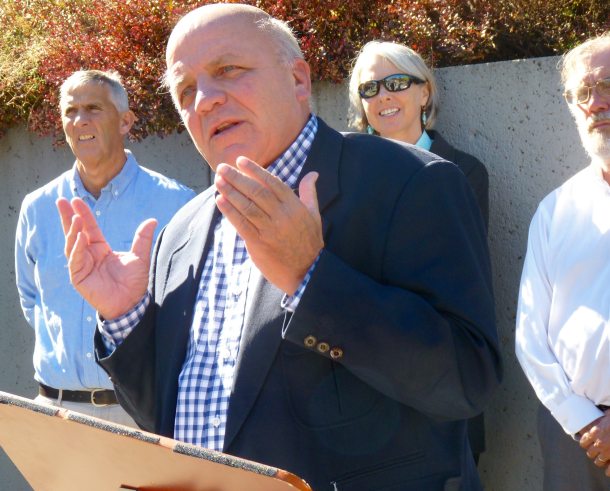
BURLINGTON — Mayor Miro Weinberger and city leaders announced a campaign Tuesday to push for passage of four ballot items they say are crucial to Burlington’s future.
Questions one through four on the Nov. 8 ballot ask voters to approve a $27.5 million general obligation bond for infrastructure projects; an $8.3 million revenue bond to improve water and sewer lines; new zoning for a portion of downtown that allows greater building height; and a $22 million tax increment financing, or TIF, bond for public infrastructure that would be built as part of a proposed mixed-use redevelopment of the Town Center mall.
Most of the items require a simple majority for passage; the exception is the general obligation infrastructure bond, which requires a two-thirds majority.
Items three and four — the new zoning and the TIF bond — are crucial elements in the proposed $220 million redevelopment of the Town Center proposed by its owner, Don Sinex. The project would bring a mix of housing, retail and office space to the roughly 5-acre property, including towers expected to be the tallest buildings in the state.
Unlike the infrastructure bonds, items three and four have faced sustained and vocal opposition from a group of residents calling themselves the Coalition for a Livable City, which recently ran an ad in Seven Days opposing the project and the new zoning.
To press for passage of all four items, Weinberger has revived the political action committee Partnership for Burlington’s Future, which was created to campaign for the mayor’s priorities in 2012.

“At critical times in our history (residents) have chosen to take proactive steps to ensure that the city stays strong economically and relevant going forward,” Weinberger said. He cited as examples the building of a breakwater on Lake Champlain in the 1800s — ensuring the city would be a commerce hub — and the creation of the Church Street pedestrian market and a waterfront bike path in the second half of the last century.
“It is now our generation’s turn to make the same kind of public infrastructure investments and the same kind of affirmative proactive choice about our economic future to ensure that Burlington stays affordable, sustainable and vibrant,” Weinberger said.
The Partnership for Burlington’s Future will host a series of town hall-style meetings and “house parties” where members, including city councilors, will speak to residents about the importance of the package of initiatives on the November ballot, Weinberger said.
The political action committee has already spent $3,500 on the new campaign and received a $1,000 contribution from Citizen Cider. The committee had $3,700 carried forward from its previous campaigns, according to its most recent filing with the secretary of state’s office.
The committee’s treasurer is Peter Clavelle, a former Burlington mayor and member of the Progressive Party. Clavelle was on hand for a Tuesday news conference where he urged residents to support questions one through four on the upcoming ballot.
“What we have here is a dinosaur. It’s a mall that’s outlived its usefulness,” Clavelle said, gesturing behind him toward the Town Center.
The proposed redevelopment would bring new uses to the space that would serve Burlington for generations, Clavelle said, adding that the new jobs, housing and property taxes from the project are critical to city remaining the cultural and economic hub of the region.
City Councilor David Hartnett, I-North District, will serve as chair of the committee.
“This isn’t a 160-foot mall. It’s an opportunity to bring a neighborhood back to downtown,” he said at Tuesday’s new conference. The 14-story towers in the Town Center proposal are expected to be 160 feet tall.
Hartnett said the city has a responsibility to bring a neighborhood back to downtown, because decades earlier it leveled a neighborhood that was there as part of urban renewal.
Hartnett predicted that, contrary to what project opponents have suggested, Burlington will get only “one bite at this apple.” If the Sinex project doesn’t go forward, it could be another 30 years before the issue resurfaces, Hartnett said.
City Councilor Joan Shannon, D-South District, said she’s not a fan of taller buildings but that the project’s benefits outweigh her hesitation about high-rises.
While the new zoning does allow taller buildings, she said, it reduces the total allowable square footage for new projects. The increased height is necessary to “compensate for the decreased footprint,” she said.
Shannon also took aim at the Coalition for a Livable City, accusing it of “distortions and misrepresentations” about the ballot items and the project Sinex is proposing.
Two members of the coalition attended Tuesday’s news conference, and at one point during Shannon’s remarks, both loudly called her a liar.
Coalition member Genese Grill was handing out pamphlets before the news conference and jokingly asked a passerby if he wanted “some opposition propaganda.”
Shannon said the coalition’s suggestion that the TIF bond would take money away from Burlington schools is false, as is the contention that a Town Center redevelopment built under current zoning would result in more affordable housing than one built under the new zoning.
“It is not every day that a developer comes into a city of this size and wants to invest $200 million,” Shannon said, echoing Hartnett and the mayor that this redevelopment is a unique opportunity for Burlington.

City Council President Jane Knodell, P-Central District, said current zoning has failed to spur downtown investment and that the city needs to try something new. Knodell said she was initially skeptical of the proposed redevelopment but that the mayor has put to rest her concerns about the project’s feasibility, the developer’s background and the public vetting process.
“Mr. Sinex has worked in the spirit of cooperation with us,” Knodell said, adding that he’s shown a willingness to compromise throughout the process.
Knodell is breaking from the Burlington Progressive Party Committee, which issued a news release condemning the project, the new zoning and the public process that has led to this point.
While she has split from the party on this issue, Knodell said she’s still a Progressive and hopes to persuade people from across the political spectrum to vote in favor of the four ballot items.
“I have never seen myself as a spokesperson for the Progressive Party but as a 20-year member of the Progressive Party that has always stood for social equity and a strong economy, and in my view, that is why Progressives should be supporting (these initiatives),” Knodell said.
In its most recent campaign finance filing with the secretary of state, the Coalition for a Livable City reported raising $1,051 and spending $594. It appears the filing predates the ad in Seven Days.
“One thing that has not changed since I was mayor of Burlington is that issues of growth and development remain hotly debated,” Clavelle said during his remarks.
He characterized that debate as healthy and said he looked forward to engaging those who oppose the initiatives he’s signed on to promote.
