



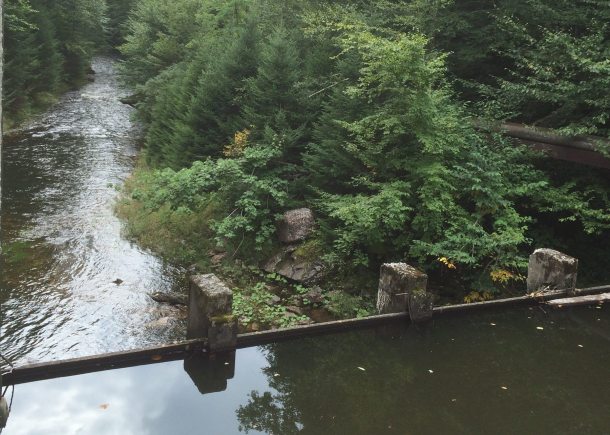
Morrisville’s electric utility has appealed a state finding that utility officials say could turn a marginally profitable hydroelectric dam the town owns into an operation that loses more than $100,000 a year and poses downstream dangers.
The utility also says the state’s finding could lead to the removal of the dam, meaning the loss of recreational opportunities on the Green River and the reservoir behind the dam.
Officials at the Agency of Natural Resources say they had no choice but to rule the dam that holds back the Green River Reservoir harms water quality because federal clean-water law requires the agency to do so even when economic harm could result.
The agency in 2015 studied the dam’s effects on plants and animals near the Green River Reservoir’s shoreline and found that water-level fluctuations of up to 10 feet dramatically shrank aquatic plant populations just below the high-water line.
Federal clean-water law requires the agency to issue a certification that describes under what conditions a dam can operate without hurting water quality. The Agency of Natural Resources said last month in the certification that to maintain the water’s ecological health, Morrisville must stop draining the reservoir over the winter.
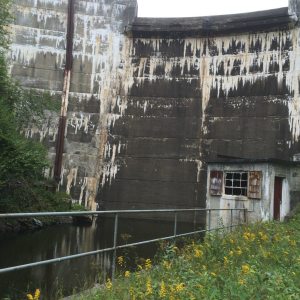
The agency submitted the certificate as part of the dam’s federal relicensing process, which occurs in 30- to 50-year cycles.
Should Morrisville fail in its appeal of the agency’s findings, the town will probably cease operations at the dam’s power generators, since it won’t operate the structure at a loss, said the head of the town’s nonprofit Morrisville Water and Light.
And if the town operated the dam according to the Agency of Natural Resources’ recommendations to the feds, Morrisville Water and Light General Manager Craig Myotte said now drawing down the dam could endanger the safety and property of residents downstream.
Downstream dangers predicted
The dam was designed for deep drawdowns over the winter, to accommodate heavy stream flows during spring runoff, according to plant Superintendent Kevin Newton. The Agency of Natural Resources’ recommendations to the feds would permit only a 1.5-foot drawdown over the winter and would leave unchanged the 1-foot drawdown limit already in place through the summer months.
If Morrisville drew down no more than a foot of the 625-acre reservoir, spring runoff could inundate the dam and flow over it, instead of going through a lower and narrower spillway where it’s supposed to go, Newton said.
“We don’t want to run it the way it was not designed to run,” Newton said.
Should water overflow the dam, it’s anybody’s guess what would result, but the power plant could be ruined, and the dam itself wasn’t built for the kind of forces that would be at work in such a scenario, Myotte said.
“Who’s going to take that responsibility? Morrisville Water and Light doesn’t want to take that responsibility,” Myotte said.
Overtopping has accounted for about a third of dam failures in the past 75 years, according to the U.S. Department of the Interior’s Bureau of Reclamation. Storms have grown more severe since the time most American dams were built, so many of them were not designed to shunt the volume of water necessary to prevent overtopping, according to Bureau of Reclamation documents.
However, the Federal Energy Regulatory Commission does permit emergency drawdowns to prevent overtopping, and FERC will not relicense the structure if it isn’t safe, according to the commission’s guiding rules.
New license could put dam in the red
But beyond those issues, Myotte said, lies an estimated $3.5 million the town would need to spend over the next 30 years to keep the dam operational under the conditions the Agency of Natural Resources suggested in its certificate.
The dam benefits Morrisville Water and Light customers only slightly at present, Myotte said, since at 1 million kilowatt-hours a year it produces about 2 percent of the utility’s total electric sales. The new permit requirements could reduce the dam’s output by a third, Myotte estimated.
Morrisville Water and Light serves about 4,000 electric customers in Stowe, Hyde Park, Morrisville and other nearby communities, Myotte said.
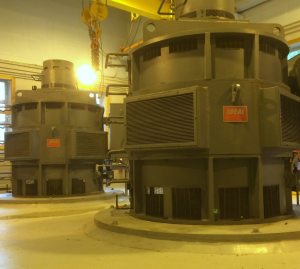
Morrisville’s two other dams, both on the Lamoille River, downstream from the Green River Dam, together put out 9 million kilowatt-hours each year, the remainder of the town’s hydroelectric power, Myotte said. The utility sells about 50 million kilowatt-hours every year in total, Myotte said.
The Green River Dam power plant currently runs only at times when energy on the New England market is especially expensive, Myotte said. On the hottest summer days, for instance, operators will drain water for several hours through the dam’s turbines to create cheap, renewable electricity when most New Englanders are buying fossil-fuel or nuclear power at high-demand, or “spot,” prices.
For comparison, Green Mountain Power owns huge diesel generators near Lake Champlain that the utility fires up when high demand occurs.
Water that pours over the spillway can’t flow through the huge pipes called penstocks that conduct impounded water from the dam’s base to the turbines. Morrisville Water and Light strives not to “waste” any of the water captured from the reservoir’s roughly 14-square-mile watershed, Myotte said.
That’s why Morrisville draws down water in the winter, he said — to generate electricity from water stored from the previous summer, and to make room for more water that will come in the spring.
Without the option of drawing down the reservoir over the winter, the entire project will become what’s called a “run-of-the-river” project, where operators release through the penstocks as much water as comes in at any given time, he said.
The downstream dams both lack reservoirs and function as run-of-the-river projects, he said.
The ability to store water behind Green River Dam, and to release large quantities at the right time, makes all three dams more profitable, Myotte said.
All other things being equal, that ability is worth about $115,000 a year over the next 30 years, he said.
The town and its residents can’t afford to lose that, Myotte said, and so if the dam’s new license includes the drawdown requirements, he said the only remaining options would be to sell the dam or tear it down.
Since the state placed a premium on what lies above the dam, it would make sense that the state be among the prospective buyers should Morrisville need to sell, Myotte said.
State purchase called unlikely
That’s not likely to happen, said Deputy Natural Resources Commissioner Trey Martin.
If every Vermont community that owns a dam asked the state to purchase them just because environmental regulations imposed new costs, the state would quickly run out of money, Martin said.
But a lot has changed since Morrisville received its last FERC license, in 1981, Martin said, and regulators know the environmental regulations added since then burden communities when they’re forced to comply.
Morrisville has had at least five years to prepare for this round of relicensing, Martin said, but he’s still sympathetic.
“Utilities throughout the state are going through this process, and it’s sometimes difficult to achieve a profit,” Martin said. “It’s definitely a reality, what Craig’s grappling with.”
But federal clean-water legislation forbids his agency from allowing economic factors to influence its recommendations in the Section 401 certificate FERC requires to relicense the dam, Martin said.
The Section 401 certificate must, on the other hand, contain the state’s response to the question of under what operating conditions the dam would not harm water quality, Martin said. The agency’s scientists conducted a solid analysis that informs the certificate, and he stands behinds its conclusions, Martin said.
The certificate’s conclusions don’t need to halt the dam’s operation, but they might require new investments to make it work, he said.
Martin said his agency has for years encouraged Morrisville to prepare for relicensing by investing in the dam so it can meet environmental regulations and still turn a profit, and he said he’s still convinced that’s a smart approach and one he’s eager to work toward.
“I believe we made a very sound decision here, but I know it’s one that comes with costs to (Morrisville residents),” he said. “I’m willing to fight for this to work.”
What’s the state’s interest?
Although Myotte said the state’s probably interested mainly in the estimated $1 million a year in economic benefits created by the state park on and around the reservoir, Martin said there are many other benefits to its continued operation under local control.
For instance, when Morrisville Water and Light customers pay their bills, that money remains within their community and supports its economy, Martin said. That’s an important factor behind his agency’s strong support for Morrisville’s continued ownership of the dam, he said.
For comparison, the state’s largest electricity, Green Mountain Power, is owned by Canadian energy giant Gaz Métro, which also owns the company called Vermont Gas Systems that is behind a controversial 41-mile natural gas pipeline under construction to Addison County. Critics often complain that profits from both Green Mountain Power and Vermont Gas Systems go north, out of the state and out of the country.
Some such company could purchase the Green River Dam and invest in it sufficiently to both meet modern environmental regulations and realize a profit, Martin said. Agency analysts believe this is one avenue likely to succeed in accomplishing both ends, he said.
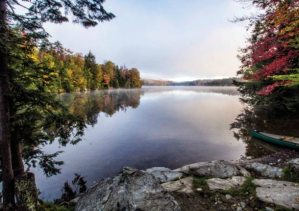
The dam’s reservoir also hosts Green River Reservoir State Park, which Martin called a “jewel” of the state’s park system, and which has attracted numbers of very devoted supporters despite its relative obscurity.
Furthermore, the electricity Green River Dam produces is renewable energy. A key piece of Vermont’s energy policy aspires to obtain 90 percent of all the state’s energy needs from renewable sources by 2050.
“We want them to operate,” Martin said. “Part of the (Vermont) comprehensive energy plan is that we have hydro (generation) in the mix. But it has to be in line with federal standards that protect the environment.”
In supporting Vermont hydroelectric dams, Martin said, the state is furthering its own energy goals.
On the horns
That’s precisely what’s so frustrating about the Agency of Natural Resources’ Section 401 certificate, said Morrisville resident Ed Loewenton.
Loewenton said he laments “the irony of curtailing the use of renewable power while promoting renewable power” that the state seems to engender through seemingly contradictory policies.
Loewenton said what he considers methodological failures within the Agency of Natural Resources’ data analysis have spurred him to take a keen interest in the dam’s relicensing. He said he worries that important wildlife and plant habitat surrounding the reservoir are threatened by the state’s apparent antipathy toward the structure that created it.
Curtailing the dam’s operations, he said, “would be an ecological disaster in the name of ecological rectitude.”
Whether his assessment of state biologists’ work holds water — Loewenton’s college and graduate education trained him in psychology, not biology — he’s correct when he asserts that Morrisville Water and Light won’t meet state requirements for renewable energy production if the utility’s dam’s outputs get drastically reduced.
Recent legislation affords utilities in these situations a grace period to bring their renewable energy holdings in line with other Vermont electric utilities, but Loewenton said the fact remains that one arm of the state is hampering Morrisville’s ability to achieve what another arm of the state is requiring.
The Legislature needs to figure out a way to promote both these seemingly competing objectives without sacrificing either, Martin said.
“We need clean energy, but not at the expense of the rivers,” Martin said.
The agency’s desire to keep the project solvent, operational and under Morrisville’s control creates a dilemma that Martin said he hopes the Legislature will resolve.
Legislative fix?
Legislators could make strides in that direction by better funding the Clean Energy Development Fund, Martin said.
That fund currently holds just over $5 million, and the Legislature didn’t appropriate further funding for its fiscal year 2017, according to Department of Public Service budget reports.
But if lawmakers would bolster the fund, utilities like Morrisville Water and Light could make investments today that would make renewable energy projects like its Green River Dam pan out financially over the long term, Martin said.
Those investments could include microturbines installed in the reservoir’s far reaches, Martin said.

If Morrisville can meet the performance standards modern environmental laws demand, they’d also generate what are known as renewable energy credits, or RECs, in addition to electricity, Martin said.
These credits represent the environmental attributes of renewable energy, and they’re sold on markets to utilities that must obtain a certain portion of their energy portfolio from renewable sources. If a utility purchases electricity from a natural gas-fired electric plant, and purchases from generators like Morrisville Water and Light a proportional number of RECs, together that electricity will satisfy the state’s definition of renewable energy.
In that instance, the electricity from which Morrisville would have stripped the RECs will not meet the state’s definition of renewable energy, even though a hydroelectric dam produced those electrons, because its “renewable” attributes would have been sold. It would, however, produce relatively cheap electricity for ratepayers, made still more affordable by whatever price the RECs fetch.
But to profit from selling RECs, Morrisville must first produce “clean” energy — meaning it can’t harm the river in doing so. Again, this will require upfront investment, Martin said.
“I know there’s not unlimited money, but we should at least ask (legislators) whether there’s a way to make this successful,” Martin said.
“It’s a good object lesson for the Legislature, that we do live with this clash of goals sometimes, and the answer isn’t to override one,” he said. “It’s better sometimes to invest in those goals.”
The odds of decommissioning
The other alternative Myotte sees for the dam, if Morrisville’s appeal fails and neither the state nor a private company will buy the dam, is decommissioning.
That’s a term used to describe the act of tearing a dam down, and both Myotte and Martin said they’re strongly opposed to decommissioning the Green River Dam.
Others are just as opposed.
“I’ll be fighting to keep that place to the end,” Sheila Goss, of Stowe, said of Green River Reservoir. “I’ll be standing in front of the bulldozers.”
“There are few places as special as that,” she said, before worrying aloud that the extreme level of affection she feels might clue others into the largely undiscovered Green River Reservoir State Park.
The park doesn’t allow gas-powered motorboats on the reservoir, and the park’s campsites are accessible only by boat. This provides an unspoiled, remote environment where the people lucky enough to be in the know go to enjoy solitude and natural beauty, she said.
“As far as I’m concerned, the state has a responsibility to maintain and keep it,” Goss said. “You can’t give someone this beautiful treasure and then say, ‘Oh, we’re going to take that.’”
Goss boats on the reservoir several times a month, she said, and she’s seen a host of wildlife species in it, above it and on its banks. These include bald eagles, osprey, mergansers, loons (“there are probably more nesting pairs of loons there than anywhere in the state,” she said), herons, kingfishers, beavers, otter and deer, Goss said.
The owner of a local fishing store said the reservoir undoubtedly brings revenue to the town that it wouldn’t have otherwise seen.
He and an employee at the shop said it’s not an unmitigated good, though.
“We sell bait to go up there, tackle and fishing stuff, all summer long,” said Eric Halperin, an employee at Morrisville’s Old Fishing Hole, a tackle shop owned by Ramel Kuney near the middle of town.
“But when there’s no water in the stream below it …” Kuney said.
“… the fishing sucks, and the fish don’t breed,” finished Halperin.
“I understand both sides,” Kuney said. “The dam does have to comply with federal standards, and the state isn’t coming up with these rules on their own.”
“But they’ve got to keep enough water in the stream to keep it the way it was …” Kuney said.
“This river used to be a phenomenal trout stream,” said Halperin.
The Green River was once featured in Field and Stream and other such publications, but since water flows became controlled for power production in the 1980s, that’s stopped, Halperin said.
Nobody’s seriously considering removal of the dam, though, Martin said.
“This park is one of the jewels of the state park system … and it’s one of the most pristine, beautiful parks in Vermont,” he said. “This decision is by no means against the reservoir, and it doesn’t put us on the path to getting rid of the reservoir.”
Other interests
American Whitewater, a national whitewater boating organization that advocates for dam removal across the country, and which has also appealed the ANR’s Section 401 findings, says it would love to see the dam removed.
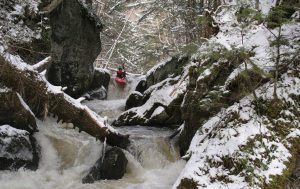
“We’re in favor of removing dams, categorically,” said Robert Nasdor, American Whitewater’s Northeast stewardship director.
As a general rule, “obsolete dams should be removed and rivers restored to their natural condition,” Nasdor said.
Should ANR’s Section 401 findings stand, Nasdor said, Vermonters shouldn’t pay millions of dollars to subsidize the dam’s operation over the next 30 years, and should instead tear it down.
But in its appeal, Nasdor’s organization is actually advocating a regulatory regime similar to what’s in place now, because what’s been proposed by ANR would severely curtail whitewater kayaking in the river below the dam. That’s against state law, Nasdor said.
Vermont law requires that existing uses of the river remain supported even through a dam’s recertification process, Nasdor said. Whitewater kayakers currently use the river, and it features high-quality, challenging rapids, even though water levels aren’t often high enough to run the stretch, he said.
The regulatory regime ANR’s Section 401 findings would all but eliminate future whitewater kayaking opportunities on the river, Nasdor said. No studies or other evidence shows that whitewater kayaking causes any harm to the Green River, he said.
“What Vermont proposes is to remove an existing use without any showing of harm,” Nasdor said. “That’s really the basis of our appeal.”
“As a whitewater boating organization, we believe recreational boating opportunities ought to be supported by Vermont, and not inhibited, and the (Section 401 certificate ANR submitted) reduces these opportunities,” he said.
