

[T]he Shumlin administration is moving closer to a six-year agreement with the federal government to set up a so-called all-payer model of health care funding with preparations starting Jan. 1.
Tom Huebner, the chief executive officer of Rutland Regional Medical Center, told his staff in an email Monday that the U.S. Centers for Medicare and Medicaid Services offered a deal to the state of Vermont.
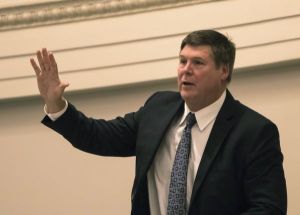
Al Gobeille, the chair of the Green Mountain Care Board, which has been negotiating the deal in partnership with the Shumlin administration, briefed Huebner and a steering committee on it June 13.
The meeting, held at the OneCare Vermont headquarters in Colchester, was private.
“(Gobeille) shared with us the financial terms of the potential agreement, which unfortunately, I am not able to share with all of you,” Huebner wrote to his staff. “Al characterized them, and I would agree, as very favorable terms, that looked good.”
Under the agreement, Vermont’s health care system would start preparing for the new model Jan. 1, called Year 0. Year 1 of the contract would start Jan. 1, 2018. The contract would continue for five years after that.
Huebner told his staff the deal with the federal government “is only the first step” and that since the “real date of the beginning of this project” is 2018, he doesn’t expect to have a final offer until this time next year.
The potential agreement would allow the state to set up a giant organization of health care providers and try to get every doctor and hospital in the state to sign up for it. The Green Mountain Care Board would then regulate that organization in a way that encourages every doctor and hospital in the state to keep their patients healthy, rather than bill for unnecessary services.
The deal being negotiated would let the state avoid following certain sections of federal law in order to set up the all-payer model.
Additionally, Huebner weighed in on the split between two accountable care organizations — OneCare Vermont, which largely represents hospitals, and Community Health Accountable Care, which largely represents community health centers, called federally qualified health centers.
The Department of Vermont Health Access wrote June 14 in response to a public records request that Community Health Accountable Care has teamed up with Optum Inc. to compete with OneCare Vermont to receive payments from Vermont’s Medicaid program on behalf of doctors.
The move has raised questions about the future of reform using an all-payer model, negotiations for which have been going on since early 2015. Establishing a single accountable care organization, based around the legal structure of OneCare, has been the basis of the all-payer model.
Huebner wrote that it is not clear whether Community Health Accountable Care simply wants to become the state’s accountable care organization under the all-payer model or is offering its services as a backup plan in case the all-payer deal falls through.
“If it is competitive that is more troubling,” he wrote. “It is also important to note that their proposal has not yet been accepted by anyone. Still, as things become more apparent, anxiety increases. It will be very interesting to see if we can keep the ‘band’ together.”
Huebner wrote that by the end of 2023, the federal government wants 80 percent of Vermont’s patients to receive care from doctors or hospitals that belong to the single accountable care organization set up under the all-payer model.
Gobeille said in an interview that the federal government gave the state “a clarifying document” full of definitions and that it did not receive an “informal offer.” He said the all-payer deal is being “very, very actively negotiated.”
With regard to the split between accountable care organizations, Gobeille said he needs a “critical mass” of federally qualified health centers and independent doctors to join with hospitals into a single accountable care organization to set up the all-payer model. That number could end up being less than 80 percent, he said.
“It would be a problem if we didn’t have a critical mass of independents, (federally qualified health centers) and hospital-employed physicians,” Gobeille said.

