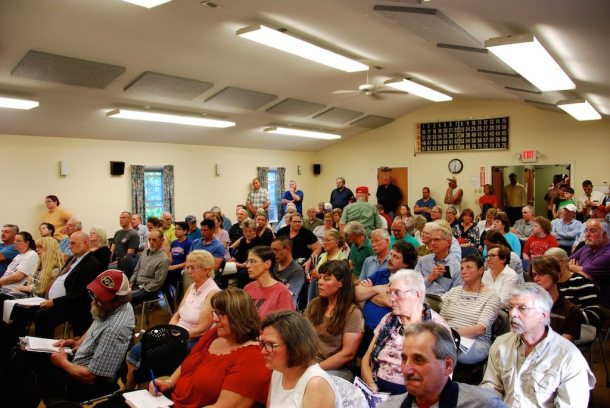
[R]UTLAND — In a heated public meeting Wednesday, the members of the Rutland Board of Aldermen and community members scrutinized a plan to resettle refugees in this central Vermont city.
While some came in support of the proposal, the majority raised objections to the way the plan had been formulated.
The proposal, announced by Mayor Chris Louras last month, would bring 100 Syrian refugees to Rutland for resettlement over the course of a year beginning in October.
Last week, the Vermont Refugee Resettlement Program submitted the proposal to resettle Syrians in Rutland to the federal government. They anticipate they will hear a response in July.
Many residents bristled at Louras’ approval of the project because he didn’t consult with city aldermen and they raised concerns about the impact the resettlement will have on the community.
In a meeting that stretched longer than three hours, the aldermen and residents expressed frustration with Louras’ decision, which they said was carried out behind closed doors and without an appropriate level of community input.
Amila Merdzanovic, the director of the Vermont Refugee Resettlement Program, and Stacie Blake, director of government and community relations at the U.S. Committee for Refugees and Immigrants, answered questions from board and community members for hours Wednesday evening.
“I don’t know that any one of us sitting in this room can just pick up a phone and order 100 refugees,” Alderman Sharon Davis, a longtime member of the board, said, inquiring about the process.
Davis admonished Merdzanovic and Blake for “encouraging” Louras to develop the plan in secrecy.
“But the lack of transparency in this issue has divided this community terribly and you have ownership in that,” Davis said, adding, “I think the process that you chose was the wrong process.”
Several other members of the board made similar complaints, prompting Blake to apologize.
Blake said that she “wanted to take responsibility” for the perceived lack of inclusion in the early phases of the decision-making process.
Blake and Merdzanovic said that they had met with some city officials, including the mayor, as well as some community groups to gauge interest.
Members of the board examined the financial documents of the organization, some pressing the Vermont Refugee Resettlement Program officials on whether the expansion of the program into Rutland is in an effort to garner new funds — an assertion that Merdzanovic and Blake denied.
In searching for host communities for refugee resettlement, Merdzanovic said, the organization looks for available housing, employment opportunities, transportation infrastructure, and social services.
They also look for communities that demonstrate a welcoming attitude towards refugees, Blake said.
“We wouldn’t want to put vulnerable refugees who have fled persecution and terrorism into an unstable or dangerous situation in any way,” Blake said.
Hours later, when the meeting opened to questions from the public, a community member asked, “How much pushback do you need?”
Many raised concerns about management of resources, questioning why refugees should receive assistance with housing and employment when some locals are struggling with the same issues.
Several board members and attendees said children of refugees would burden the school system, and, in turn, impact property taxes.
Louras, who attended the event but did not speak publicly, said he takes responsibility for keeping the process private. He said he wanted to avoid a public vote on whether to allow refugees to resettle in Rutland.
“That’s not who we are as a community,” Louras said. “It’s offensive that anyone would consider voting on where anyone is allowed to live.”
There is a petition circulating that would put the question on the ballot later this year for a non-binding referendum, according to Alderman Ed Larson.
Meanwhile, some members of the board expressed support for the proposal, including Christopher Ettori, who said that he sees it as an opportunity for economic development.
Chair William Notte also said that he is supportive of the proposal. He learned that the plan was brewing two months before Louras’ announcement in April, he said.
According to Notte, the majority of residents either back the plan or do not have a strong opinion.
Throughout the evening, the representatives from the refugee resettlement organizations maintained that they had found support in the city for the Syrian families.
“Rutland is ready, that is what we heard, for this new chapter in history,” Merdzanovic said.