

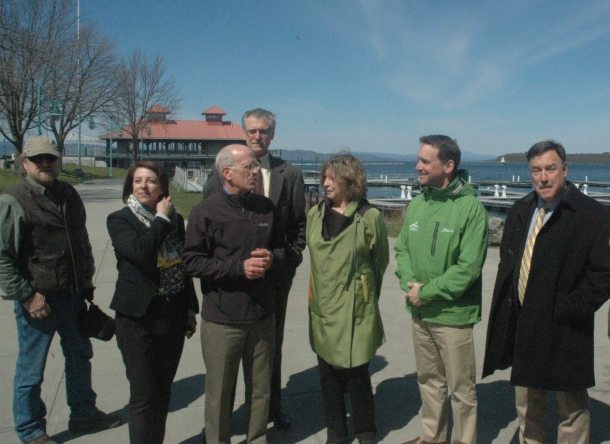
[B]URLINGTON — After a morning ride along the sunny shores of Lake Champlain, Rep. Peter Welch dismounted his Vermont-made Budnitz bicycle to peddle the positive impacts of outdoor recreation on the economy.
Welch was on the waterfront Monday specifically to highlight that a piece of bipartisan legislation he co-sponsored — the Outdoor REC Act of 2016 — had spurred the U.S. Department of Commerce to undertake a study to quantify the sector’s economic upside.
In announcing the study last week, U.S. Secretary of the Interior Sally Jewell noted that “consumer spending for outdoor recreation is greater than household utilities and pharmaceuticals combined — and yet the federal government has never fully recognized or quantified these benefits.”
Welch hailed the study and praised the recreational opportunity in the Green Mountains that “boosts the bottom lines of businesses across Vermont.”
“We want to make sure that Vermont continues to be the best place in the whole wide world for outdoor recreation,” Welch continued.
The Vermont Democrat was flanked by a handful of travel and tourism leaders from around the state who highlighted some of the bright spots in Vermont’s outdoor economy.
They also noted some of the not-so-bright spots, including this past winter.
Among the good news:
The Vermont State Parks saw 1 million visitors last year. More miles are being added to the Lamoille Valley Rail Trail, a four-season trail that snakes through the the state. Hunters saw strong turkey and deer seasons, and work is being done to clean up the state’s waterways, including Lake Champlain.
But clearly lacking throughout much of the Monday news conference was acknowledgment of the state’s struggle with outdoor recreation this past winter, one of the worst for many industries and the most temperate on record.
The state won’t have a detailed economic picture of the snowy season for another two or three weeks. But after the rosy words at the Welch news conference ended, a number of the gathered players acknowledged deep wounds suffered from a weak winter.
“It was a bad winter for us,” said Cindy Locke, the executive director of the Vermont Association of Snow Travelers. She said membership in the snowmobile group was down about a third this year. “We are going to end the year about $350,000 in the red.”
Parker Riehle, president of Ski Vermont, said last year’s economic activity related to skiing and snowboarding was record-breaking, as the East was pummeled with snow. But this year was not nearly as good, he said, with December activity being especially sluggish.
“We don’t know yet how far down we will be, but it will be quite a bit,” Riehle said.
He also pointed out that strong snow-making operations have helped a number of resorts remain open, including Jay Peak, Killington and Sugarbush — all of which are slated to end their seasons this weekend, although Killington may stay open longer if conditions allow.
While a number of Vermont resorts were spared economic annihilation thanks to snow-making, there isn’t one snow gun on the 300 miles of the Catamount Trail, which caters to cross-country skiers.
Amy Kelsey, the executive director of the Catamount Trail Association, said only five of the organization’s 35 scheduled tours took place this winter.
“It was a really hard winter for cross-country skiing,” Kelsey said. “We depend on natural snow, so it was very difficult.”
Tom Torti, president of the Lake Champlain Regional Chamber of Commerce, said the region saw “a slight dropoff in the number of visitors, but not proportional to the weather that we’ve seen.”
Gray Stevens, who runs the Vermont Outdoor Guide Association, expressed a sentiment that many others at the news conference echoed: Vermont needs to adapt to global warming.
“It was an innovative year,” Stevens said. “Dog sledding became dog carting. If you weren’t ice climbing, you were rock climbing. If you couldn’t snowshoe you were out hiking.”
“It just brought out a lot of creative, nontraditional winter activities,” he added.
Kelsey said the Catamount Trail Association has started pondering whether to make the trails available all season. Craig Whipple of the Vermont State Parks also said there were discussions about catering more to warm-weather activities.
Welch also encouraged a robust four-season outdoor picture in Vermont and decried the lack of action in Congress to address climate change.
“I’m working with some of the best minds of the 17th century when it comes to climate change theory,” he said sarcastically.
In a cruel twist, two of the resorts that have been working toward four-season status are now caught up in the largest alleged fraud in Vermont’s history: Jay Peak and Q Burke.
The federal Securities and Exchange Commission recently charged the owners and operators of those mountains, Bill Stenger and Ariel Quiros, with running a massive “Ponzi-like” scheme. They are accused of misusing $200 million of the approximately $350 million they raised through the EB-5 investor program that allows foreigners to gain permanent residency in the United States in return for investing at least $500,000.
Stenger and Quiros used the funds to build out a four-season resort at Jay Peak, which included a hotel, water park, indoor ice arena, condominiums and golf course in the economically depressed Northeast Kingdom. At Q Burke, plans were announced for an aquatic center, tennis facility and indoor mountain biking park.
On Monday, the Lake Champlain chamber’s Torti praised the work done at Jay Peak. He said the resort had pivoted effectively in the face of climate change, and added that its investments should be “instructive for other ski areas.”
“There’s something good to be taken out of the story,” Torti said, adding the bright spot “gets lost in the media frenzy to condemn people before they are convicted.”
Welch also praised some of the EB-5 development projects, adding the alleged issues were “less about the mechanism of financing and more about the misconduct of the developers.”
Welch wouldn’t say if he would support a future EB-5 project if additional oversight and reforms were made, and he said he didn’t have enough information to judge whether the state mishandled oversight on any of the projects.
Welch said he hoped the newly built Q Burke hotel would open and that no more jobs would be lost at the resort.
“I don’t know what the endgame will be there,” he said, “because there’s enormous problems there now.”

