

Editor’s note: Jon Margolis is VTDigger’s political columnist.
[A] funny thing happened to the “undemocratic” process for awarding Vermont’s delegates to the Democratic Convention. By the time it had all sugared off, the results turned out to be almost perfectly democratic.
The “undemocratic” label came from an official of MoveOn.org, the liberal group backing Sen. Bernie Sanders for the Democratic nomination, and was prompted by the inclination of so many of Vermont’s “super-delegates” to back Hillary Clinton.
Those “super-delegates” (not their official title) are elected officials and party big-wigs who get to become delegates simply by virtue of their public or party positions. They may vote for whomever they choose at the convention, no matter how their constituents voted in primaries or caucuses.
Some folks find that “undemocratic.”
So when Sanders got a whopping 85.69 percent in the March 1 Vermont primary to Clinton’s 13.56 percent (call it 86-to-14) his backers in and outside the state, noting that such prominent super-delegates as Gov. Peter Shumlin and Sen. Patrick Leahy were for Clinton, started assailing not only Shumlin, Leahy, et al, but the whole super-delegate system.
Then all Vermont super-delegates announced their preferences. It turns out Sanders is going to get 22 of the 26 delegates.
That’s about 86 percent. Clinton will get four delegates, or roughly 14 percent. Things don’t get more democratic than that.
No, this result does not entirely end the super-delegate debate. In some states, the final counts might not end up as close to the primary or caucus results.
At least not yet. Critics of the super-delegates seem to forget that those delegates are politicians, and as Middlebury College political science professor Bert Johnson pointed out on Vermont Public Radio the other day, “one of the great things about democracy is that politicians tend to be … cowards.” They have what economists might call a marginal propensity to the support the candidate their constituents prefer. They can and do change their minds.
That’s what happened in 2008, when many of the super-delegates who had endorsed Clinton switched to Barack Obama after he won primaries in their districts and states. It may well be what happened in Vermont over the past few weeks when the four super-delegates who had not previously revealed a preference came out for Sanders.
But there’s another factor in this dispute that has gone largely unnoticed. Critics of the super-delegates argue that the presence of these unpledged delegates violates the “one person/one vote” standard. It does. But a political party is not a government agency. It is a private entity which – within reason – may establish its own rules, the better to accomplish its mission.
Its mission is to elect its candidates. To do so, it has to nominate the most electable candidates. That’s what inspired the creation of super-delegates. In the early 1980s, Democrats remained haunted by the example of the late Sen. George McGovern of South Dakota, who rode a wave of anti-war sentiment to win the 1972 nomination and went on to lose 49 states to President Richard Nixon.
So a lightbulb went off in the collective Democratic brain. How about making sure that some of the delegates were people who had actually … gotten elected. Governors, senators, House members, maybe a few state legislators – people who knew how to appeal to the entire electorate, not just the primary voters who tend to be the most active and committed, and therefore the most ideological.
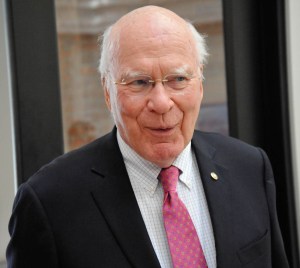
In Vermont, for instance, it is hard to argue that Pat Leahy should not be a delegate. He has been elected seven times, usually by huge margins, and is likely to be re-elected again. Don’t tell anybody, because it seems to be something of a secret, but Leahy’s term is up. He’s on the ballot this fall, and he’s so strong politically that so far nobody is running against him. Asked via email whether any Republican was preparing to challenge Leahy, Vermont GOP Executive Director Jeffrey Bartley replied, “No one has asked me to talk for them.”
Leahy, clearly, is a guy who knows what it takes to get elected. He thinks Hillary Clinton would be the Democrat most likely to get elected president. He probably thinks she’d be a better president than Sanders, too. In either or both judgments, he might be wrong; anybody might be wrong about anything. But his credentials are impressive.
So back in 1984, the Democrats decided to make their sitting governors, senators, House members and a few other officials automatic delegates. Then they added top party officials – state chairs, vice chairs and the like. The case for this addition is less compelling, but hardly surprising. These were the folks making the decision. They want to go to the conventions, so they adopted a rule making it easier for them to get there. People tend to do things that makes their lives easier.
The super-delegates have been attacked as a ploy to strengthen the hand of party elites. It was and is, and there was nothing surreptitious about it. Neither is it necessarily a bad idea. A person becomes a member of an elite by doing his or her job better than the rest of us. The first job of a politician is to get elected. There is something to be said for paying attention to the folks who are better at that job when it comes to choosing candidates.
Granted, elites in any field – government, corporations, universities, newspapers – can become stodgy, self-satisfied, more interested in protecting their perks than in performing their assigned tasks.
In government and politics, the remedy for this defect is to run against the elites. Bernie Sanders – part of the elite himself (he’s a United States senator, not a ditch-digger) – is running against them, and so far doing a pretty good job of it. If he keeps winning primaries, he will convince enough super-delegates to support him to win the nomination. If not, he won’t.
Democracy, in this contest, is doing its job.

