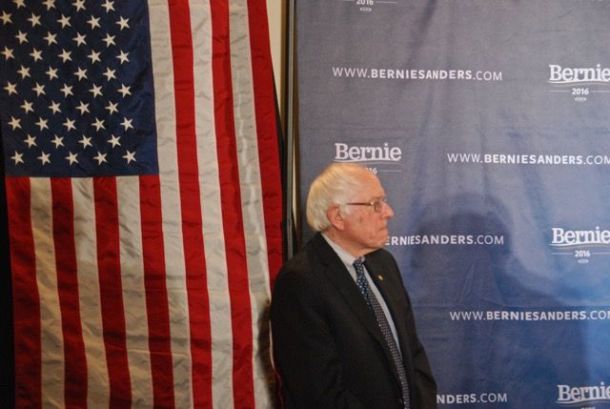
CONCORD, N.H. — So could he really win?
Not just the nomination. With Sen. Bernie Sanders’ victory in the New Hampshire primary Tuesday, there is little doubt that winning the Democratic nomination is possible.
But what about the general election? What about Bernie Sanders becoming president of the United States? Is that possible?
That’s the question being bandied about in Democratic circles. Not just Democratic politicians, either. Democratic (and Democratic-leaning) pontificators, analysts, professors and self-appointed wise men/women are debating the matter in print, over the air, online and on cable.
Last week, Vox, an online news site with a center-left orientation, asked six political scientists whether Sanders could possibly beat the Republican candidate in the fall.
Maybe, they said, but just barely, and then only if everything broke his way. Noting the obvious political baggage Sanders carries – his age, his Brooklyn accent, and above all being a self-described socialist “more toward the ideological pole than the average American” – their consensus was that Sanders was more likely to lose, with a real chance he could get blown away, like George McGovern in 1972, with Democratic disasters down the ticket.
That report prompted a debate between two left-of-center economists, Nobel Prize winner (and New York Times columnist) Paul Krugman and Dean Baker of the Center for Economic and Policy Research and a blog called “Beat the Press.”
Krugman said liberals should take the findings of the political scientists seriously, and warned against “believing what you want to believe” despite evidence to the contrary.
Baker responded that the real question was whether Sanders would be likely to lose an election that Hillary Clinton might win. Considering her advantages with Democratic office-holders, many of whom will be “super-delegates” to the Democratic National Convention, Sanders “could not get the nomination (without) a decisive victory in the primaries,” Baker said.
If Clinton ends up losing to a candidate “who has all (Sanders) weaknesses,” Baker asks, how likely is it that she could win the general election?
Both men are better economists than political analysts. Baker overstated the importance of super-delegates. Besides, Sanders did win decisively here Tuesday, and could in the future.
But that doesn’t mean he could win a general election. The voters who go to the polls in Democratic primaries are not just Democrats. They tend to be the most liberal Democrats. The November electorate is a completely different animal, far more challenging for a candidate like Sanders.
Baker did make one good point. So far, Sanders is doing so well because he is a better candidate than Clinton, and he’s running a better campaign. Why should anyone expect that Clinton’s team – so blunder-prone in February – will be any more capable in October? So far they, and she, have proven adept at nothing but blowing big leads.
But then the political scientists may not be such great political analysts, either. Remember: political science isn’t. It isn’t really a science, that is, the way that physics and biology are. The political scientists bring up some points that, as Krugman said, ought not to be dismissed: Americans rarely elect “movement candidates.” In a contest between fear and hope, fear usually wins; those polls showing Sanders beating some GOP contenders will remain meaningless until after the inevitable Republican attack on Sanders can be put into the equation.
A McGovernish, 49-state loss appears highly unlikely. In this era of political polarization, it’s hard to see how a Republican could carry Massachusetts, New York or California — no matter who the Democratic candidate is.
And remember, centrist Walter Mondale, hardly close to “the ideological pole,” lost 49 states, too.
Besides, all these projections about what might happen are based on what has happened, and on the assumption that people will react in the future as they have in the past.
They might not. Something is different, and while “something” is always different, the difference today may be more politically salient than most.
Perhaps the best way to understand this difference is to pose a question: Has the neo-liberal (meaning conservative) experiment that began sometime in the late 1970s failed? Is it now clear that the deregulation, privatization and marketization of the last few decades were a mistake?
The answer is: yes … if. Yes, if success is defined to include a broad-based prosperity in which everyone who is able-bodied, able-minded, and prepared to work can carve for him or her self a middle-income standard of living. Or at least the upper levels of a lower-middle income standard of living.
(Not everyone uses that definition, which may explain why the experiment has failed; but that’s a subject for another day.)
No matter how often Bernie Sanders intones the term, “income inequality” alone does not tell the story. Were the rich just getting richer faster than everyone else, the political impact would not be nearly as profound.
That is not what is happening. What is happening is that a 40-year-old man who did not graduate from college probably earns substantially less (in real, inflation-adjusted dollars) than his father did at 40. His retirement prospects are grimmer (his father may have had a pension), and things don’t look any better for his teenage son (or daughter; but the decline in male well-being is greater because the guys had more to begin with).
What is happening is that most Americans in the lower half of the income distribution spectrum are doing no better, if not worse, than they were a few decades ago, and worse than their parents did at their age. This creates an extraordinarily fertile field for a candidate who insists that the economy is “rigged,” the campaign finance system “corrupt,” the Wall Street business model a “fraud.”
Whether Sanders can plow, sow and harvest that field remains to be seen. He can come across as (and the Republicans will certainly try to paint him as) a one-trick pony who talks about nothing but the economy. The next time somebody asks him a question about foreign affairs, he might try turning his full attention to it and acting as though he cares about it, instead of trying to pivot as quickly as possible back to the subject of economic inequality.
Sanders also seems indifferent to the non-policy aspects of the presidency, its function as “a bully pulpit,” as Teddy Roosevelt called it, or “a place of moral leadership,” in the words of his cousin, Franklin. Voters want their president to propose good policy. But that’s not all they want from him.
Or her. Sanders is not even close to having the Democratic nomination in hand. For all her errors, Clinton remains a formidable candidate. As of Tuesday morning, she was still leading in the national polls. The conventional wisdom still holds that a 74-year-old Jewish socialist can’t become president, or maybe even a major party nominee.
Conventional wisdom should not be casually dismissed. It’s often right; that’s how it gets to be conventional. It’s way too early for the Bernie backers to buy champagne. But thanks to the strength of the Sanders campaign, the weaknesses of Clinton’s, the turmoil of the Republican campaign, and – most of all – the difficult plight of so many Americans, it’s not impossible that this 74-year-old Jewish socialist could end up living in the White House.