


[B]URLINGTON — A state trooper and a Drug Enforcement Administration agent who shot and killed a suspected drug dealer during a Dec. 22 raid in his Elmwood Avenue apartment were justified in their use of force, according to prosecutors.
State’s Attorney T.J. Donovan made the announcement flanked by state and local law enforcement officers at a news conference Thursday. The shooting was justified because the two officers “reasonably believed” they were in imminent danger of being killed or seriously injured, he said.
Vermont Attorney General William Sorrell made the same finding, according to a news release.
Conspicuously absent from Thursday’s news conference was any representation from the DEA, which planned and led the operation that led to the death of Kenneth Stephens.
Trooper Matthew Cannon, who is assigned to the DEA drug task force, has returned to active duty with the DEA. Officials could not say whether DEA Special Agent Tim Hoffman had returned to active duty, as DEA officials would not comment beyond a statement provided to media.
Also Thursday, state police released video and audio of the raid captured by a body camera on a Burlington officer.
Elected officials and the Vermont Civil Liberties Union have questioned agents’ decision to use a warrant that did not require them to knock before entering, as well as the decision to confront Stephens in his home, where he was known to keep a loaded .50-caliber muzzleloader rifle.
Of special concern to public officials was that two of the shots officers fired left Stephens’ apartment and entered a neighboring home, nearly striking one of the occupants.
Stephens had a long and violent criminal history, but Donovan reminded members of the media that he was also a son and a friend to many, with people who loved him. Donovan said he told Stephens’ father and a close friend about his decision before Thursday’s news conference and that they had asked people to respect their privacy.
Donovan and other officials said their investigation and review were limited to whether, at “that moment in time” when officers fired their weapons, their response was reasonable and justified. They did not examine whether the operation unnecessarily endangered the public or could have been executed differently.
“We certainly didn’t investigate the operating procedures of DEA,” said State Police Maj. Glenn Hall, whose agency led the investigation, but he added that nothing in their investigation suggested the operation was “outside of standard practice” for the execution of a search warrant.
U.S. Attorney Eric Miller, the only federal official present Thursday, said he spoke with the DEA special agent in charge for New England, Mike Ferguson. Miller said Ferguson told him the DEA is conducting a review that includes the tactics used during the raid.
“The scope of their investigation will be in order to determine whether the operation complied with DEA standards and Department of Justice standards regarding force and the use of deadly force,” Miller said.
Miller said he did not know if the DEA review could lead to disciplinary action or criminal charges, or if it would be considered a public record. The DEA issued a statement confirming its review is ongoing but declined to answer questions.
Burlington Police Chief Brandon del Pozo said that while his department won’t conduct a formal investigation, it will do a “tactical review” to see if similar operations can be done in a way that produces “better safety outcomes.”
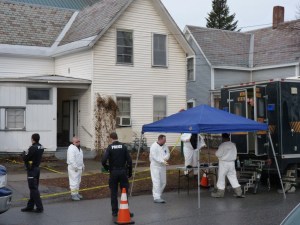
Donovan’s report reveals that on Dec. 21 agents’ initial plan was to lure Stephens out of his residence and arrest him before carrying out the search warrant. It’s unclear why an arrest wasn’t made that day. The report states only that “officers decided that the warrants should not be executed that evening.”
On Dec. 22 agents learned that Stephens would likely purchase drugs that afternoon. Agents then held a briefing to go over the plan, which was “essentially, the same plan” as the previous day, according to the report.
“Surveillance teams observed Mr. Stephens coming and going from the residence,” the report states. Agents learned Stephens had bought drugs and may have taken drugs as well. Toxicology reports later confirmed Stephens was on cocaine, heroin and a “Valium-like substance.”
Members of the Burlington Police Commission have questioned why officers didn’t arrest Stephens when he left his home that day. Del Pozo publicly suggested DEA agents may have been interested in building a stronger case by arresting Stephens in his home with the drugs in his possession.
Officers recovered $2,600 worth of heroin, or 260 $10 bags, and a “distribution amount” of crack cocaine from Stephens’ apartment, according to Miller, the U.S. attorney.
As officers prepared to execute the warrants from a nearby parking lot, a Burlington police officer assigned to the DEA task force requested help from additional Burlington officers.
Sixteen officers were present for the operation, with nine officers forming a line that approached the narrow entryway wrapping around the side of the apartment. The only officer wearing a body camera was a Burlington officer near the back of the line.
None of the other departments involved have body cameras as part of their uniforms.
The officer with the body camera was around the corner from the entrance to Stephens’ apartment and therefore did not capture the shooting on video. His body camera did, however, capture audio from the incident.
About 7 p.m. on the day of the raid, a DEA agent at the front of the line began to strike Stephens’ door with a battering ram. The agent had to strike it 12 times to break it open.
When the door did not open immediately, Trooper Cannon shouted, “Police” and “Don’t move.” Everything that followed happened “extremely quickly,” Donovan said.
Fifteen seconds elapsed from the time the agent first struck the door to when the last of 13 shots was fired. All 13 shots came in two seconds, according to the report.
As the door was being struck, Stephens allegedly yelled something to the effect of “Hit it harder. Come on, hit it harder.” A voice can also be heard yelling, “Smash it,” according to the report. Those words are muffled on the body camera recording and difficult to make out.
The force of impact from the battering ram jostled a shade covering the window, giving Trooper Cannon a momentary glimpse of Stephens sitting in a chair across the room. As the strikes continued, Cannon saw Stephens stand up and again shouted for him not to move, according to the report.
When the door broke open, Stephens was standing facing it, pointing a rifle at the officers, according to the report. He then yelled something to the effect of “Who wants to die?” Those words are allegedly captured on the body camera video, but again are muffled and difficult to make out.
Investigators found that Stephens’ rifle was loaded, but the primer that would have allowed him to shoot was not in the gun. Officers found it “within reach” of where he was originally sitting, according to the report.
It was roughly 15 feet from the threshold of the door to where Stephens was standing. Cannon fired 10 shots. Hoffman, the next officer through the door, fired three times, according to the report. All three of Hoffman’s bullets were recovered from Stephens’ body.
Stephens lurched forward, then spun and fell on his back. After determining there was no one else in the apartment, officers trained as emergency responders gave aid. Within minutes Burlington firefighters were on the scene and determined Stephens was dead, according to the report.
An autopsy revealed he had been struck seven times by bullets. He had gunshot wounds to both hands “consistent with a person holding a rifle against his shoulder” while facing the person who shot him.
Chief Medical Examiner Dr. Steven Shapiro found “flecks of metallic material” in Stephens’ right hand that could be shrapnel from the rifle, which was also struck by a bullet, the report states.
Stephens was also hit in the left arm and the right side of his abdomen. There were gunshot wounds in the right side of his back and one in the back of his head. Donovan said the shot to the back of his head was consistent with him spinning and falling.
Interviews with Stephens’ family conducted as part of the investigation found his mental state was “rocky” after the death of his daughter last year. He told multiple people he would die before going back to jail, according to the report.
Officials would not speculate Thursday whether Stephens intended for officers to take his life. Witnesses told investigators that Stephens got the muzzleloader “through a private arrangement” two months before he was killed.
Stephens had been convicted of multiple charges and served more than 15 years for a federal firearms violation. That conviction stemmed from an incident in 1995 where he shot a man in the head. The man survived, and an attempted murder charge was dismissed in Windsor County.
In 2013, Stephens was convicted of felony marijuana possession. A charge that he provided a roommate with opiates that the roommate later overdosed on was dismissed.
It was legal for Stephens to have the muzzleloader because under federal law, such a weapon is not considered a firearm, Miller said. There is also no state law that would have made it a crime for Stephens to have the muzzleloader, officials said.
“We don’t have a lot of gun laws in Vermont,” Donovan said.
Police found six bullets in the wall and quickly realized three had left the apartment. One was stopped by an electrical fuse box. Two others crossed a 12-foot grassy area, where Chief del Pozo has said one of his officers was standing, and entered another home.
Capt. J.P. Sinclair, chief criminal investigator for the state police, said it’s impossible to tell how fast the bullets were traveling when they left the apartment. They were found in the neighbor’s home largely intact, he said.
One passed through the neighbor’s wall but did not penetrate the canvas of a painting. It was discovered inside the painting’s frame. The other went through a window, scattering debris on a resident. That bullet was found on the couch next to him.
Both Cannon and Hoffman were armed with semi-automatic assault rifles, loaded with .233-caliber ammunition. Cannon’s rifle was issued by state police, but the ammunition was provided by the DEA.
The rifles have an effective range of up to 600 yards but are reliable at close range as well and hold a high-capacity magazine.
Public officials have questioned the use of assault rifles in a densely populated area. Hall, with the state police, said the rifles were appropriate for the operation and noted that pistol fire could have easily left the apartment as well.
