


[B]URLINGTON — In the wake of a deadly federal drug raid in December, members of the city’s Police Commission pressed the chief of police on how officers might avoid similar outcomes in the future.
Commission members said they were especially upset that several bullets left the apartment where the raid took place and reportedly almost struck a neighbor in his home. They asked the chief if there are ways to conduct operations that would be more likely to keep the public out of harm’s way.
Chief Brandon del Pozo said he shared the commissioners’ concerns and revealed that a Burlington police officer was in the alley behind the apartment and also came close to being struck by a stray bullet.
Del Pozo said that while he doesn’t believe DEA agents did anything “reckless or negligent” he will do what he can going forward to ensure his department has a greater role in reviewing operations before they’re executed.
“We need to be satisfied independently that the plan is sound,” he said.
The Dec. 22 raid was planned and conducted by Drug Enforcement Administration agents with assistance from Burlington and Essex Police as well as Vermont State Police. It’s unclear how much notice del Pozo and his officers had about the operation. The warrant that allowed the raid to go forward was issued the day before the raid.

It was carried out using a warrant that did not require police to knock before entering. Such warrants are extremely rare. Only three of 136 warrants issued by the U.S. District Court last year allowed police to enter without knocking.
Officers broke down the door of Kenneth Stephens, 56, a suspected drug dealer with a violent criminal past, whom they knew to have a muzzleloader rifle in his home.
Stephens allegedly aimed the rifle at police and said, “Who wants to die?” A state trooper and a DEA agent shot 13 bullets with assault rifles, striking Stephens in the head and torso an unknown number of times.
The chief said Tuesday night that he’s limited in what he could say about the raid, because he doesn’t have all the facts. State police investigated the officer involved shooting, and State’s Attorney TJ Donovan is reviewing their report.
Del Pozo said more information will be available Thursday when Donovan is expected to hold a news conference on whether his review of the evidence found any wrongdoing on the part of law enforcement.
He did, however, remind commissioners that before the night of Dec. 22, the only person involved in the raid who had shot someone was Stephens, who was convicted on federal firearms charge stemming from a shooting in the 1990s. Del Pozo described him as “a destructive force in the community” and an appropriate target for the DEA-led Drug Task Force.
Among the concerns raised by commissioners was whether DEA agents leading the Stephens investigation had other opportunities to make an arrest that would not have put the public in as great danger and why they chose to go in with assault rifles.
Working with confidential informants, DEA agents had already bought heroin or crack cocaine from Stephens on three occasions. Commissioners said it was difficult to understand why they chose to break down Stephens’ door at 7 p.m. on a Wednesday to confront him.
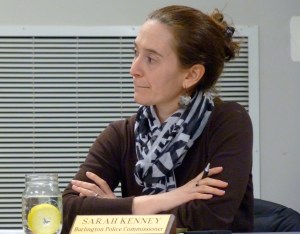
“It seems like there were opportunities before he was in his home to apprehend him without discharging a firearm,” said Sarah Kenney, chair of the commission.
Del Pozo said it was his understanding that agents monitoring Stephens that day had information that he was going out to buy drugs. When Stephens returned and made a monitored call saying he had the drugs, agents decided to execute the no-knock warrant, he said.
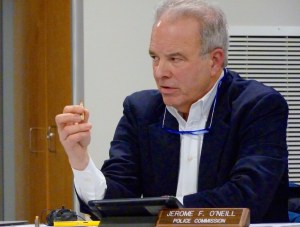
Commissioner Jerry O’Neil, a former federal prosecutor in Vermont, said the controlled purchases of drugs would have made a solid case against Stephens on their own, and the officers could have avoided confronting him in his home where they knew he kept a rifle.
Del Pozo said it was his understanding that agents did not want to rely on testimony or evidence gathered by confidential informants, which wouldn’t carry as much weight in court as direct testimony or evidence gathered by officers.
The chief said he agrees with the commissioners that when there are opportunities to “maximize public safety,” even at the expense of building a more compelling case, “what we collectively owe to citizens is to maximize safety.”
O’Neil said he has “grave concerns about the common sense DEA exercises,” adding that he was recently run off the road by DEA agents involved in a high speed chase.
“I realize we can’t stop them from acting as they’ve been known to do,” O’Neil said, but he urged del Pozo to use whatever “leverage” he had to “rein in some of their practices.”
Burlington has historically had one full-time detective assigned to the DEA-led Drug Task Force, and while he’s not suggesting that BPD pull out from the task force, he would like to see greater accountability from federal agents operating in Vermont.
“It seems like (federal agents) hold all the cards, but when it comes down to it, they can’t do these operations without us. So we do have the ability to sit down with them and really take a good look at how stop this from happening again,” del Pozo said.
O’Neil questioned the choice to arm the participating officers with assault rifles, especially in light of where the raid was taking place — a densely populated area with wood-framed houses. Del Pozo said he didn’t believe the type of weapon increased the likelihood bullets would leave the apartment.
One factor that may have played a role in bullets exiting the apartment, is that police shootings in Vermont are extremely rare. It’s possible that irregularity impacted officers situational awareness, he said.
“People get into habits where they’re forgetting that walls can be perforated by bullets. I mean the sergeant that was there that day will never forget this and the officers will never forget this,” del Pozo said.
But after years and years of executing search warrants without having to fire a shot, it may not have been top-of-mind for officers that their bullets could leave the apartment, he said.
“I mean an infantry unit just out of Afghanistan or Iraq would never have made that decision because they were discharging their weapons on a constant basis,” del Pozo said.
“I’m not excusing what happened. I’m saying, to be candid, I doubt that folks were even thinking that way,” he added.
