

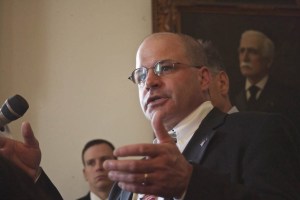
Committee Chairman Bill Lippert, D-Hinesburg, said Miller will address the panel at 4:30 p.m. Thursday.
Starting Feb. 4, the committee will have hearings every Wednesday at 11 a.m. with members of the Shumlin administration’s health care reform team.
The news comes after revelations last week that the embattled health insurance exchange had a backlog of thousands of needed changes to customer accounts and more than 1,000 customers who were unable to renew their plans due to technical problems.
“We are going to continue to address the issues that need continuing attention, including the question of what the sustainability questions are for Vermont Health Connect,” Lippert said.
House Speaker Shap Smith said the hearings will lead to a discussion between him and Lippert about whether to switch to the federal health care exchange.
Lippert said a constituent called him Wednesday morning on behalf of a family member who was having trouble navigating the billing and financial issues with the Vermont exchange.

As recently as Friday, Vermont Health Connect had about 4,000 so-called life changes backlogged in its system and up to 1,400 customers who couldn’t renew their plans. The backlog returned because the state had to turn off an automatic function for processing those life changes, called changes of circumstance, Miller said.
The administration said it has fixed the underlying technology that prevented the state from using the change of circumstance feature. Miller said in an interview Jan. 21 that clearing the backlogs will take about a month.
However, last week lawmakers said they felt blindsided because many heard about the backlog for the first time in the news media. Blue Cross Blue Shield of Vermont and Vermont Legal Aid are both calling for an independent review of the exchange’s technical foundation.
“We knew that the change of circumstances was going to go offline for a while,” said Smith, D-Morristown. “What I want to make sure of is there’s no thing that’s happening that was unanticipated.”
“In other words, are there bigger challenges than the change of circumstances going offline?” Smith said. “And if there are, then I think we need to know that. And if there are bigger challenges, then I think it calls into question whether or not we should use the exchange.”
“The administration says, ‘We’ve got a story to tell that was pretty clear about the change of circumstances going offline,’ and I think it’s incumbent upon us to make sure that’s accurate,” he said.
At the end of the hearings, Smith said, he will talk with Lippert to find out whether the state should abandon the Vermont exchange. “The different options have their own challenges, and we’ve always known that, and that’s one of the reasons we’ve been willing to stick with the state exchange,” Smith said.
Scott Coriell, the governor’s spokesman, cited a November report the administration gave to the Joint Fiscal Office that said finishing the Vermont Health Connect project is the state’s cheapest and most efficient option.
The administration estimates it would cost $10 million in state money and $14 million in federal money to transition to the federal exchange, plus $5 million in state money to operate the new system. Federal law would require the state to keep running Vermont Health Connect during a roughly 18-month transition period.
In a tight budget year such as the upcoming fiscal year 2017, the Legislature generally has three options for funding new initiatives: Cut spending in another part of state government, use one-time money, or raise taxes.
“Anyone recommending a move to the federal exchange must include with that recommendation a revenue package” to pay for transitioning and operating under the federal exchange, Coriell said.
Vermont Health Connect now serves about 33,000 customers with commercial insurance, and the state is moving about 143,000 Medicaid customers from an old system over to the exchange.
Coriell said the exchange “successfully processed 21,0000 renewals, putting us four months ahead of where we were last year. He said it “continues to smoothly sign up new people” for Medicaid and commercial insurance.

