


Editor’s note: This is the first of a five-part series of stories to appear weekly until Iowa’s first-in-the-nation caucuses Feb. 1.
[M]ost politicians would turn cartwheels to land a profile in Rolling Stone magazine.
Bernie Sanders isn’t most politicians.
Reporter Mark Binelli was shadowing the Democratic presidential candidate for a multi-page feature spread — “Weekend With Bernie,” published July 9, 2015 — when the Vermont senator grimaced at an opportunity his challengers would greet with a smile.
“Midway through the course of two interviews,” Binelli went on to write, “when we’ve already discussed the loss of U.S. manufacturing jobs, the destructiveness of international trade agreements and the co-opting of the Democratic party by corporate interests — talk shifts to Sanders’ initial race for mayor of Burlington, and I ask what brought the native Brooklynite to Vermont in the first place.”
“‘So this story is mostly gonna be about me personally, as opposed to what I’m trying to do?’ he asks testily.”
Sanders isn’t your typical office seeker. The Washington Post illustrated this in an Oct. 13, 2015, story headlined “Why does Bernie Sanders dress like that?”
“Sanders has an almost Einsteinian nebula of white hair and is prone to wearing suits that look as if he pressed them under a mattress,” noted the newspaper. “His clothes seem to hang on him, as if he borrowed them from another man’s closet. Sanders strongly suggests Oscar Madison, albeit with a more detailed college-tuition plan.”
The New York Times devoted an entire corner of its Sunday, Nov. 1, 2015, front page to the news “Bernie Sanders Won’t Kiss Your Baby. That a Problem?”
“He rarely drops by diners or coffee shops with news cameras in tow, unlike most politicians,” reported the Times. “To Mr. Sanders, the independent senator from Vermont, political schmoozing is a phony business, and anathema to his total focus on weighty issues.”
As seemingly all of America has come to learn, Sanders loathes income inequality, social injustice, economic and political oligarchy — and media preoccupation with his personal story.
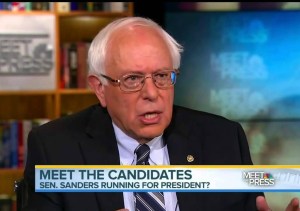
“The American people want to know why the middle class in this country is disappearing, why we have 47 million people living in poverty, why we have massive income and wealth inequality,” Sanders said on the Nov. 8, 2015, edition of NBC’s “Meet the Press.” “I think it might be a better idea, I know it’s a crazy idea, but maybe we focus on the issues impacting the American people and what candidates are saying, rather than just spending so much time exploring their lives of 30 or 40 years ago.”
That hasn’t stopped Time magazine from placing Sanders on its cover (“The Gospel of Bernie,” Sept. 17, 2015). Or the New Yorker from publishing an 8,000-word biography (“The Populist Prophet,” Oct. 12, 2015). Or the candidate himself from unwittingly justifying such stories when asked on “Meet the Press” why he was bringing up Hillary Clinton’s past positions on present-day issues.

“What I understand politics and elections to be about is to discuss differences of opinion,” Sanders responded. “What people want to know is who has leadership? Who was there in 1996 in terms of the Defense of Marriage Act? What I think the issue is who is prepared under difficult circumstances, when it’s not necessarily popular, to make decisions which are the right decisions, rather than 20 years later.”
And so, viewed as a catalyst to his current thinking, what is Sanders’ story? How is the nation’s political press reporting it? And is that coverage accurately reflecting what Green Mountain residents, scribes and scholars know to be his main attributes, accomplishments and aspirations?
‘A little bit about myself’
When the New Yorker staff writer Margaret Talbot was assigned to sum up Sanders, she began by extolling the virtues of seemingly everyone but him.
“American politicians know the power of a personal story,” Talbot wrote. “The first lines of Jeb Bush’s biography on his official campaign site describe how he met his wife, Columba: ‘My life changed forever when I was a young man on an exchange program in León, Guanajuato, Mexico. Across a plaza, I saw a girl. She spoke little English, and my Spanish was a work in progress. But for me, it was love at first sight.’ Hillary Clinton’s official online biography sounds like one of those books about great Americans aimed at young readers: her father’s drapery business and ‘rock-ribbed’ Republicanism, her family’s Methodism, and her youthful turn as a Girl Scout all get their due. Elizabeth Warren, the Massachusetts senator whose critiques of income inequality presaged Sanders’s presidential campaign, often speaks of her parents’ economic hardship to help explain her values today.”

As for the article’s subject?
“Sanders’s campaign website lists his educational history,” Talbot wrote, “says that he is married to Jane Sanders and that they have four children and seven grandchildren, and mentions that he worked as ‘a carpenter and a documentary filmmaker’ before entering politics. That’s it for personal stuff.”
Ingest all the up-close-and-personal profiles the national media is producing about Sanders and you’ll find they start with the same fact: Sanders hates up-close-and-personal profiles.
“If you’re the type of candidate who sees presidential politics as theater, you will likely shape your personal narrative in such a way as to ensure you’re the protagonist of the drama,” Rolling Stone’s Binelli wrote last summer. “At the five Sanders 2016 events I attend in Iowa and New Hampshire, he basically does none of these things. The part of his Davenport speech where he says, ‘My friends, let me just tell you a little bit about myself,’ is followed by exactly three sentences, in which Sanders reveals that, before serving in the Senate, he was a congressman and a mayor; that his father was an immigrant who worked as a paint salesman; and that growing up, he learned ‘what money — or lack of money — means to a family … [when] every nickel being spent was being argued about.’ (Bowing to clear domestic self-interest, he also points out his wife, Jane, in the audience and notes that it is their 27th wedding anniversary.)”
The New Yorker offered a different take on the same subject.
“When I asked Sanders a question about his early years, he sighed with the air of a man who knows he can no longer put off that visit to the periodontist,” Talbot wrote. “‘I understand,’ he said. ‘I really do. For people to elect a president, you’ve got to know that person — you’ve got to trust them.’ He insisted that he was happy to talk about his life. But he couldn’t resist sermonizing first: ‘When I talk about a political revolution, what I’m talking about is how we create millions of decent-paying jobs, how we reduce youth unemployment, how we join the rest of the world, major countries, in having paid family and sick leave. I know those issues are not quite as important as my personal life.’”
‘Twisted priorities of the press’
This has led some reporters either to surrender (“Sanders won’t say much about his childhood,” Rolling Stone concluded) or to power up a steam shovel and dig for dirt. This past May, Mother Jones magazine unearthed a stream-of-consciousness essay on male-female sexual dynamics a 30-year-old Sanders wrote for the now defunct alternative newspaper the Vermont Freeman.
“A man goes home and masturbates to his typical fantasy — a woman on her knees, a woman tied up, a woman abused,” Sanders’ essay began. “A woman enjoys intercourse with her man — as she fantasizes being raped by 3 men simultaneously.”

Forget that the provocative opening leads to a less-reported closing statement: Traditional gender roles can create trouble for men and women, Sanders concludes, and they should rethink how they interact with one another. Four decades later, the essay threatened to be a problem for the author himself.
“This is a piece of fiction that I wrote in 1972,” Sanders responded on Meet the Press. “And if you read it, it was dealing with gender stereotypes. Why some men like to oppress women. Why other women like to be submissive. You know, something like ‘Fifty Shades of Grey.’ Very poorly written 43 years ago. What I’m focusing on right now are the issues impacting the American people today.”
The story came and went — but only after seemingly every major media outlet in the country shared it coast to coast.
“Are there any lessons to draw from this?” National Public Radio reporter Danielle Kurtzleben asked in a June 1, 2015, piece titled “The Bernie Sanders ‘Rape Fantasy’ Essay, Explained.” “Absolutely: if you’re a politician — especially on the national level — everything you’ve ever written, said, or done can, and likely will, be dredged up for all the world to inspect and critique.”
Several news outlets demonstrated that by reporting personal revelations about Sanders’ early years in Vermont.
In July, VTDigger broke a story about the real identity of the mother of the candidate’s eldest son. Biographical articles over the years have said Levi Sanders is the product of his father’s first marriage to college sweetheart Deborah Messing, who he wed in 1964 and divorced in 1966. But, as a campaign spokesman confirms, Levi was born to another woman, Susan Mott, although his father didn’t correct the record until questioned this past summer.
Politico offered a more dramatic take in a story headlined “Bernie Sanders Has a Secret.”
“In his chosen home, a state that at the time was morphing from one of the country’s most resolutely conservative to one of its most reliably liberal, the New York City-raised Sanders found an environment that suited him: a tolerant, loosey-goosey era and place, but with an abiding Yankee sense of privacy,” Politico staff writer Michael Kruse expounded. “It allowed him to focus on what fueled him without being forced to discuss publicly significant details about his personal life — like his meager finances, his bare-bones living arrangement, and the fact that the mother of his one biological child is not his ex-wife. That’s a surprise to some who have known him for decades. It’s also very much a product of an unwritten compact between Sanders, his supporters and local reporters who have steered clear rather than risk lectures about the twisted priorities of the press.”
Neither story lasted long in the shadow of Donald Trump.
“So what!” one Politico reader commented in a surprisingly short thread of responses to “Bernie Sanders Has a Secret.” “It just makes me like him and trust him all the more. He is real!”
‘Those kinds of things, you should know’
On the plus side for Sanders, the articles presented his campaign with an opportunity to practice crisis management and message control. As Politico’s Kruse would conclude his story:
“I sent Michael Briggs, Sanders’ spokesman, an email with a list of questions, including personal questions about the parts of his past that to this point have gone largely unknown or unchecked. … Briggs called me a little more than an hour after I sent my questions. He said he had talked with Sanders and had answers. He ticked them off one by one. … The last question I had sent him was whether there was anything else he thought I should know. ‘Yes,’ Briggs said. ‘The middle class is collapsing. Income and wealth inequality is greater now than it has been at any point since before the Great Depression. The American people are working longer hours for lower wages, and they’re angry. Those kinds of things, you should know.’”
Another fact missing from all the profiles about Sanders’ disdain for profiles: The candidate willingly shared his story in his 1997 autobiography “Outsider in the House” — which Verso Books, the self-described “largest independent, radical publishing house in the English-speaking world” recently revised and reprinted under the new name “Outsider in the White House.”
“I grew up in a lower-middle-class home in Brooklyn, New York, and knew what it was like to be in a family where lack of money was a constant source of tension and unhappiness,” the 74-year-old Sanders writes in an opening chapter titled “You Have to Begin Somewhere.”
“My father worked hard as a paint salesman — day after day, year after year. There was always enough money to put food on the table and to buy a few extras, but never enough to fulfill my mother’s dream of moving out of our three-and-a-half-room apartment and into a home of our own. Almost every major household purchase — a bed, a couch, drapes — would be accompanied by a fight between my parents over whether or not we could afford it. On one occasion I made the mistake of buying the groceries that my mother wanted at a small, local store rather than at the supermarket where the prices were lower. I received, to say the least, a rather emotional lecture about wise shopping and not wasting money.
“I was a good athlete,” Sanders continues, “and there was always enough money for a baseball glove, sneakers, track shoes, and a football helmet — but usually not quite of the quality that some of the other kids had. While I had my share of hand-me-downs, there was enough money for decent clothes, but only after an enormous amount of shopping around to get the ‘best buy.’ At a very young age I learned that lack of money and economic insecurity can play a pivotal role in determining how one lives life. That’s a lesson I’ve never forgotten.”
The book — co-written with University of Vermont English professor Huck Gutman, who served as Sanders’ Senate chief of staff from 2006 to 2012 — includes a new afterword by the Nation magazine national affairs correspondent John Nichols, as well as an updated preface by the author himself.
“From the time I began to get involved in politics, as a student organizing for civil rights on the University of Chicago campus, as a peace activist in the Vietnam War era, as a supporter of labor unions and peoples’ struggles, what offended me most about electoral politics was the pettiness,” Sanders writes in the new edition. “It seemed that the media and political parties were encouraging voters to make decisions of enormous consequence on the basis of whether a candidate had a bright smile or delivered a zinger belittling another candidate — not on the basis of ideas or philosophy, let alone idealism. I never wanted to be a part of such a soulless politics. And across my years of campaigning for causes and for elective office, I think I have done a pretty good job of avoiding it.”
Until joining the presidential race, that is.
(Coming in part two: “Sanders is understandably irritated,” Salon writer Joan Walsh recently opined, “that 50 years of work on civil rights — going back to attending the March on Washington with Dr. Martin Luther King Jr. — don’t seem to count, especially with people who were born a generation after those events.” Why the candidate’s past isn’t always understood in the present.)

