

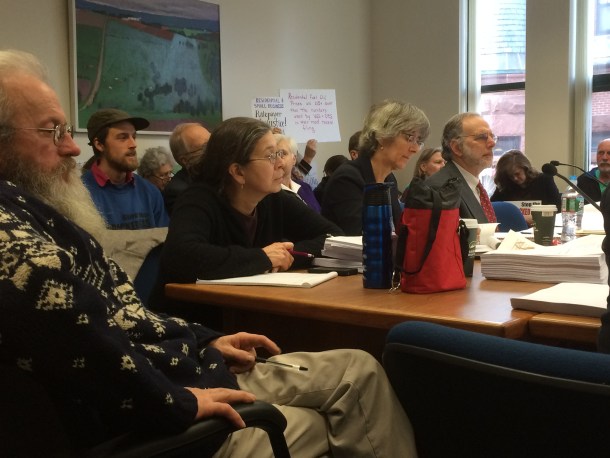
[L]itigants in a four-year battle over a natural gas pipeline in Addison County concluded contentious technical hearings this week at the Public Service Board.
The question before the board is whether Vermont Gas Systems’ proposed construction of a $154 million natural gas pipeline from Colchester to Middlebury is in the public interest. Under an agreement between the Vermont Department of Public Service and Vermont Gas, ratepayers would be required to pay for $134 million of the cost. Gov. Peter Shumlin has endorsed the deal.
The board is expected to arrive at a decision about whether the construction project can go forward by mid-January. If Vermont Gas can’t start construction at that point, company officials say they could face millions of dollars in additional costs.
The hearing turned on testimony from lawyers representing the state of Vermont, the pipeline’s developers, the Conservation Law Foundation, the American Association of Retired People and the Vermont Fuel Dealers Association.
AARP attorney Jim Dumont argued residential ratepayers were being unfairly forced to support large businesses through the pipeline’s pricing scheme.
Middlebury College and Cabot Creamery parent Agri-Mark benefit directly from the pipe’s installation, he said. Vermont as a whole benefits from the jobs and other economic goods that come as a result, he said.
But is it right, he asked Eileen Simollardes, vice president of Supply and Regulatory Affairs for Vermont Gas, that the cost of that public benefit fall on Vermont Gas ratepayers?
Eileen Simollardes, vice president of Supply and Regulatory Affairs for Vermont Gas, said what’s relevant to the hearing is whether the pipe is in the public good — regardless of who pays for it. And that question, she said, is for the Public Service Board to answer, not her.
Dumont aimed pointed questions at Department of Public Service Commissioner Chris Recchia and challenged the commissioner’s statements that the pipeline had been built according to proper quality-control standards.
“That wasn’t true, was it?” he asked.
Dumont cited critical safety measures that had been found lacking in July, and pointed out that the company had to remove an 800-foot section from the ground and replace it after contractors damaged it during installation.
Recchia said he believed the pipe had been built according to quality-control standards.
In his final minutes of questioning witnesses before the board, Dumont left Public Service Board members considering the possibility that the pipeline might be complete as it is today — 11 miles long.
Those 11 miles differ from the remainder of the planned 43-mile project in that ratepayers directly benefit from that section of pipe, Dumont said. Recchia said ratepayers benefited from all of the sections.
Dumont asked whether Recchia knew what would happen to the cost of gas if the project was not completed. The Department of Public Service hasn’t analyzed the effect on rates if the project were halted now, Recchia said. Nor has the department discussed with Vermont Gas Systems the pros and cons of such a move, he said.
“We have certainly raised the prospect of stopping the project in various conversations” within the department, Recchia said.
But even with ratepayers on the hook for $134 million of the pipe’s cost — a cost that has repeatedly increased since the state originally approved the structure — Vermont still enjoys a net public good from its construction, he said.
Even if ratepayers paid the entirety of the projected $154 million price, Vermonters would still come out on top, Recchia said in response to pro se litigant Jane Palmer’s questioning.
He had considered that the pipeline’s investors should bear some of the cost, given that they’ll benefit from its construction as well, Recchia said, responding to questions from Vermont Fuel Dealers Association attorney Richard Saudek.
He hadn’t arrived at any numbers for how the costs should be split between investors and ratepayers, however, Recchia said.
Reply briefs in the case will be filed by both sides before Christmas.

