

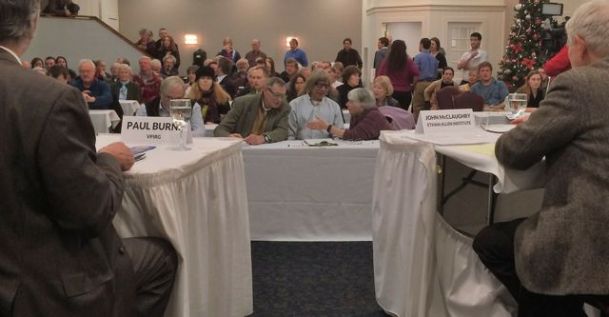
Debate participants hurled epithets — “propagandist,” “denier” — against each other, and at one point even the moderator brought fire on himself.
The debate at Montpelier’s Capitol Plaza drew a standing-room-only crowd of about 150, who by the end had hissed, cheered, shouted and applauded the debaters’ assertions.
The debate pitted Vermont Public Interest Research Group executive director Paul Burns and University of Vermont’s Jon Erickson, fellow of the university’s Gund Institute for Ecological Economics, against Ethan Allen Institute President Rob Roper and Vice President John McClaughry.
The opponents aired differences over proposals for a statewide tax on carbon pollution.
Roper and McClaughry said the tax would harm Vermont businesses and working families, and — if climate change is real — would have no effect on the severity of global warming. Vermonters already do their part for the environment, Roper said. And whatever reduction in carbon emissions Vermonters may effect with such a tax, new Chinese coal-powered plants will more than offset, McClaughry said.
Erickson and Burns said the carbon tax would reduce Vermont’s sales tax by $1 billion over the next 10 years, cut the sales tax by $600 million, save state employers $850 million, and provide $270 million worth of energy-saving improvements to low-income Vermonters, and in so doing would save Vermonters around $150 million each year in energy costs.
The carbon tax would be offset by job creation and tax cuts on retail goods, Erickson and Burns said.
The debate kicked off with one side claiming the mantle of scientific rigor.
“Despite overwhelming consensus from scientists on the urgency to act on climate change, and overwhelming consensus from economists — my profession — on how to act through tax reform, I anticipate you’re going to see some major differences of opinion tonight on this urgency and on these solutions,” Erickson said in his opening statements.
Roper countered that even if what scientists say is true, neither Vermont nor any country participating in the Paris Climate Summit could stem global climate temperature increases.
Burns cited the state’s passagge of the gay marriage law as an example of the impact the second-least populous state in the union can have on the nation as a whole.
“If you think Vermont is too small to make a difference, ask the millions of Americans who can now get married legally in this country,” Burns said. “Fifteen years ago, Vermont legislators had the courage to lead on that issue by passing civil unions, and my guess is, today there isn’t a single one of them who regrets their vote for being on the right side of history there.”
Roper said Vermonters can’t hope to have that kind of impact with regard to climate change, because if what scientists say is true the problem is too big to solve.
“If one accepts the predictions of climate change activists,” Roper said, the global temperature will rise by 1.5 degrees to 4.5 degrees Celsius. “Vermont enacting a carbon tax will have zero impact on that temperature trajectory.”
Should every nation in attendance at the Paris Climate Summit put proposed reforms in place, they might reduce that forecasted temperature increase by 0.17 degrees Celsius, he said.
“Our actions in Vermont, even coupled with our indirect influence sparking similar actions on a global scale, will not save winter in Vermont, or alter any future violent weather patterns,” Roper said.
For such a meager return on investment, Roper said, Vermonters should refuse to support a tax that in 10 years be as high as 89 cents a gallon.
McClaughry questioned the scientific authority of his opponents.
“I heard the other side say that one side of this debate will embrace science, and it clearly wasn’t intended to refer to our side,” McClaughry said. “The moderator neglects to mention I have a Bachelor’s degree in physics, with honors, and a Master’s degree in nuclear engineering, and I spent 40 years since then reading scientific magazines, scientific works, and I consider myself a staunch partisan of climate science, which is not to be confused with the kind of propaganda that seems to register with our opponents.”
Were the legislature to adopt a carbon tax, McClaughry said, lawmakers would inevitably divert revenue to reward constituencies.
“This bill means more money for government to spend, and less money for you to spend, unless you’re one of the lucky ones qualifying for state subsidies,” he said.
The bills would dedicate 10 percent to 20 percent of revenue to subsidize energy-saving measures such as heat pumps for low-income Vermonters, home weatherization and infrastructure improvements.
Eighty to ninety percent of the revenue generated by the carbon tax would be used to cut other taxes.
The largest tax cuts would go to low-income people who would be hit the hardest by the carbon tax.
Burns said 97 percent of climate scientists support a carbon tax, and he challenged McClaughry and Roper to propose another means of cutting carbon emissions by 75 percent from 1990 levels by the year 2050.
“Even as skilled a propagandist as you ought to be ashamed to bring up that 97 percent of climate scientists thing,” McClaughry rejoined.
Burns interrupted McClaughry and said he was disputing figures from the National Aeronautics and Space Administration.
McClaughry wheeled on his opponent and fixed him with a furious glare.
“Paul you stop! You got something else you want to say now?”
McClaughry said he’d already rebutted the 97 percent figure years ago, and said he didn’t need to repeat his argument at that moment.
“I’m a staunch partisan of real climate science, which is not to be confused with the torrent of propaganda that keeps issuing from VPIRG’s offices to pass more bills to create big government and raise taxes on the people of Vermont,” McClaughry said.
Vermonters are already doing enough anyway, Roper said.
“I think it’s fair to say Vermonters are doing their part, and what you’re asking is more than our part,” Roper said. “We’re already doing it — you’re forcing us to make this the sole focus of our existence as a state and as individuals.”
As the debate wore on, Roper returned to this theme.
“According to what you’re asking us to do, the most climate mitigation you’re going to get by the end of the century is a fraction of a degree,” Roper said. “Even if everybody does their part, they’re still not going to impact the things that you say are going to make a difference. The temperature is still going to affect the ski industry, it’s still going to affect the snow in Vermont. It’s not enough to stop the Tropical Irenes from happening.
“So if we can’t do this, even with everybody working together,” he said, “what’s the point?”
The fact that a problem exists and must be confronted has been established, Burns said.
“There’s a saying out there: ‘Science doesn’t care whether you believe in it or not,'” Burns said. “And that’s what we’re facing here, with the damage we are doing to the climate every day, by burning fossil fuels, and having the oil companies profit by polluting our atmosphere for free.
“It’d be like your neighbor saying, well for free I’m going to dump my trash in your yard — it’s a better deal for me,” he said. “That’s the deal the fossil fuel companies have had forever in this country, and it’s time to put an end to it.
“There’s no magic, no perfect answer here, but together we have to do something, and throwing up your hands and saying there’s nothing you can do to make a difference is not a solution,” he said.”
The solution under debate, should it have any effect on the climate at all, Roper said, would destroy Vermont’s environment.
“You’re saying we’re not advocating doing anything,” he said. “That’s not exactly true. You’re talking about maintaining the climate, and what can we do to preserve the climate as it is. But in doing so, you are wrecking the local ecology with the thing that you’re going to be investing in.
“We’re going to see 200 miles of ridgeline with 500-foot wind towers, we’ll see between 30,000 acres and 90,000 acres with solar panels,” Roper said. “That is going to affect how the state looks, it’s going to affect how animals can travel through the state, and if there’s no benefit to how we impact the climate, why don’t we put our energy and our efforts into saving the ecology of the state so we can pass that on to our children and grandchildren?”
Toward the end of the evening, moderator Peter Hirschfeld, of Vermont Public Radio, clarified a statement he made about reluctant Democratic support for the carbon tax. “I will note that there are some prominent Democrats in this state, that would agree with you wholeheartedly that climate change is the threat of our time, who do oppose this legislation,” Hirschfeld said.
Burns, at that point, turned on Hirschfeld. “I actually think that’s an unfair assertion,” he said. “You should let those people speak for themselves, and not try to [characterize] their positions.
“To suggest they oppose the idea of a price on carbon because they have said something about a particular piece of legislation is unfair,” he said. “I think those very people, who I’ve had conversations with, might like the opportunity to explain their position on this issue, and not have you characterize it as simply being in opposition to a price on carbon. I don’t think that’s accurate at all.”
Before the evening’s end, McClaughry advocated for nuclear energy, arguing that no discussion on cheap energy is complete if it omits nuclear power.
“A civilized society needs electricity,” he said.
In his final remarks, Burns said he and Erickson “believe with the world’s climate experts and roughly 200 world leaders that climate change is real and that we all have a responsibility to do something about it.”
McClaughry closed the evening with the assertion that imposing “a $500 million-a-year tax on beneficial plant food will cripple Vermont’s economy, place a special burden on people in rural areas, and on truckers [and] equipment operators, who aren’t going to drive battery-powered cars, trucks and tractors, especially when the desperate legislature diverts the promised tax reductions to pay for ballooning costs of ever-bigger government, and especially when the effects on global temperatures will be utterly undetectable.”
“Yes, sometimes Vermont should set an example, like we did when we abolished slavery,” McClaughry said. “But setting the example of crippling the shaky economy of our little state, solely to advance this grand global crusade against climate change simply to get some kind of bragging rights is beyond foolish. Can we scrap this misbegotten carbon tax, and focus on making Vermont prosperous again? Yes we can.”
